MFDS Discusses Future Plans at the Ministerial Meeting on National Issues
Achieving Tangible Results in Alleviating Public Hardships and Global Regulatory Harmonization
The Ministry of Food and Drug Safety (MFDS) announced that a total of 260 food and drug regulatory innovation tasks over the past three years have been progressing smoothly, with a 76% implementation rate as of the end of October.
On the 31st, Oh Yu-kyung, the head of MFDS, reviewed the progress of food and drug regulatory innovation tasks and discussed major achievements and future plans at the 48th Ministerial Meeting on National Issues chaired by Prime Minister Han Duck-soo.
MFDS has prioritized the safety, life, and health of the public, resolving procedural regulations that hinder public stability and industrial growth, and identified regulatory innovation tasks in three phases from 2022 to 2024 to improve regulations that have a high impact on the field. As a result of promoting regulatory improvements through various methods such as legislation, proactive administration, pilot projects, and field communication to ensure that the public and industry can feel the effects of regulatory innovation, 198 tasks, including 170 completed and implemented and 2 bills submitted to the National Assembly, representing 76%, have been implemented or have entered the institutionalization phase.
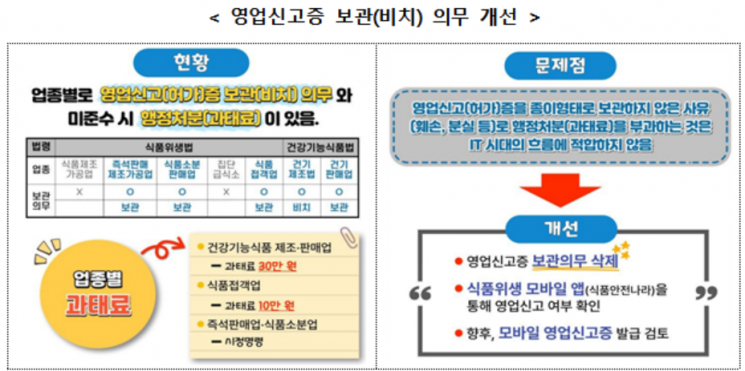
One example of alleviating public inconvenience and burden is the improvement of the "business registration certificate retention (storage) obligation." Previously, businesses were required to keep a paper-printed business registration certificate inside restaurants, which exposed personal information such as birthdates and led to excessive fines and administrative penalties, causing a burden on business operators. In response, the government completely abolished the paper business registration certificate retention obligation for the first time in 48 years and improved the system so that business registration status can be checked via a mobile application. This has been actively promoted since May.
An example of regulatory innovation supporting future industries in new technologies and environments is the enactment of the "Digital Medical Devices Act" in January this year. Recognizing the limitations of the existing hardware-centered regulatory system in supporting the rapidly developing digital medical device industry, a software-centered, tailored regulatory system for digital medical devices was established, securing regulatory support budgets, strengthening the global competitiveness of the K-medical device industry, and expanding treatment opportunities for patients.
Since September last year, electronic inspection (SAFE-i 24) has been introduced at 22 inspection offices nationwide, including Pyeongtaek, for over 800,000 annual imported food inspections. Foods with low risk of hazards and repetitive imports are now inspected 24 hours a day, 365 days a year, within 5 minutes. This improvement has reduced customs costs and time for businesses and enabled the public to consume fresher food more quickly.
South Korea’s food and drug safety regulations have also shown excellent results in leading global standards and expanding access to world markets. In October last year, South Korea became the first country to be listed on the World Health Organization (WHO) Good Regulatory Practices list in the pharmaceutical and vaccine sectors. Based on this, the approval and review processes for domestic pharmaceuticals in the Philippines and Paraguay were shortened, raising expectations for export activation. This year, the MFDS held the Artificial Intelligence (AI) Medical Products Regulatory Symposium (AIRIS) with the U.S. Food and Drug Administration (FDA), leading global standards in advanced fields. Additionally, an agreement for confidential information exchange on pharmaceuticals was signed between Korea and the European Union (EU) in April, and joint pharmaceutical reviews began. Through regulatory diplomacy based on scientific data, a July achievement was made in withdrawing Denmark’s recall of Korean spicy ramen products.
MFDS plans to continue focusing on regulatory innovation to establish a foundation for the rapid development of pharmaceuticals. Director Oh Yu-kyung emphasized, "We will accelerate the tasks so that the public can feel the results of regulatory innovation," and added, "We will internalize innovation by linking it with work plans to ensure that food and drug regulatory innovation does not remain a temporary effort."
© The Asia Business Daily(www.asiae.co.kr). All rights reserved.
![Clutching a Stolen Dior Bag, Saying "I Hate Being Poor but Real"... The Grotesque Con of a "Human Knockoff" [Slate]](https://cwcontent.asiae.co.kr/asiaresize/183/2026021902243444107_1771435474.jpg)
















