Provocation After 10 Months Since Last December
High-Angle Launch Fails to Prove Atmospheric Reentry
On the 31st, North Korea launched a ballistic missile, presumed to be an intercontinental ballistic missile (ICBM), into the East Sea. This marks the first ICBM provocation by North Korea this year, coming 10 months after the launch of the Hwasong-18 ICBM on December 18 last year.
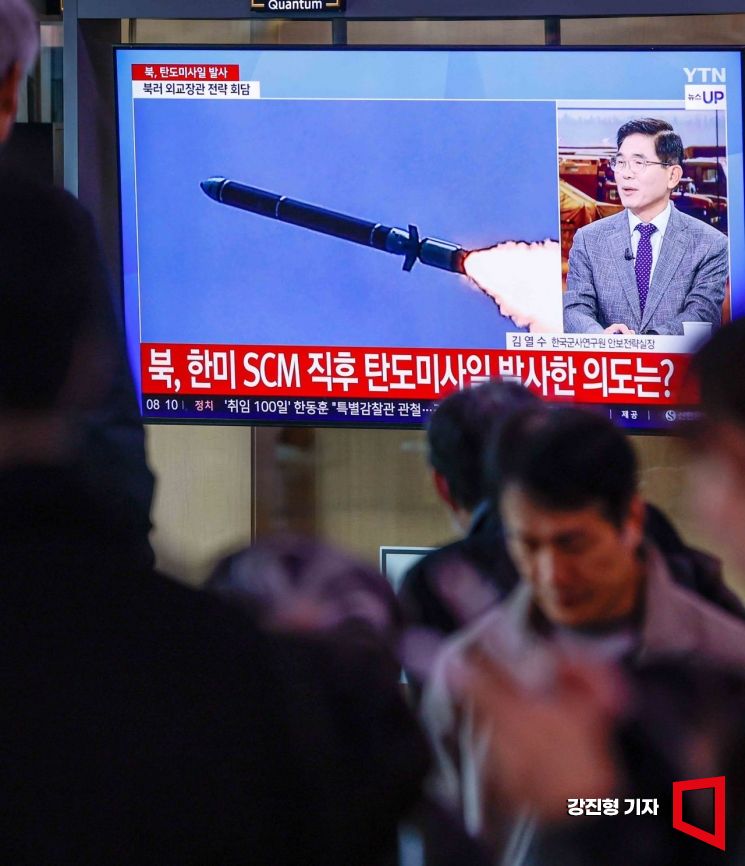 On the 31st, when North Korea launched a ballistic missile presumed to be an intercontinental ballistic missile (ICBM) into the East Sea, citizens at the Seoul Station waiting room were watching news related to the North Korean missile launch. Photo by Kang Jin-hyung
The Joint Chiefs of Staff stated, "The military detected a ballistic missile launched from the Pyongyang area toward the East Sea around 7:10 a.m. today," adding, "It was launched at a high angle and flew approximately 1,000 km before landing." The Japanese government explained, "This object fell into waters about 300 km west of Hokkaido, and the ballistic missile landed around 8:37 a.m., making it the longest flight so far, suggesting it could be a new type of missile." North Korea’s ICBM launch appears to express dissatisfaction with the South Korea-U.S. alliance condemning North Korea’s deployment of troops to Russia, while also aiming to divert international attention away from Russia.
However, North Korea again launched the ICBM at a high angle instead of a normal angle (30?45 degrees). A high-angle launch cannot verify the performance of the reentry vehicle carrying a nuclear warhead. This indicates that the final development has not been completed. Although North Korea launched its latest ICBM, the Hwasong-18, at a normal angle in April and July last year, the second and third stage launch vehicles flew on a high-angle trajectory to adjust the range to about 1,000 km. At that time, doubts were raised that North Korea had not yet acquired the atmospheric reentry technology, a core ICBM technology.
Failing to succeed in ICBM development, North Korea may proceed with a nuclear test to exert greater pressure on the international community. The Defense Intelligence Agency analyzed during a closed National Assembly Intelligence Committee hearing on the 30th, "There is a possibility of a nuclear test using Tunnel No. 3," adding, "Kim Jong-un is expected to make a decision considering the strategic environment, including the U.S. presidential election."
If North Korea proceeds with a nuclear test, it could be conducted at Tunnel No. 3. The third and fourth tunnels at the Punggye-ri nuclear test site have never been used. Tunnel No. 1 was closed after the first nuclear test in 2006, and nuclear tests from the second to sixth were conducted in Tunnel No. 2 between 2009 and 2017. However, North Korea announced in May 2018 that Tunnels No. 3 and 4 were closed by "explosion" methods.
© The Asia Business Daily(www.asiae.co.kr). All rights reserved.
![Clutching a Stolen Dior Bag, Saying "I Hate Being Poor but Real"... The Grotesque Con of a "Human Knockoff" [Slate]](https://cwcontent.asiae.co.kr/asiaresize/183/2026021902243444107_1771435474.jpg)
















