독일 Zindelphingen Vehicle Safety Technology Center Crash Test
150 Collision Analyses per Vehicle from Multiple Angles and Scenarios
Data Collected by Cameras and Sensors Surrounding the Crash Moment
"Conducting In-House Tests at Standards Higher Than Those of Various Countries"
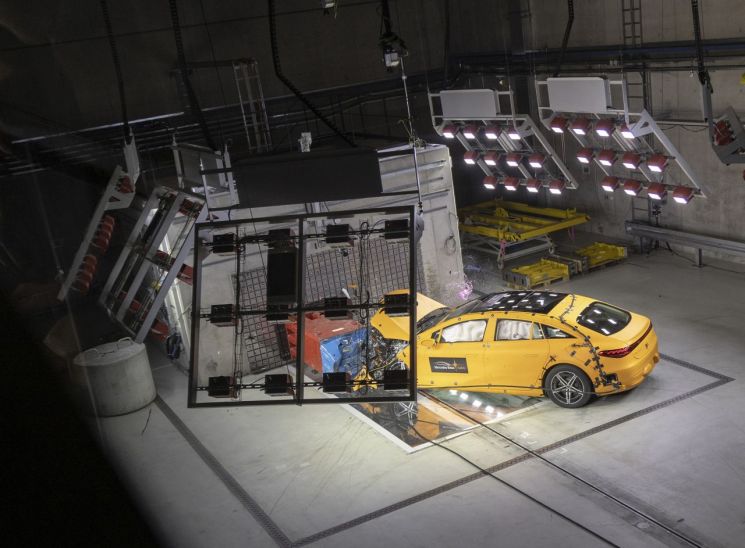 On the 22nd (local time), a collision test of the Mercedes-Benz EQS vehicle is being conducted at the Vehicle Safety Technology Center in Sindelfingen, Baden-W?rttemberg, Germany. (Photo by Mercedes-Benz)
"This is a very special moment even for our engineers. For those who are sensitive, please cover your ears as there will be a loud noise."
As soon as Yulia Hinners, Mercedes-Benz collision safety engineer, finished speaking, an EQS worth over 160 million KRW sped at 60 km/h and crashed into a structure. The front of the vehicle crumpled instantly, and various parts scattered. At the moment of impact, 72 surrounding lights simultaneously turned on, emitting an intense brightness of over 100,000 lux. This was to capture thousands of precise photos per second from the front, rear, sides, and underside of the vehicle. Once the situation settled, the firefighting team completed the initial inspection and gave the "OK sign." Then, analysts equipped with various computer devices approached the vehicle to carefully examine its condition and collect data.
On the 22nd (local time), Mercedes-Benz invited a Korean press group to the Vehicle Safety Technology Center (TFS) in Sindelfingen, Baden-W?rttemberg, Germany, to demonstrate a collision test using the new EQS.
The test EQS was identical to the production model except for the orange test paint and attached measurement equipment. Male and female test dummies were seated in the driver’s seat and rear seat respectively, and the vehicle started 70 meters away from the structure, crashing at a speed of 60 km/h. The vehicle, weighing over 2800 kg, collided with about 40% of its width. The front of the vehicle was completely crushed, and washer fluid spilled onto the floor. Thanks to the front absorbing most of the impact, the front chassis (A-pillar) was not twisted at all. Airbags deployed from the windows and steering wheel, enveloping the test dummies. The instrument panel and center fascia display were undamaged except that the screens were turned off.
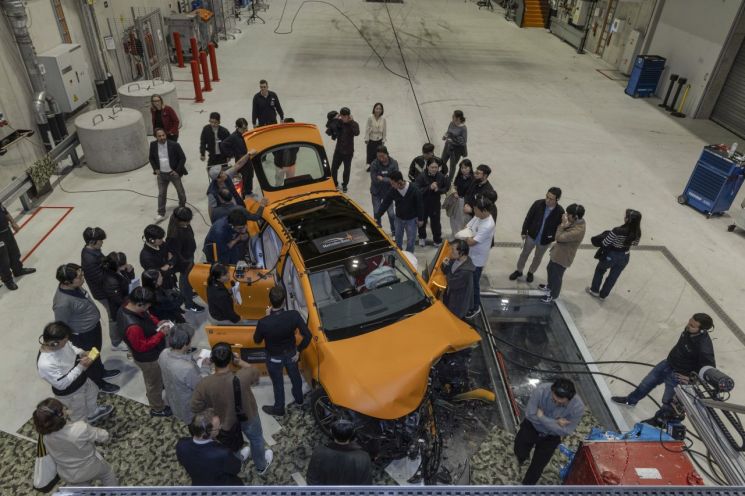 On the 22nd (local time), Mercedes-Benz engineers explained the collision test results of the EQS vehicle to the Korean press at the Mercedes-Benz Vehicle Safety Technology Center in Sindelfingen, Germany. (Photo by Mercedes-Benz)
Marcel Brodbeck, electric vehicle collision test engineer, explained, "The front part was completely destroyed to absorb the impact and prevent damage to the passengers inside. At the moment the airbags deploy, the steering wheel moves forward to minimize the shock felt by the passengers, and additional airbags are arranged to deploy in preparation for a secondary collision." He added, "Immediately after the accident, to prevent further damage from high voltage, the vehicle detects the impending collision about 0.01 seconds in advance and cuts off the high voltage."
The Vehicle Safety Technology Center, which Mercedes-Benz proudly operates, covers a total area of 55,000 square meters and is the largest collision test site in Europe. It was built using 7,000 tons of steel, comparable to that used in the Eiffel Tower in Paris, France. The longest track exceeds 200 meters, and a perfectly flat environment with an error margin of only 5 mm was created for precise testing. Numerous sensors and cameras are installed at the collision point to digitally measure the vehicle’s exterior, including the underside, and immediately transmit the data.
Before mass production, Mercedes-Benz vehicles undergo about 15,000 accident simulations and must pass 150 actual collision tests at this facility. Using over 50 scenarios, almost every type of accident is recreated from various angles and situations. Up to 900 collision tests and 1,700 sled (sliding collision) tests are conducted annually.
Mercedes-Benz emphasizes that it conducts evaluations with standards stricter than those required by various countries, such as the U.S. Insurance Institute for Highway Safety (IIHS) and the New Car Assessment Programs (NCAP) of Korea and Japan. Engineer Juliana stated, "We conduct collision tests for all types of vehicles, regardless of electric or internal combustion engines, tailored to their size and weight, simulating real-world environments. For electric vehicles, we tested battery safety according to various separate standards such as side impact and body protection, and so far, there has never been a serious case of fire or battery damage caused by collisions."
© The Asia Business Daily(www.asiae.co.kr). All rights reserved.
![Clutching a Stolen Dior Bag, Saying "I Hate Being Poor but Real"... The Grotesque Con of a "Human Knockoff" [Slate]](https://cwcontent.asiae.co.kr/asiaresize/183/2026021902243444107_1771435474.jpg)

















