Currently, commonly used perovskite solar cells have the issue of not utilizing about 52% of solar energy. A next-generation solar cell technology to overcome this drawback has been developed in Korea.
On the 31st, KAIST announced that Professor Jeong-Yong Lee's research team from the Department of Electrical Engineering and Computer Science, in collaboration with Professor Woo-Jae Kim's research team from the Department of Chemistry at Yonsei University, developed a high-efficiency and high-stability organic-inorganic hybrid solar cell fabrication technology.
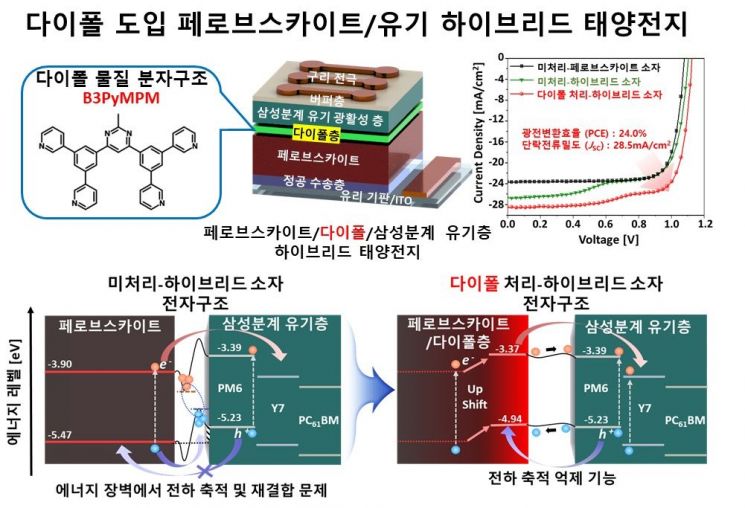 Improvement of electronic structure and charge transfer capability through perovskite-organic hybrid device structures and dipole interfacial layers (DILs). Provided by KAIST
The developed technology maximizes the collection of near-infrared light beyond the existing visible light range. It is also expected to lead to technological advances in the global solar cell market by improving power conversion efficiency.
First, the joint research team enhanced the hybrid next-generation device structure of organic semiconductors that complement the existing perovskite materials limited to visible light absorption and expanded the absorption range to near-infrared light.
Next, by introducing a dipole layer, they succeeded in developing a high-performance solar cell device that resolves electronic structure issues occurring in the advanced device structure. The dipole layer is a thin material layer that adjusts energy levels within the device to facilitate charge transport and forms a potential difference at the interface to improve device performance.
Existing lead-based perovskite solar cells have an absorption spectrum limited to the visible light range with wavelengths below 850 nanometers (nm), resulting in the inability to utilize about half of the total solar energy.
However, the solar cell developed by the joint research team is designed as a hybrid device combining organic bulk heterojunction (BHJ) with perovskite, allowing absorption up to the near-infrared region.
In particular, the introduction of a dipole interface layer below the nanometer scale alleviates the energy barrier between perovskite and organic bulk heterojunction (BHJ), suppresses charge accumulation, and maximizes near-infrared contribution. Through this, the current density (JSC) increased by 4.9 mA/cm², explained the joint research team.
The core achievement of this study is the significant increase in the power conversion efficiency (PCE) of the hybrid device from the existing 20.4% to 24.0%, achieving a high internal quantum efficiency (IQE) compared to previous studies and increasing the near-infrared region to 78%.
Above all, this device maintained more than 80% of its initial efficiency during maximum power tracking for over 800 hours even under extreme humidity conditions due to its high stability.
.
Professor Lee said, “The joint research team effectively solved the charge accumulation and energy band mismatch problems faced by existing perovskite and organic hybrid solar cells, greatly improved power conversion efficiency while maximizing near-infrared light collection performance. The main research achievement is that it provided a breakthrough to overcome the optical limits by solving the mechanical and chemical stability issues of existing perovskite.”
Meanwhile, this research was conducted with the support of the National Research Foundation of Korea.
© The Asia Business Daily(www.asiae.co.kr). All rights reserved.

















