Mayor Kim Dong-geun of Uijeongbu Announces 'Comprehensive Plan for Chudong Forest Garden Development'
Transforming 220,000 Pyeong Forest Space in City Center into a 'Forest Garden'
Upgrading Singok 1·2-dong and Songsan 1-dong, Home to Chudong Park, into Forest Zones
Connecting 3 Symbolic Spaces, 12 Gardens, and 5 Themed Forest Trails
Mayor Kim Dong-geun: "We Will Become a Walkable City and a Garden City Where People Want to Stay"
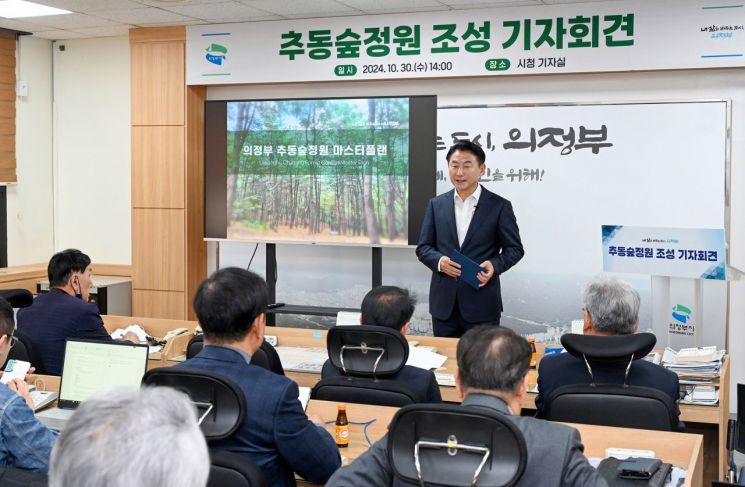 Kim Dong-geun, Mayor of Uijeongbu, held a regular press conference at the city hall press room on the 30th to explain the "Comprehensive Plan for the Creation of Chudong Forest Garden."
 ‘Chudong Park,’ located in the heart of Uijeongbu City, Gyeonggi Province, is being reborn as the best ‘forest garden’ in northern Gyeonggi.
On the 30th, Kim Dong-geun, Mayor of Uijeongbu City, held a regular press conference at the city hall press room and announced the ‘Comprehensive Plan for Creating Chudong Forest Garden,’ which aims to develop Chudong Park into the best forest garden in northern Gyeonggi.
The city plans to invest a total of 11.3 billion KRW to create a forest garden by 2030, connecting three symbolic spaces, 12 gardens, and five themed forests with a forest trail. Through this, a forest zone will be established in Singok 1 and 2-dong and Songsan 1-dong, significantly enhancing the city’s brand value.
Chudong Park, covering approximately 220,000 pyeong (about 726,000 square meters), is the largest park in Uijeongbu, located in a densely populated residential area with large apartment complexes. It is used by about 59,000 people annually on average, and about 25% (approximately 115,000 people) of the total population within a 1 km radius live nearby, indicating very high potential demand.
In particular, it boasts an ecologically and environmentally excellent natural environment, rated Grade 1 and 2 in the National Land Environmental Assessment, Grade 2 in the Ecological Naturalness Index, and Grade 1 and 2 in the Biotope Evaluation, which measures the value of habitats shared by various species, making it highly valuable as an ecological green axis within the city.
However, due to a lack of symbolism and identity, many citizens are not well aware of the park, and there is a weakness in the overall park’s characteristics and connectivity between spaces. As a result, some sports facilities within the park are used only for simple activities like walking, and the number of users has decreased by about 3,000 annually over the past three years.
Recognizing the need for change in Chudong Park through annual citizen surveys and social research on park usage, the city decided to move away from the conventional government-centered uniform park projects and provide a high-quality park green space that citizens desire. Since August, the city has formed a working group including private experts and prepared a comprehensive plan to transform Chudong Park into ‘Chudong Forest Garden.’
The city will actively reflect the trend that forests and gardens enhance urban brand value by creating Chudong Forest Garden. With a total project cost of 11.3 billion KRW, the city plans to create a forest garden offering diverse sensations, experiences, and encounters from the second half of this year through 2030.
According to a detailed plan consisting of seven stages, the city intends to transform ▲ simple walking paths into ‘rest spaces where people want to walk and stay’ to become an ecological brand loved by citizens ▲ government-centered parks into ‘open spaces created together with citizens’ ▲ ordinary parks without distinction into ‘ecological landmarks that enhance urban value.’
Since the project will be implemented in stages, citizens can expect to see the evolving appearance of Chudong Park as a forest garden every year.
Next year, the city will create symbolic spaces (two entrance gardens and one Chudong Sky Yard), themed forests (fir forest, Korean dogwood forest, maple forest), and seven gardens (including Wind Garden), planting a variety of perennial plants, hydrangeas, azaleas, and other flowers suited to the themes, connecting the entire park with a comfortable forest trail.
After 2026, the city plans to secure an additional budget of 6 billion KRW through active fundraising and create additional metasequoia and birch forests through afforestation projects. Furthermore, the city will proceed with phased projects to create the remaining five gardens (Lawn Yard, Healing Garden, Picnic Garden, Sharing Garden, Forest Library).
Ultimately, the city envisions transforming the existing Chudong Park into ‘Chudong Forest Garden’ with three symbolic spaces, 12 gardens, and five themed forests.
The city also plans to devote great effort to creating ‘symbolic spaces’ to better inform more citizens about the high ecological value of the existing Chudong Park.
For example, a wide-open ‘Chudong Sky Yard’ will be created at the summit of Hyojabong in Chudong Park, offering citizens a special experience of viewing the cityscape 360 degrees and enjoying sunrises and sunsets in the urban area.
Additionally, to improve the currently insufficient accessibility of Chudong Park, ‘Entrance Gardens’ inviting visitors to the forest garden will be created at the Science Library and Chudong Well-being Park, where the park entrances are located.
First, the entrance garden at the Science Library will be designed not just as a simple library entrance but as a space signaling the start of the forest garden, with symbolic installations and improved accessibility by adding various pathways in addition to the existing entrance routes.
Chudong Well-being Park, known for its water playground and indoor badminton court, has seen visitors concentrated only on specific facilities rather than the park itself, resulting in a lack of recognition as a park entrance.
Therefore, symbolic installations will also be placed in the entrance garden to help citizens recognize Well-being Park as an important gateway to Chudong Forest Garden. Additionally, unnecessary pathways will be reorganized, and a ‘Wind Hill’ planted with annual flowers will be created to greatly improve the landscape.
The city plans to connect the main symbolic spaces and each themed forest with a 3 km forest trail, starting with the trail linking the Science Library to Chudong Sky Yard.
Existing walking paths will also be maintained to connect the symbolic spaces, themed forests, and gardens, allowing citizens to easily use the forest garden from anywhere.
Above all, the city will focus on creating a forest garden directly touched by citizens’ hands.
Volunteer groups such as the Chudong Forest Garden Volunteer Corps and Chudong Gardeners will be formed, and events like Chudong Volunteer Day, tree planting ceremonies, and Gardening Day will be held.
In particular, Chudong Gardeners, composed of landscaping and horticulture experts, will participate directly in the design, nurturing the garden as a public-private collaborative project.
Mayor Kim Dong-geun said, “In a situation where there was a lack of park green spaces that citizens want and are satisfied with, a high-quality forest and garden are essential to enhance the rapidly changing urban value of society. We will brand Chudong Forest Garden together with citizens and gift an ecological landmark representing the city.” He added, “The creation of Chudong Forest Garden is part of the project to make Uijeongbu a city where people want to walk and stay, and we will create the best forest garden in northern Gyeonggi together with our citizens.”
© The Asia Business Daily(www.asiae.co.kr). All rights reserved.