13.9% Reduction in Greenhouse Gas Emissions Compared to 2018
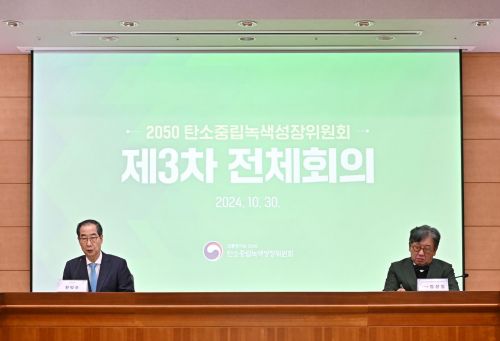 The 3rd plenary meeting of the Presidential Committee on Carbon Neutrality and Green Growth 2050 is being held on the 30th at the Government Seoul Office, chaired by Prime Minister Han Duck-soo. (2024.10.30) Photo by Tan Nokwi.
Last year, South Korea's total greenhouse gas emissions amounted to 624.2 million tons, exceeding the target reduction by 6.5%. As a result, South Korea has seen a decrease in greenhouse gas emissions for two consecutive years despite economic growth. The expansion of carbon-free power generation, including nuclear power, played a major role in this achievement.
The Presidential 2050 Carbon Neutral Green Growth Committee (co-chairs: Prime Minister Han Duck-soo and KAIST Vice President Kim Sang-hyup) held its 3rd plenary meeting of 2024 on the 30th at the Government Seoul Office, chaired by Prime Minister Han Duck-soo, to discuss the "2023 Greenhouse Gas Reduction Target Implementation Review Results."
According to the committee, South Korea's total greenhouse gas emissions in 2023 were 624.2 million tons. The committee explained, "Due to the expansion of carbon-free power generation such as nuclear power, industrial structural improvements, and the global economic situation, we achieved a 6.5% reduction exceeding the target."
Unlike South Korea, global greenhouse gas emissions increased by an average of 1.1% compared to the previous year in 2023. According to the International Energy Agency (IEA) and the UK Climate Change Committee (UKCCC), last year, greenhouse gas emissions decreased by 4.1% in the United States, 5.4% in the United Kingdom, and 9% in the European Union (EU), while China and India saw increases of 4.7% and 7%, respectively.
The committee stated, "While global energy-related greenhouse gas emissions reached a record high of 37.4 billion tons in 2023 and continue to rise annually, South Korea has seen a decrease in emissions every year since 2018 despite GDP growth. This indicates a strengthening trend of 'decoupling between economic growth and greenhouse gas emissions,' where actual emissions decrease despite factors that typically increase emissions due to economic growth."
To review the overall and sector-specific greenhouse gas emission reduction performance, the committee formed and operated an implementation monitoring group involving stakeholders. The review found a decreasing trend in all sectors, including energy transition, buildings, and industry. However, some sectors fell slightly short of targets due to factors such as a decline in electric vehicle adoption, minimal effects from reduced livestock numbers, and increased waste incineration.
On the same day, the committee also discussed the "1st Biennial Transparency Report" and "Measures to Enhance Corporate Carbon Accounting, Reporting, and Verification (MRV) Capabilities."
Under the Paris Agreement, from 2024 onwards, all parties must prepare and submit biennial transparency reports to the United Nations every two years. South Korea, along with China and India, will submit its transparency report for the first time this year.
The transparency report states that South Korea reduced greenhouse gas emissions by 13.6% in 2023 compared to the base year of 2018. South Korea's Nationally Determined Contribution (NDC) submitted to the UN targets a 40% reduction compared to 2018.
With the introduction of carbon regulations such as the EU's Carbon Border Adjustment Mechanism (CBAM) and the US's Clean Competition Act (CCA), companies on the ground are facing difficulties in preparing for carbon emissions accounting, reporting, and verification (MRV). Small and medium-sized enterprises also lack adequate conditions for emissions accounting. Accordingly, the Ministry of Environment and related ministries plan to establish a foundation for utilizing carbon MRV and strengthen companies' capabilities in emissions accounting to alleviate their burdens.
Meanwhile, with this plenary meeting, the 1st term of the committee, launched in October 2022, concluded its activities.
Prime Minister Han Duck-soo, who presided over the meeting, emphasized, "Although the implementation review of greenhouse gas reduction targets showed a decrease in emissions for two consecutive years following 2022 due to the normalization of nuclear power and expansion of carbon-free energy and industrial structural improvements, there is still a long way to go. I urge related ministries to accelerate the development of core technologies in energy and eco-friendly sectors and strengthen policy support in key areas such as power and energy demand management, timely construction of transmission networks, expansion of zero-emission vehicles, and the spread of zero-energy buildings."
© The Asia Business Daily(www.asiae.co.kr). All rights reserved.
![Clutching a Stolen Dior Bag, Saying "I Hate Being Poor but Real"... The Grotesque Con of a "Human Knockoff" [Slate]](https://cwcontent.asiae.co.kr/asiaresize/183/2026021902243444107_1771435474.jpg)











