Additional 45.8 Billion KRW Secured for Automated Cargo Handling Equipment
Accelerating the Promotion of Gwangyang Port Automation Testbed
Yeosu Gwangyang Port Authority (President Park Seong-hyun, YGPA) announced on the 30th that it is accelerating the promotion of the "Port Automation Testbed (Gwangyang Port)" project by securing additional funds for automated cargo handling equipment, which had been stalled, through negotiations with the Ministry of Economy and Finance to increase the total project cost.
YGPA completed negotiations on the project cost reflecting the basic data survey results with the Ministry of Economy and Finance in November last year and began ordering automated cargo handling equipment in phases from December. This year, the transfer cranes (32 units) and unmanned transport equipment (44 units) have been initiated, but the container cranes (8 units), which are key equipment for automated ports, have faced delays due to repeated bidding failures caused by increased material and labor costs associated with localization, hindering project progress.
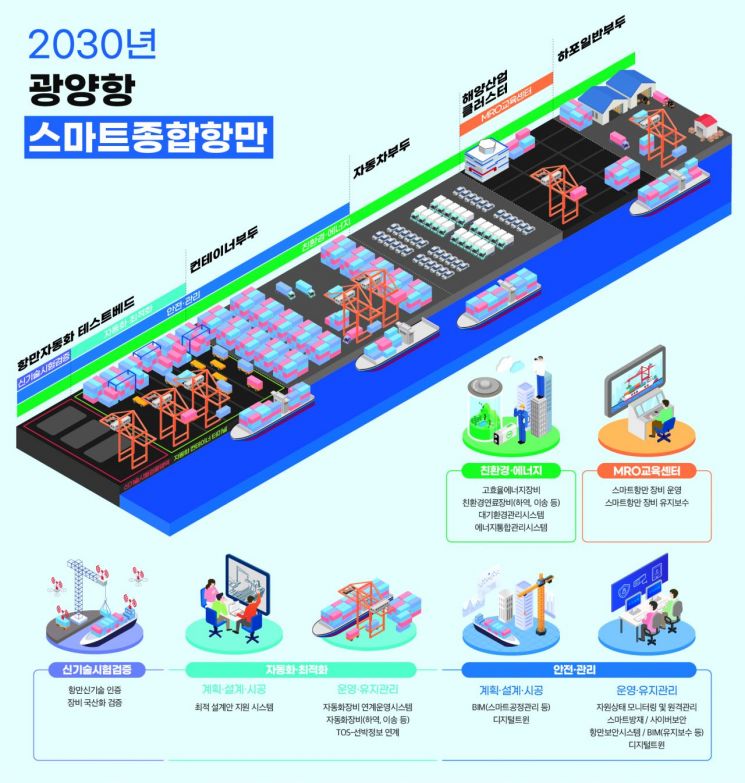 The future image of Korea-style smart port at Gwangyang Port in 2030. [Image provided by Yeosu Gwangyang Port Authority]
Accordingly, YGPA, in collaboration with the Ministry of Oceans and Fisheries, renegotiated the total project cost with the Ministry of Economy and Finance starting in July this year and secured an additional 45.8 billion KRW for the localization of container cranes despite the tight fiscal policy.
The project period was also adjusted to enhance completeness as a fully automated Korean-style port by simultaneously opening four berths in 2029 after sufficient stabilization periods, instead of the originally planned phased openings (first phase in 2027, second phase in 2029), considering the delivery schedule and operational conditions of the domestically produced handling equipment.
Park Seong-hyun, President of YGPA, stated, “We will focus our capabilities to use the hard-earned national funds more meaningfully by introducing automated cargo handling equipment centered on domestic technology to secure competitiveness in the port industry and to serve as a model for a sustainable future smart port.”
© The Asia Business Daily(www.asiae.co.kr). All rights reserved.
![Clutching a Stolen Dior Bag, Saying "I Hate Being Poor but Real"... The Grotesque Con of a "Human Knockoff" [Slate]](https://cwcontent.asiae.co.kr/asiaresize/183/2026021902243444107_1771435474.jpg)
















