Price Increase of Low- and High-Grade Coffee Beans Due to Heatwaves and Abnormal Climate
Poor Growth of Beans in Major Producing Regions Like Brazil and France
Raising Prices by 100 Won Challenging Amid Fierce Competition
Due to severe droughts and heatwaves caused by global warming, coffee bean prices worldwide have soared to unprecedented heights. From Robusta, mainly used in instant coffee, to Arabica, commonly used in cafes, prices have surged, hitting all-time highs or 52-week highs. With Starbucks, the industry leader, signaling the start of price hikes amid rising costs, concerns about a 'domino effect' of price increases among cafe franchises are growing. However, due to market saturation and fierce survival competition, most franchises say they will "hold on until the end of this year."
From Low-Cost Robusta to High-End Arabica... Coffee Bean Prices Surge Due to Abnormal Weather
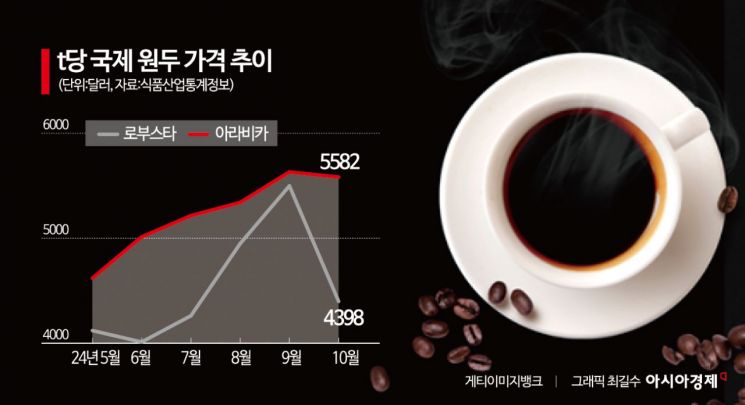
According to the Food Industry Statistical Information of the Korea Agro-Fisheries & Food Trade Corporation (aT) on the 30th, the price of Robusta coffee beans on the London International Financial Futures Exchange (LIFFE) closed at $4,398 per ton the previous day. This is a 79% increase compared to $2,453.95 per ton a year ago. It has surged 46% just this year. On the 26th of last month, it even hit an all-time high of $5,527 per ton, but since then, prices have fluctuated, maintaining a state of price instability.
While Robusta is a low-cost bean mainly used in instant coffee, Arabica beans are relatively high-end and primarily used in cafes. The rising trend in coffee bean prices applies to Arabica as well. According to the New York Board of Trade (NYBOT), the price per ton is $5,582.05, up 63% from $3,431.45 per ton a year ago. It has risen more than 30% this year alone. On the 26th of last month, it recorded a 52-week high of $6,038.4 per ton.
Price increases in Arabica have occurred occasionally before. However, the sharp rise in Robusta prices is unusual. Unlike Arabica, which is vulnerable to pests and diseases, Robusta grows like a weed regardless of the region.
The price surge in coffee beans is driven by abnormal weather caused by global warming. South Korea mainly imports Robusta from Vietnam and Arabica from Brazil. Brazil, the largest coffee-producing region, is experiencing the worst drought and high temperatures in 70 years, leading to poor coffee bean growth. Vietnam is also facing ongoing droughts and significant typhoon damage this summer, disrupting coffee bean production. Since these are not short-term factors, the upward trend in coffee bean prices is likely to continue next year.
With Starbucks Starting Price Hikes, Consumers Fear a 'Chain Reaction' in Coffee Prices
As coffee bean prices fluctuate wildly, concerns about rising coffee prices among Korean consumers, known as a 'coffee republic,' are growing. Despite efforts to cut spending in this high-inflation era, coffee has become an essential rather than a luxury. According to Euromonitor, last year, the annual per capita coffee consumption in South Korea was 405 cups, more than double the global average of 152 cups per capita annually.
Moreover, Starbucks, the leading cafe industry player, has already triggered price increases. In August, Starbucks raised the prices of all drinks in Grande (473ml) and Venti (591ml) sizes by 300 won and 600 won, respectively. As a result, the popular Cafe Americano's Grande size price rose from 5,000 won to 5,300 won, and the Venti size price increased from 5,500 won to 6,100 won.
At that time, the price hike excluded the Tall (355ml) size due to consumer backlash, but from November, even those prices will increase. Prices for 11 iced beverages, including Java Chip Frappuccino, will rise by 200 won for the Tall size. A Starbucks representative explained, "We have internally absorbed external price increase factors such as rising international coffee bean prices, high exchange rates, and labor costs, but as the burden has continued to accumulate, we have decided to raise prices on some products."
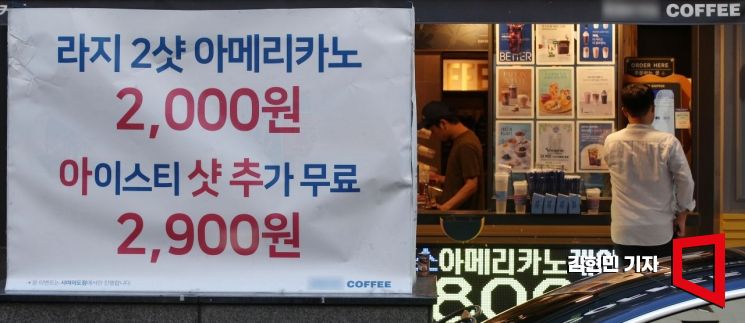
Cafe Franchises Struggle... Difficult to Raise Prices Even by 100 Won Amid Survival Competition
Cafe franchises are deeply concerned about Starbucks leading the market with price hikes. However, no other franchises have announced plans to raise prices yet. Except for Lotte Nestle and low-cost franchise The Venti, which raised coffee prices before Starbucks, the market remains quiet. Major high-end franchises like Twosome Place and Hollys, as well as mid-to-low-priced franchises like Ediya and Mega Coffee, all state they "currently have no plans to raise prices."
The reason they are holding back on price hikes is survival competition. According to aT, as of the end of 2022, there are nearly 99,000 coffee and beverage shops in South Korea. Given the high price elasticity of demand in the coffee market, even a 100 won increase in Americano prices is difficult to implement. Otherwise, they risk losing customers to neighboring stores.
A Twosome Place representative said, "We currently have no plans to raise prices" and "plan to focus on selling our main product, cakes, during the winter season." Ediya Coffee also stated, "It is true that coffee bean prices have risen significantly, but we have no plans to raise prices," explaining, "Since we import beans, roast them ourselves, and supply them to franchise stores, we can somewhat suppress price increases compared to other companies."
Low-cost coffee brands are also trying to endure through 'economies of scale.' A Mega Coffee representative said, "While it is difficult to control international coffee bean prices, we are making efforts to reduce the burden of coffee bean costs by leveraging our large consumption volume."
© The Asia Business Daily(www.asiae.co.kr). All rights reserved.
![Clutching a Stolen Dior Bag, Saying "I Hate Being Poor but Real"... The Grotesque Con of a "Human Knockoff" [Slate]](https://cwcontent.asiae.co.kr/asiaresize/183/2026021902243444107_1771435474.jpg)


















