Statistics Korea Announces Autumn Cabbage and Radish Cultivation Area Survey
Ministry of Agriculture, Food and Rural Affairs: "No Supply Issues Expected for Kimjang Cabbage"
This fall, the cultivation area of napa cabbage and radish decreased compared to last year due to abnormal weather conditions. While the decrease in napa cabbage was limited to the 1% range, radish cultivation area shrank by more than 19%, marking the smallest area recorded since statistics began. The government expects no difficulties in supply and demand during the kimchi-making season despite the reduced cultivation area of fall napa cabbage.
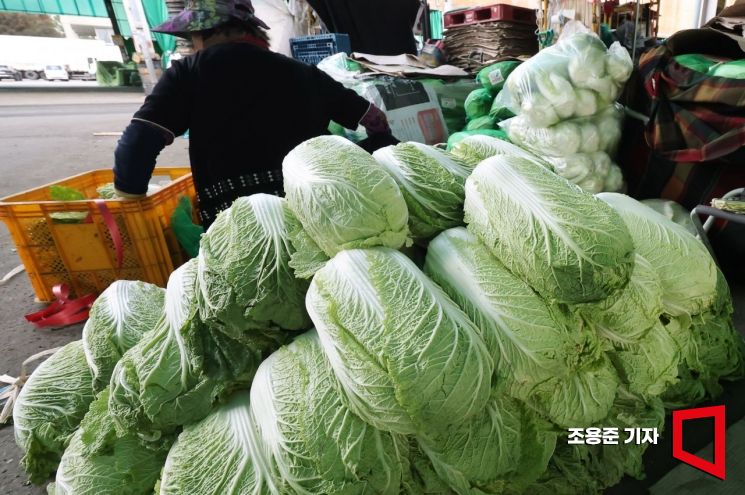 On the 23rd, a vendor at the vegetable section of Garak Market in Songpa-gu, Seoul, is trimming napa cabbage. Photo by Jo Yongjun
Decrease in Fall Napa Cabbage Cultivation Area in Jeonnam, Chungbuk, and Others
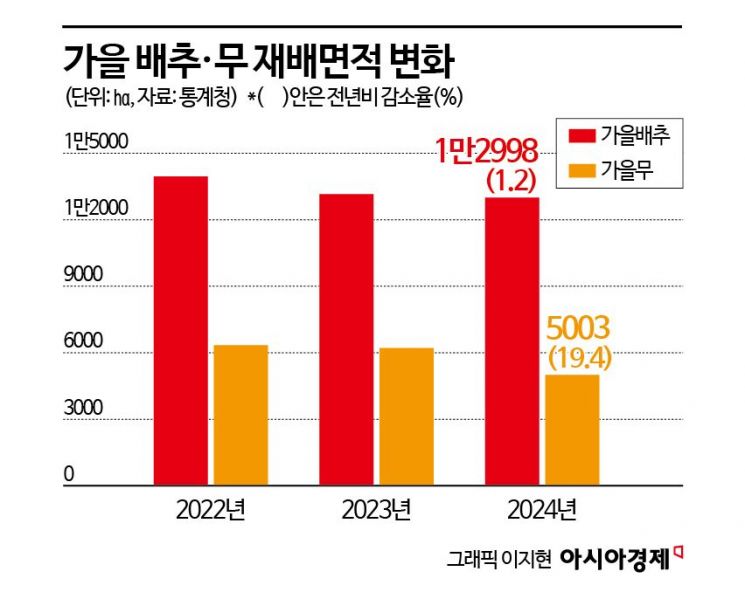
According to the "2024 Fall Napa Cabbage and Radish Cultivation Area Survey Results" released by Statistics Korea on the 30th, this year's fall napa cabbage cultivation area was 12,998 hectares, down 1.2% (154 hectares) compared to the same period last year. The cultivation area decreased due to adverse weather conditions during the planting period for napa cabbage (July to September). In fact, the number of heatwave days during the planting period was 27.2 days, more than double the 13.1 days recorded in the same period last year. Last month's precipitation was also higher at 241.2 mm compared to 197.3 mm in the same month last year.
The fall napa cabbage cultivation area has shown fluctuations every year but has been on a declining trend since 2022. In 2022 (13,953 hectares) and last year (13,152 hectares), the area was in the 13,000-hectare range, but this year it decreased to the 12,000-hectare range. However, while last year's decrease rate was 5.7% compared to the previous year, this year the decline narrowed to the 2% range.
Looking at this year's fall napa cabbage cultivation area by province, the order was Jeonnam (3,017 hectares), Gyeongbuk (2,160 hectares), Chungbuk (1,998 hectares), Gangwon (1,599 hectares), Jeonbuk (1,222 hectares), Chungnam (1,209 hectares), Gyeonggi (883 hectares), and Gyeongnam (463 hectares). Compared to last year, the area decreased in Gyeonggi (-10.1%), Chungbuk (-9.7%), Gangwon (-5.2%), and Jeonnam (-2.7%), while it increased in Jeonbuk (14.3%), Chungnam (12.8%), Gyeongnam (2.1%), and Gyeongbuk (0.8%).
This year's fall radish cultivation area was 5,003 hectares, down 19.4% (1,205 hectares) compared to the same period last year. The area decreased due to adverse weather conditions during the radish sowing period (July to September). Similar to fall napa cabbage, the fall radish cultivation area has been declining for three consecutive years, following 2022 (6,340 hectares) and last year (6,207 hectares). Notably, this year recorded the smallest area since statistics began in 1975.
By province, this year's fall radish cultivation area was highest in Jeonbuk (969 hectares), Chungnam (962 hectares), Gyeonggi (891 hectares), Jeonnam (704 hectares), Gangwon (417 hectares), Gyeongbuk (401 hectares), Gyeongnam (173 hectares), and Chungbuk (151 hectares). Compared to last year, the decline was significant in several regions including Gyeongbuk (-31.7%), Gangwon (-30.7%), Jeonnam (-27.9%), and Jeonbuk (-24.9%).
Ministry of Agriculture, Food and Rural Affairs: "No Difficulties Expected in Kimchi Napa Cabbage Supply"
The Ministry of Agriculture, Food and Rural Affairs stated that the fall napa cabbage cultivation area survey results released by Statistics Korea are not significantly different from the Agricultural Outlook Center's projections. Although the fall napa cabbage cultivation area slightly decreased and early fall napa cabbage growth (late August to mid-September) was poor due to high temperatures, the ministry explained that there will be no difficulties in kimchi napa cabbage supply because demand for kimchi has decreased and temperatures suitable for napa cabbage growth have recently continued.
The ministry added, "Since mid-this month, as fall napa cabbage shipments have started in Gangwon, Gyeonggi, Chungbuk, and Gyeongbuk, wholesale prices have rapidly declined," and "when shipments begin in early next month in Jeonnam, Chungnam, and Jeonbuk, which account for about 50% of the fall napa cabbage cultivation area, prices are expected to fall further." They also explained, "Consumers will feel the price drop when kimchi-making season fully begins next month."
In the case of fall radish, there was a discrepancy between the cultivation area survey results from Statistics Korea and the Agricultural Outlook Center's projections. The Agricultural Outlook Center expected the fall radish cultivation area to decrease by about 2.7% compared to last year, but Statistics Korea anticipated a double-digit decrease rate.
The ministry explained, "This is because the sample populations and survey methods differ between the two organizations." Additionally, they elaborated, "Due to the high temperatures from mid-August to early September, the radish sowing period, many farmers replanted and supplemented (planting additional seedlings where plants died or were damaged) until mid-September, which is later than usual. Therefore, depending on the survey timing, there can be significant differences in cultivation area."
© The Asia Business Daily(www.asiae.co.kr). All rights reserved.


















