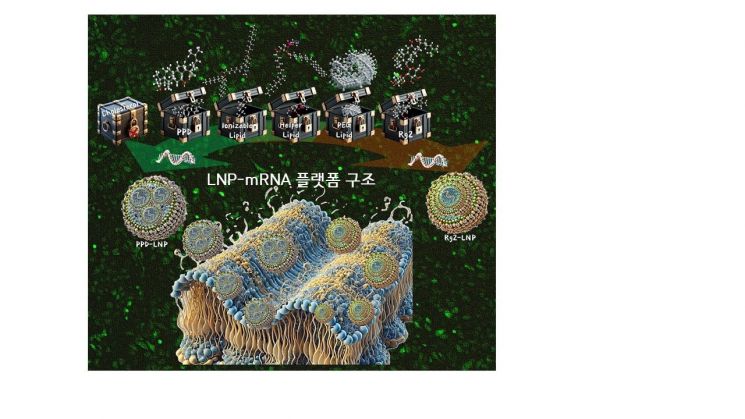
Genomictree (CEO Seonghwan Ahn) announced on the 30th that it has successfully designed LNPs capable of stably delivering and expressing mRNA by replacing animal-derived cholesterol, one of the main components of conventional LNPs used as vaccine and therapeutic delivery vehicles, with plant sterols and derivatives derived from ginseng components.
The research results were published as a paper in the journal Biomaterials Science, published by the Royal Society of Chemistry, UK, and were selected as the cover paper of the journal.
Since the COVID-19 pandemic, mRNA has attracted attention as an innovative method for the prevention and treatment of various diseases. However, to develop effective mRNA therapeutics, a stable delivery system that can safely and efficiently deliver mRNA into the body is essential. The core of this delivery system is to protect mRNA from degradation, effectively deliver it to target cells, and enable smooth translation into proteins inside the cells.
Conventional animal-derived cholesterol has been pointed out to have limitations due to cytotoxicity caused by oxidation and contamination issues from animal sources. To address this, Genomictree replaced it with plant-derived components, especially sterols derived from ginseng, which have excellent biocompatibility and lower toxicity risks from oxidation. Through this, they successfully developed new LNP compositions (Rg2-LNP and PPD-LNP) that demonstrate performance comparable to conventional LNPs.
According to the research results, these two new LNPs showed superior transcription and expression efficiency compared to commercial LNPs when delivering EGFP mRNA into cells, with performance confirmed through optical microscopy and flow cytometry analysis. Additionally, in vivo experiments using mice demonstrated that the delivery and expression efficiency of luciferase mRNA were better than those of conventional cholesterol-based LNPs.
Seonghwan Ahn, CEO of Genomictree, stated, “The differentiated LNP design replaced with ginseng-derived sterols improved the issues of conventional cholesterol while enhancing mRNA delivery and expression performance.” He added, “Although not specifically emphasized in the paper, we optimized and used unique UTR sequences for differentiated mRNA design. This can be universally applied to various mRNA structural settings and may play an important role in next-generation mRNA gene therapy and vaccine development.”
© The Asia Business Daily(www.asiae.co.kr). All rights reserved.

















