Sales Suspended from Chuseok Holiday, Then Normalized
Increased Supply of Autumn Cabbage... Prices Turning Downward
Still More Expensive Than Average
Rising Demand for Store-Bought Products Instead of Kimjang
Due to supply issues with napa cabbage, online sales of whole cabbage kimchi, which had been halted around the Chuseok holiday, are resuming. This is because the quantity of autumn cabbage has significantly increased with the cooler weather. As raw material prices have risen compared to previous years, demand for buying kimchi instead of making kimjang has increased, resulting in some manufacturers' retail kimchi sales more than doubling.
According to the industry on the 29th, among domestic kimchi manufacturers, Daesang's 'Jongga,' which holds over 40% market share, announced that it will resume orders for whole cabbage kimchi and flavored kimchi sold on its online mall starting today. This comes about 40 days after temporarily suspending sales from the 19th of last month, right after the Chuseok holiday.
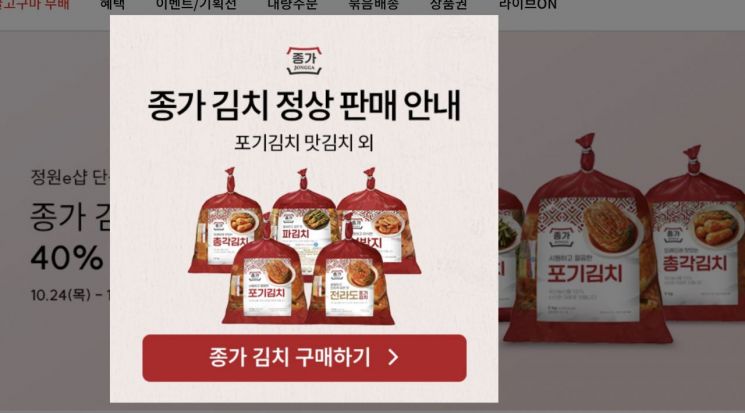 Daesang Jongga has announced that it is selling products such as pogi kimchi and flavored kimchi normally through its online mall.
 [Photo by Daesang]
A Daesang representative explained, "We have already been supplying kimchi quantities normally to offline channels such as large supermarkets, and to control quantities, orders for whole cabbage kimchi were blocked only on our online mall. Now that autumn cabbage is available, online orders are proceeding normally."
Orders for whole cabbage kimchi are also being processed without issues on other manufacturers' online malls, such as Ourhome and Pulmuone. However, CJ CheilJedang, which holds over 37% market share, still has online orders blocked for some products including Bibigo whole cabbage kimchi, sliced napa cabbage kimchi, and young radish water kimchi.
The industry expects that considering the average growing period of napa cabbage is about 45 days, kimchi production and sales will both normalize from early next month when harvesting begins in earnest.
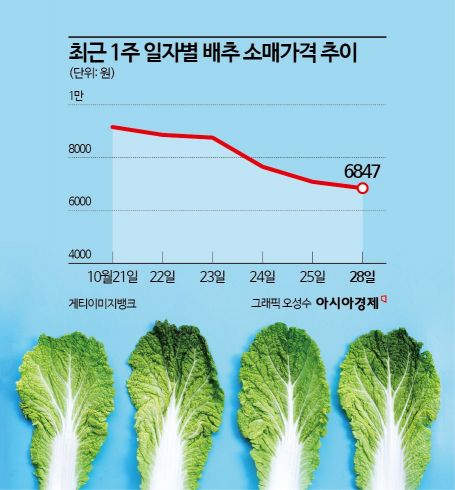
In fact, the rapidly rising price of napa cabbage has also stabilized since mid-month. According to the Korea Agro-Fisheries & Food Trade Corporation (aT) Agricultural Product Distribution Information (KAMIS), the retail price of one head of napa cabbage (standard grade) was 9,162 won on the 21st, exceeding 9,000 won, but dropped by 25.3% to 6,847 won within a week.
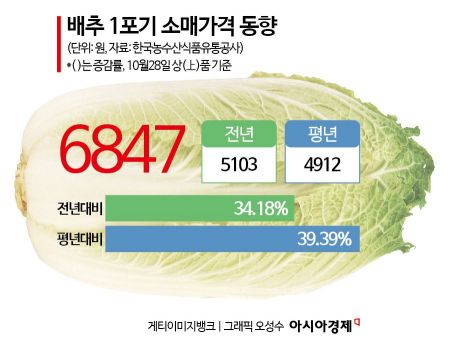
However, the price of one head of napa cabbage in the 6,000 won range is still 34.2% higher than the same period last year (5,103 won). Compared to the average price over the past three years from 2019 to last year, excluding the highest and lowest prices, it is also 39.4% higher than the normal price. Prices of other vegetables used as kimchi ingredients, such as radish and red chili peppers, have also risen by more than 30% compared to normal years, leading more consumers to seek retail kimchi rather than making kimjang.
For example, Ourhome reported that sales of napa cabbage kimchi products increased by more than 110% compared to the same period last year. Sales of premium home meal replacement (HMR) brand Gussibanga’s products such as hairtail kimchi, green leaf kimchi, and young radish kimchi also more than doubled compared to the same period last year. An Ourhome representative said, "Recently, demand for packaged kimchi has increased, and interest in unique products like hairtail kimchi has grown."
A survey conducted by the agricultural subscription platform 'Monthly Nonghyup Matseon,' operated by Nonghyup, from the 18th to the 23rd with about 500 members found that 72% of respondents said they would not make kimjang this year. Among them, 88.7% said they plan to purchase packaged kimchi. The preferred types of packaged kimchi among these consumers were napa cabbage kimchi at 96.5%, followed by young radish kimchi (47%) and green onion kimchi (26.3%).
© The Asia Business Daily(www.asiae.co.kr). All rights reserved.



















