[US Election 2024]
Once soaring to 9%, the US inflation rate has slowed to the 2% range this year, signaling a likely victory in the more than two-year-long 'war on inflation.' However, concerns have been raised that the upcoming US presidential election, just 8 days away, could change this outlook. Regardless of who wins, inflation risks driven by growth-promoting policies are deemed inevitable. In particular, if former President Donald Trump, known for his large-scale tariffs, is elected, the threat of inflation is expected to increase significantly.
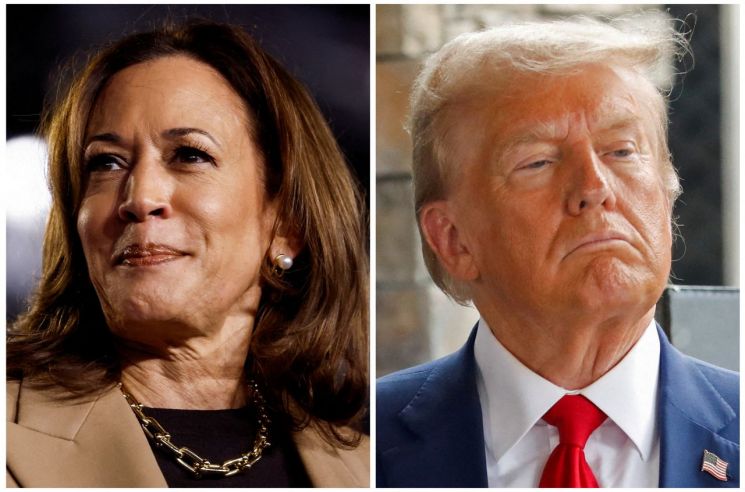
The Wall Street Journal (WSJ) reported on the 28th (local time) that economists are warning of new inflation risks after the election. WSJ noted that inflation had slowed due to high interest rates, supply chain recovery, and increased labor supply, but currently, both former President Trump and Vice President Kamala Harris are pursuing growth-promoting policies that make further inflation reduction difficult.
Earlier, Republican presidential candidate Trump announced plans to extend the 2017 tax cuts, which are set to expire next year, and to further reduce corporate taxes. Democratic presidential candidate Vice President Harris pledged to promote housing construction and expand child tax credits. All these measures could increase fiscal deficits and fuel upward inflationary pressures. WSJ evaluated that "both candidates have massive spending plans."
Economists especially agree that if former President Trump, who emphasizes large-scale tariffs and tax cuts, wins this year's election, inflation risks will increase further. WSJ stated, "Even economists and conservative advisors worry that Trump's ideas risk fanning the flames of inflation," specifically mentioning universal tariffs of 10-20% on imported goods, worker deportations due to strict immigration policies, and pressure on the Federal Reserve (Fed) to lower interest rates.
Adam Posen, president of the Peterson Institute for International Economics, warned, "If Trump implements everything he has said, the US economy will face negative supply shocks," adding, "Inflation will soar, and the ability to supply goods and services will decline." Contrary to the Trump camp's dismissal that the so-called 'Trump tariffs' would not cause inflation, the price burden from large-scale tariffs will inevitably be passed on to consumers. According to the institute, if Trump, who advocates strict immigration policies, undertakes massive deportations, inflation will rise sharply and economic output will plummet.
Brian Riedl, a former Republican Senate aide, said, "Putting all this together, we are moving more toward inflation," expressing concern that "inflation could worsen in 2025." The recent rise in US Treasury yields, amid growing predictions of Trump's election, reflects this background. On that day in the New York bond market, the 10-year US Treasury yield hovered around 4.27%, marking the highest level in the past three months.
Mark Short, a former Trump administration official, noted that unlike during Trump's previous term when inflation was stable at low levels, the economic environment has changed, making concerns about increased inflation threats in a potential second Trump term valid. He also warned that this situation could lead to a new battle with the Fed, which must achieve price stability targets. Trump had previously openly pressured for interest rate cuts during his tenure. The next president could appoint a new Fed chair in 2026.
Earlier, the non-profit organization Committee for a Responsible Federal Budget (CRFB), which advocates for deficit reduction, estimated that Trump's pledges would increase the US fiscal deficit by $7.5 trillion (approximately 1,391 trillion won) over the next 10 years. Vice President Harris's pledges were projected to increase the deficit by about half that amount, $3.5 trillion (approximately 484.8 trillion won). Riedl pointed out that Harris's plans did not include deficit reduction measures and said, "If Harris wins and the Democrats take power, inflation may not spike as much as under Trump, but it will remain persistently stubborn."
Meanwhile, last month, the US Consumer Price Index (CPI) rose 2.4% year-on-year, approaching pre-pandemic levels.
© The Asia Business Daily(www.asiae.co.kr). All rights reserved.

















