To achieve the 2050 carbon neutrality target, it has been pointed out that POSCO should halt the reconstruction of the Gwangyang No. 2 blast furnace currently underway.
Climate Solutions analyzed the remaining carbon emission allowance for the Korean steel industry to meet the global average temperature rise limit of 1.5 degrees Celsius in its report published on the 28th, titled "Gwangyang No. 2 Blast Furnace, Distance from Carbon Neutrality Increasing as Much as Life Extension." Based on this, they analyzed scenarios for the closure of Korean steel production facilities.
According to Climate Solutions, POSCO must shut down the Gwangyang No. 2 blast furnace, which is currently being reconstructed, by 2025, and by 2030, four blast furnaces including Hyundai Steel's Dangjin No. 1 and No. 2 blast furnaces must be closed.
Climate Solutions calculated the blast furnace closure scenarios for the domestic steel industry using the concept of the "carbon budget" presented by the Intergovernmental Panel on Climate Change (IPCC). The carbon budget refers to the amount of carbon dioxide that can be emitted worldwide to keep the global average temperature rise within 1.5 degrees Celsius. It can be considered the remaining carbon emissions allowed until carbon neutrality is achieved.
According to the IPCC, to have a 50% chance of limiting the global temperature rise to within 1.5 degrees Celsius compared to pre-industrial levels, the remaining global carbon budget as of January 2020 is approximately 500 billion tons of CO2 equivalent (500 GtCO2). In other words, if the world exceeds this limit in greenhouse gas emissions, it will be difficult to keep the Earth's temperature rise within 1.5 degrees Celsius.
This study estimated Korea's carbon budget by considering national carbon emissions and population based on the global carbon budget, then calculated the 2024 carbon budget for the Korean steel industry by further considering sectoral emissions and energy usage. The result showed that the remaining carbon budget for the Korean steel industry to keep the global temperature rise within 1.5 degrees Celsius is 550 million tons (550 MtCO2).
The report derived closure scenarios for coal-based Korean steel production facilities based on this carbon budget. Currently, there are a total of 11 coal blast furnaces owned by POSCO and Hyundai Steel domestically, along with 2 POSCO FINEX facilities.
The analysis showed that starting with the closure of POSCO's Gwangyang No. 2 blast furnace in 2025, which will have been 20 years since its last reconstruction, three blast furnaces including Hyundai Steel No. 1 and No. 2 blast furnaces and POSCO Gwangyang No. 1 blast furnace must be closed by 2030. Additionally, two more blast furnaces, Hyundai Steel Dangjin No. 3 and POSCO Pohang No. 2, need to be closed by 2033, and by 2034, all remaining five blast furnaces except the two FINEX facilities must be shut down to comply with the steel industry's allocated remaining carbon budget and achieve the 1.5-degree target.
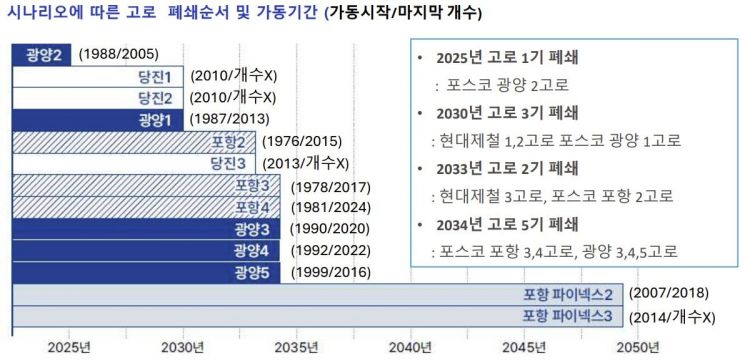 Image source=Climate Solutions 'Gwangyang No. 2 Blast Furnace, the Distance from Carbon Neutrality Growing as Lifespan Extends' Report.
However, POSCO has not yet disclosed specific plans to close blast furnaces and is instead planning to continue using existing blast furnaces by reconstructing them. POSCO is understood to have completed the reconstruction of Pohang No. 4 blast furnace at the end of June and has started the delayed reconstruction of Gwangyang No. 2 blast furnace.
In its 2023 business report released in April this year, POSCO specified the contract period for Gwangyang No. 2 blast furnace as January 2024 to August 2025 and disclosed contract details worth approximately 30 billion KRW. In the 2024 semi-annual report, the contract amount was increased to 283 billion KRW. The amount spent so far is 3.425 billion KRW, which corresponds to 1.2% of the total budget, indicating that initial reconstruction work is underway.
Reconstruction refers to extending the lifespan of a blast furnace. After investing a huge cost in reconstruction, it is industry practice to extend the furnace's life by more than 15 years. In the case of Gwangyang No. 2 blast furnace, if reconstructed, it could be used from 2025 until 2040. The report predicted that considering the investment scale for Gwangyang No. 2 blast furnace, POSCO's greenhouse gas emissions would rather increase after the reconstruction work.
This is far from the carbon neutrality roadmap POSCO has presented so far. POSCO has set goals to reduce carbon emissions by 10% by 2030 compared to the base year, 30% by 2035, 50% by 2040, and achieve carbon neutrality by 2050. The report explained, "Extending the equipment life through Gwangyang No. 2 blast furnace reconstruction is equivalent to newly constructing coal facilities that would emit a cumulative 13.702 million tons of carbon over the next 15 years, even without considering expansion reconstruction."
The report's author, Climate Solutions Steel Team researcher Kang Hye-bin, stated, "The moment POSCO reconstructs the Gwangyang No. 2 blast furnace, it will be difficult to achieve the 1.5-degree temperature rise limit." She emphasized, "POSCO must stop the reconstruction of Gwangyang No. 2 blast furnace, which does not align with the 1.5-degree target and carbon neutrality implementation, and immediately declare its closure." Additionally, Kang added, "POSCO and Hyundai Steel should announce a phased closure plan for all blast furnaces considering the steel industry's carbon budget and reflect this in their carbon neutrality roadmaps."
© The Asia Business Daily(www.asiae.co.kr). All rights reserved.
![Clutching a Stolen Dior Bag, Saying "I Hate Being Poor but Real"... The Grotesque Con of a "Human Knockoff" [Slate]](https://cwcontent.asiae.co.kr/asiaresize/183/2026021902243444107_1771435474.jpg)
















