Criticism at Ministry of Employment and Labor Audit
“Rigidity Leads to Decline in Competitiveness”
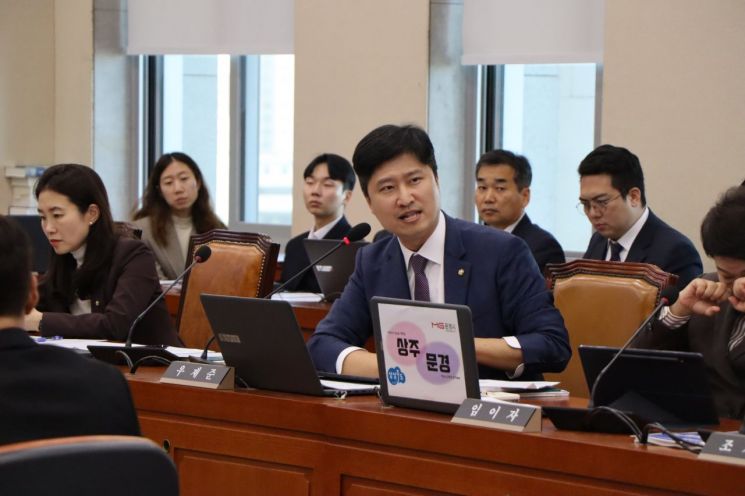
Woo Jae-jun, a member of the People Power Party representing Daegu Buk-gu Gap, expressed concerns on the 25th during the National Assembly’s comprehensive audit of the Ministry of Employment and Labor that Korea’s corporate competitiveness is declining due to rigid working hours, and that the 52-hour workweek system does not benefit workers either.
During the audit, Rep. Woo also questioned whether any Ministry of Employment and Labor employees actually comply with the 52-hour workweek, emphasizing, “It is irresponsible to enforce the 52-hour limit on companies and workers when even the Ministry of Employment and Labor and the Environment and Labor Committee cannot adhere to it.”
Articles 50 and 53 of the Labor Standards Act uniformly set the maximum working hours at 8 hours per day without considering the characteristics of industries or individuals. In 2018, the 52-hour workweek system was introduced, allowing up to 12 hours of overtime per week through mutual agreement between parties.
However, to manage workers’ income and secure corporate competitiveness, the introduction of a flexible working hours system is necessary. According to data released in 2024 by the Australian Strategic Policy Institute (ASPI), in the national competitiveness rankings of 64 advanced technologies, the United States ranked first in 11 technologies, China ranked first in 57 technologies, but South Korea did not rank first in any field.
Since 2018, the total number of people with side jobs increased by 33%, from 432,000 to 575,000, and among them, household heads responsible for livelihood with side jobs surged by 42%, from 275,000 to 390,000. A survey conducted by Flea Market showed that more than half of the respondents cited “income reduction due to decreased working hours” as the reason for having side jobs.
Rep. Woo Jae-jun stated, “This is not about forcing unpaid overtime, and the culture that causes death from overwork must disappear,” but added, “There should be increased flexibility in working hours through various measures, especially by industry type or for high-income earners.”
Rep. Woo pointed out, “Many young people want to work more,” and said, “The important thing is to create an atmosphere where people can work autonomously, rather than imposing uniform regulations and restrictions.”
Kim Chang-han, CEO of Krafton, who attended as a witness that day, responded to Rep. Woo’s question by saying, “There are concerns that China’s capabilities have surpassed Korea’s, which we view very seriously,” and added, “I believe that an autonomous working environment is important to maintain competitiveness.”
Kim Min-seok, Vice Minister of Employment and Labor, also replied, “In previous surveys, many expressed the desire to set working hours autonomously through labor-management agreements,” and said, “It has been 70 years since the Labor Standards Act was enacted in 1953, and we need to consider whether it is right for the system to remain unchanged.”
© The Asia Business Daily(www.asiae.co.kr). All rights reserved.
![Clutching a Stolen Dior Bag, Saying "I Hate Being Poor but Real"... The Grotesque Con of a "Human Knockoff" [Slate]](https://cwcontent.asiae.co.kr/asiaresize/183/2026021902243444107_1771435474.jpg)











