Interpretations Divided Over Ruling Coalition's Failure to Secure Majority
In the Japanese House of Representatives election (general election), the ruling coalition of the Liberal Democratic Party (LDP) and Komeito failed to secure a majority, leaving the future of Japanese politics unpredictable. Amid this, heated debates continue online among Japanese citizens who cast their votes in this election. They expressed fatigue over the 15-year-long "LDP era" while also showing concerns about a parliament without a majority.
After the election results were announced on the 28th, the popular Japanese morning program on TV Asahi, "Hatori Shinichi Morning Show," invited political journalist Shiro Tajaki to provide commentary.
Journalist Tajaki defined the significance of this election as "the beginning of a minority ruling party government from the outset," explaining, "Going forward, if the government cannot gain cooperation from other forces to pass budgets and bills, everything will be rejected. It will be a very strict parliamentary and government operation."
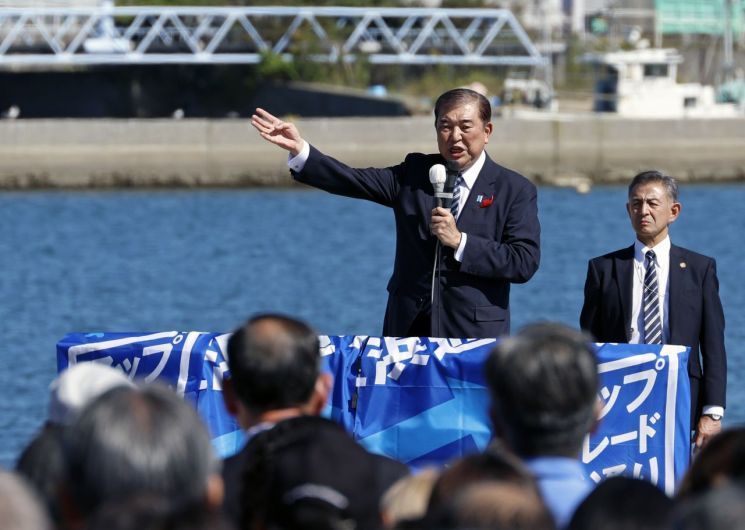 Japanese Prime Minister Shigeru Ishiba campaigning for the general election on the 15th [Image source=Yonhap News]
In this election, the ruling LDP won 191 seats, and its coalition partner Komeito secured 24 seats. Not only did they fall far short of the ruling party's solo majority (233 seats or more), but even combined, the coalition failed to secure a majority. This is the first time since 2009, when the old Democratic Party took over the government, that the ruling coalition has failed to cross the majority threshold in the Japanese parliament.
Following the broadcast, opinions among Japanese citizens about the meaning of this election remain divided. However, most netizens agreed on the fatigue toward the 15-year-long "LDP era." Criticism toward the ruling party poured in, with comments such as "I went to vote in this election. I prayed and voted so that it wouldn't become another LDP-dominated era" and "We protected Japan from the LDP."
One netizen strongly criticized, saying, "It's strange that people say they are surprised by the election results. Earthquake disaster recovery is sluggish, and among young people, 'dark part-time jobs' are rampant," adding, "This is the result of policies against the will of the people."
However, skepticism toward the opposition parties, which have effectively become the 'casting vote,' remains strong. When another citizen declared, "The LDP-Komeito coalition basically lost this election. From now on, budgets and policies should be handled according to the opposition's proposals," rebuttals flooded in, such as "Are you kidding? Most opposition parties support tax increases," and "It's not that the opposition advanced, but that the LDP-Komeito lost trust. We need to clearly distinguish that difference."
Regarding the future political situation, skepticism was more prominent than hope. Opinions included, "I dislike the LDP-Komeito coalition, but it would have been better for politics if the ruling party had secured a majority," "Factional fights will only intensify from now on," and "There is no politician in Japan right now who can lead through this crisis."
The current coalition, having failed to secure a majority, may attempt to expand the coalition by linking with independent lawmakers or other opposition parties. However, right-wing groups like Nippon Ishin no Kai and the Democratic Party for the People have previously expressed negative views on participating in a coalition, suggesting that securing additional seats will be difficult.
Additionally, as Prime Minister Shigeru Ishiba received the worst results in 15 years, calls for accountability are rising, and opposition factions may attempt to oust the prime minister. Although, in theory, the opposition could unite to secure a majority and attempt a regime change, it is difficult to nominate a single prime ministerial candidate. Reflecting this political instability, the yen fell to 153.27 yen per dollar at one point in the foreign exchange market on the day, marking its lowest level since the end of July.
© The Asia Business Daily(www.asiae.co.kr). All rights reserved.

















