7 Keywords Leading Changes in the Consumer Market
In the distribution and consumer goods industry, the trend of ‘Liquid Consumption’ is spreading, with consumption patterns polarizing into downward and upward consumption. Liquid consumption refers to a consumption form where traditional fixed consumption types disappear and consumption fluidly changes according to the consumer’s needs and circumstances.
On the 28th, Samjong KPMG published a report titled ‘A Paradigm Shift in Consumption: Liquid Consumption Trends in the Distribution and Consumer Goods Industry,’ presenting seven key keywords driving changes in the consumer market: ▲price polarization ▲experience ▲time-performance ratio ▲individuality ▲wellness ▲sustainability ▲digital technology.
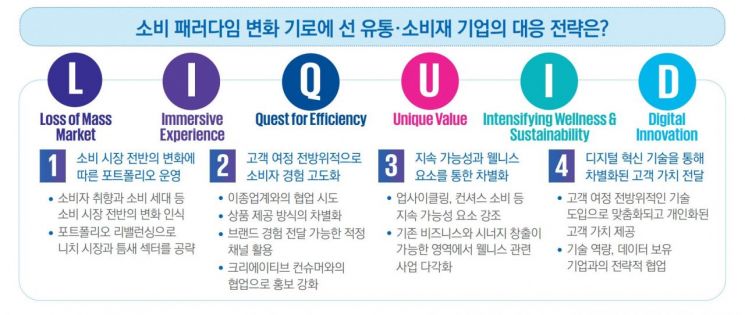
According to the report, consumption patterns have polarized into downward and upward consumption. While extreme rationalism tendencies increased, such as using Daiso and ultra-low-cost Chinese e-commerce, consumers also made purchases regardless of price in areas they valued. In the food and dining market, paradoxical consumption behaviors stood out, with ‘small luxury’?gaining psychological satisfaction through minor indulgences?and a simultaneous pursuit of low prices emphasizing relatively affordable and reasonable costs.
Recently, consumers have valued gaining satisfaction through experiences more than owning goods. In particular, pop-up stores receive strong responses from young consumers as they provide unique experiences and effectively convey brand identity. Subscription services are also expanding beyond existing OTT (online video services) to various fields such as rental of home appliances like TVs and laptops, customized health meal plans, and nutritional supplements.
Consumers emphasized ‘time-performance ratio’ (performance relative to time) beyond ‘cost-effectiveness.’ Platforms providing services such as cleaning and laundry outsourcing and waste collection are gaining attention. In the childcare sector, platforms connecting babysitters and visiting tutors are popular.
Consumption expressing individuality rather than mass products is also expanding. Emerging designer brands and niche markets are gaining attention, and consumers are becoming prosumers who directly participate in the production and distribution process, acting as both producers and consumers. The younger generation continues ‘Health Digging’ consumption focused on health management. Domestic food and beverage companies are reorganizing their portfolios around zero-calorie and sugar-free foods and products with added functional ingredients.
With growing interest in ethical consumption, products and services emphasizing environmental and social responsibility have emerged. In the fashion industry, products using upcycling and eco-friendly materials are expanding, while in the food and beverage industry, alternative foods targeting flexible vegetarians are gaining attention. The cosmetics industry is strengthening sustainable beauty solutions by realizing eco-friendly values throughout all processes from raw materials to packaging.
Shingijin Shin, partner at Samjong KPMG’s Strategy Consulting Division, said, “In the past, consumption was focused on ‘price,’ but in the liquid consumption environment, various aspects such as experiential and technological factors are observed alongside price.” He added, “To successfully respond to the liquid consumption trend, portfolio readjustment is necessary, focusing on discovering niche markets and providing new experiences such as pop-up stores and customized subscription services to deepen relationships with consumers.”
© The Asia Business Daily(www.asiae.co.kr). All rights reserved.
![Clutching a Stolen Dior Bag, Saying "I Hate Being Poor but Real"... The Grotesque Con of a "Human Knockoff" [Slate]](https://cwcontent.asiae.co.kr/asiaresize/183/2026021902243444107_1771435474.jpg)
















