Failure to Secure Majority for Ruling Coalition After 15 Years...Ruling Party Advances
Public Sentiment Lost Due to Slush Fund Scandal and Inflation
Opposition May Attempt to Oust Ishiba
The Liberal Democratic Party (LDP) suffered a crushing defeat in the Japanese House of Representatives election (general election). Not only did the LDP fail to secure an outright majority of seats (233 or more), but the ruling coalition of the LDP and Komeito also failed to cross the majority threshold. For the first time in 15 years, the ruling party failed to secure a majority, and Prime Minister Shigeru Ishiba is expected to face calls for accountability.
According to Kyodo News and public broadcaster NHK on the 28th, the LDP won 191 seats, while Komeito secured 24 seats.
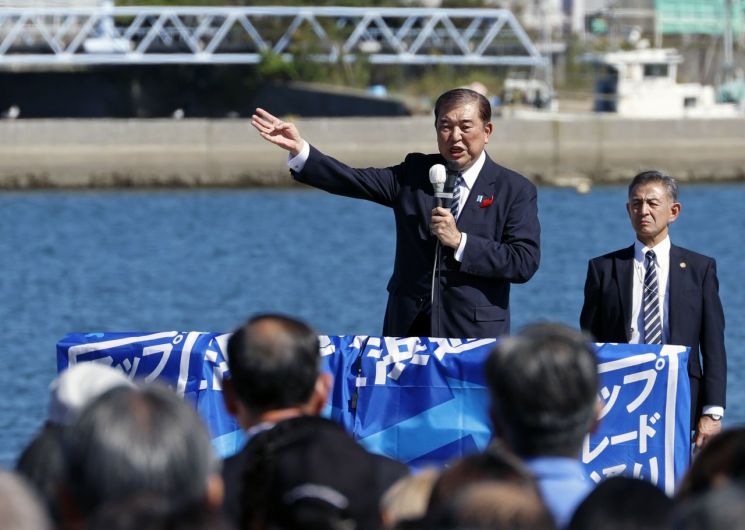 Japanese Prime Minister Shigeru Ishiba campaigning for the general election on the 15th [Image source=Yonhap News]
The combined total of the two parties is 215 seats, falling short of the 233-seat majority in the 465-seat House of Representatives. Compared to before the election, they lost a significant number of seats. Initially, the LDP and Komeito held 247 and 32 seats respectively, totaling 279 seats. This is the first time in 15 years since the former Democratic Party handed over power in 2009 that the LDP and Komeito coalition failed to secure a majority in a general election. It is also the first time in 12 years that the LDP failed to secure an outright majority on its own.
In addition to the LDP's "slush fund scandal" that broke out at the end of last year, factors such as real wage declines due to high inflation are believed to have influenced voter sentiment. According to the interim tally based on NHK exit polls and vote counts around 4 p.m. on election day, 28 out of 46 lawmakers involved in the slush fund scandal?62%?were classified as losers (including those certain to lose). While 62% of all LDP candidates (342 in total) were elected, the election rate for lawmakers involved in the slush fund scandal was only 39%.
Last year, allegations of a "slush fund scandal" surfaced, claiming that major LDP factions organized political fundraising events ("parties") and created slush funds by returning excess money to lawmakers who sold more "party tickets" than their quotas.
On the other hand, the main opposition party, the Constitutional Democratic Party, which focused its attacks on the LDP's slush fund scandal while calling for "political reform," made significant gains, increasing from 98 to 148 seats. According to the Yomiuri Shimbun, this is the first time in 21 years since the Democratic Party won 177 seats in 2003 that the main opposition party has secured more than 30% (140 seats) of the total seats.
The right-wing opposition party Nippon Ishin no Kai saw its seats decrease from 44 to 38, while the Democratic Party for the People significantly increased its seats from 7 to 28.
Japanese media believe that since the LDP still maintains its position as the largest party, it is highly likely to expand the coalition government by recruiting independent lawmakers and forming alliances with some opposition parties. However, Nippon Ishin no Kai and the Democratic Party for the People have previously expressed negative opinions about participating in a coalition government.
Even if the coalition government secures a majority, Prime Minister Ishiba is unlikely to escape calls for accountability after receiving the worst results in 15 years. Within the LDP, opposition factions may move to "oust Ishiba."
Japan must convene a special Diet session within one month after the general election triggered by the early dissolution of the House of Representatives. Currently, the Ishiba Cabinet will resign en masse, and the newly elected lawmakers will designate the next prime minister at the special Diet session. The Nihon Keizai Shimbun (Nikkei) analyzed that it has become difficult to foresee Ishiba’s continued tenure as prime minister since the ruling party fell far short of a majority. If Ishiba remains in office, a second cabinet will be formed, but if calls for accountability arise due to the election results, he may be replaced. This would make him the shortest-serving prime minister in history.
Although the opposition parties could theoretically unite to secure a majority and change the government, they have failed to unify candidates in several constituencies, making it difficult to nominate a single prime minister candidate. The Constitutional Democratic Party is expected to plan a long-term strategy to regain power by forming alliances with other parties, considering political schedules such as next year’s House of Councillors election.
© The Asia Business Daily(www.asiae.co.kr). All rights reserved.
![Clutching a Stolen Dior Bag, Saying "I Hate Being Poor but Real"... The Grotesque Con of a "Human Knockoff" [Slate]](https://cwcontent.asiae.co.kr/asiaresize/183/2026021902243444107_1771435474.jpg)











