Lee Chang-yong G20 Accompanying Press Corps Meeting
Strong Rebuttal to Early July Rate Cut Theory
"It's Like Telling Doctors to Make Patients Suffer More"
Lee Chang-yong, Governor of the Bank of Korea, stated, "The exchange rate has become a new consideration factor in the Monetary Policy Committee's base rate decision scheduled for this November."
Governor Lee made this remark on the 25th (local time) after attending the G20 Finance Ministers and Central Bank Governors Meeting and the International Monetary Fund (IMF) and World Bank Annual Meetings held in Washington DC, USA, during a meeting with accompanying reporters.
He said, "We expected the exchange rate to stabilize once the U.S. pivoted (direction change), but after the October Monetary Policy Committee meeting and over the past two weeks, due to the U.S. presidential election outlook and stronger-than-expected U.S. growth, the view that the U.S. would not lower interest rates quickly has grown, causing the dollar to strengthen significantly."
He added, "The dollar exchange rate is higher than we want and is rising rapidly. The exchange rate, which was not a consideration factor at the October Monetary Policy Committee meeting, has re-entered as a consideration factor at the November meeting."
The Bank of Korea's Monetary Policy Committee lowered the base rate by 0.25 percentage points from 3.50% to 3.25% on the 11th of last month. This was the first rate cut in 4 years and 5 months since May 2020 during the COVID-19 pandemic, and the first cut in 3 years and 2 months since the rate hike cycle began in August 2021.
Governor Lee said, "We will make a decision (on whether to cut in November) by comprehensively considering the slowdown in export growth, the effects of macroprudential policies on financial stability, and changes in the dollar trend after the U.S. presidential election."
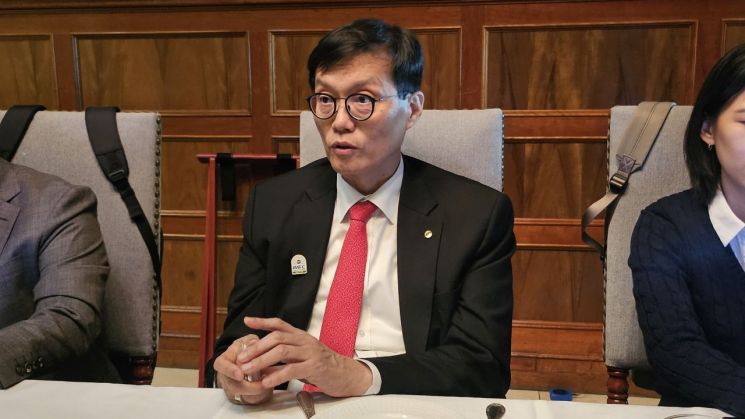 Bank of Korea Governor Lee Chang-yong is holding a meeting with accompanying reporters after attending the G20 Finance Ministers and Central Bank Governors meeting held in Washington DC, USA, on the 25th (local time).
Regarding the 'rate cut delay theory,' which claims that the Bank of Korea missed the opportunity to cut rates by freezing them in August, Governor Lee said, "Please wait about a year and then discuss after seeing the results (in economy and financial stability)."
He actively refuted the opinion that "the Bank of Korea hesitated to raise rates following the U.S. due to concerns about real estate project financing (PF) defaults and thus is now cornered," saying, "This is no different from a doctor making a sick patient sicker before giving medicine to cure them."
In response to criticism that rates should have been lowered preemptively since July when inflation was expected to settle around 2%, he countered, "If rates had been lowered then, household debt would have surged by 10 trillion won in September, and real estate prices in Seoul and other areas would have risen more severely."
He also expressed the difficulty of facing the dual challenge of maintaining financial stability while preventing an economic recession when implementing monetary policy. He requested that after about a year, if the economy has not significantly deteriorated and financial stability is achieved, then the results should be reviewed to judge right or wrong.
Governor Lee also shared key outcomes from the IMF Annual Meeting. He said, "Global growth is holding up better than expected, but there are opinions about downside risks." The overall assessment is that global growth, excluding the U.S., has structurally declined since the pandemic, with this year's global growth rate at 3.2%, lower than 3.8% twenty years ago.
He noted that in this low-growth environment, high debt levels in advanced countries, geopolitical risks, and low productivity are major uncertainties affecting global growth. Governor Lee predicted, "Regardless of whether the Democrats or Republicans win the upcoming U.S. presidential election, the U.S.'s expansion policy using the dollar's status as the key currency will continue for a considerable period," and "The U.S. fiscal deficit situation resulting from this will also persist for a significant time."
Regarding the U.S. presidential election outcome, he said, "We will have to wait and see the results," adding, "Regardless of who wins, overall, the China policy will be tough."
He also mentioned concerns that the climate crisis is occurring faster than expected and leading to fiscal losses, but global preparedness for this is insufficient.
On the third-quarter growth rate exceeding forecasts, he said, "On an annual basis, it will converge to the Bank of Korea's expected level of 2.3% or 2.2%." He added, "The change in this year's growth rate will have a minimal impact on monetary policy."
© The Asia Business Daily(www.asiae.co.kr). All rights reserved.
![Clutching a Stolen Dior Bag, Saying "I Hate Being Poor but Real"... The Grotesque Con of a "Human Knockoff" [Slate]](https://cwcontent.asiae.co.kr/asiaresize/183/2026021902243444107_1771435474.jpg)
















