'Excavating "Jageun Doknip-hyeong Jutaekdeul" (Small Detached Houses)'
An unusually large number of fresco-decorated houses have been discovered in Pompeii, the 'volcano city' of Italy.
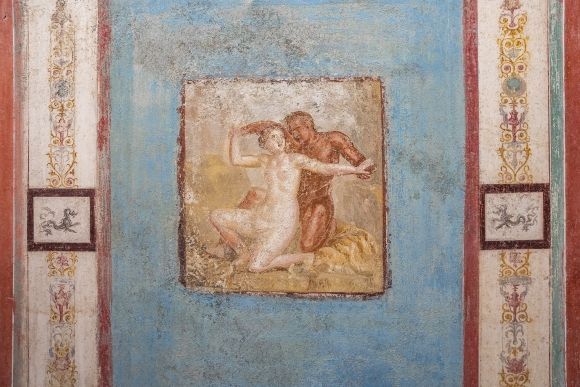 A 2,000-year-old house decorated with erotic murals has been newly excavated in Pompeii, Italy.
 [Image source=Reuters Yonhap News]
On the 25th, the British Guardian and others reported the recent excavation of a 2,000-year-old house decorated with erotic frescoes in Pompeii. The Pompeii Archaeological Park posted photos of the excavation site on Facebook, stating, "Although small in scale, we are excavating 'small detached houses' that are very elegantly decorated."
The park introduced a house named the 'House of Phaedra' as a representative example, explaining, "The high level of decoration is impressive enough that there is no need to envy the largest and wealthiest nearby mansions." Notably, one of the erotic frescoes found in this house, painted using the fresco technique, depicts a satyr?a half-man, half-goat figure from Greek and Roman mythology?and a nature spirit nymph engaged in sexual intercourse on a bed.
 A 2,000-year-old house decorated with erotic frescoes has been newly excavated in Pompeii, Italy. [Image source: Screenshot from Pompeii Archaeological Park Facebook]
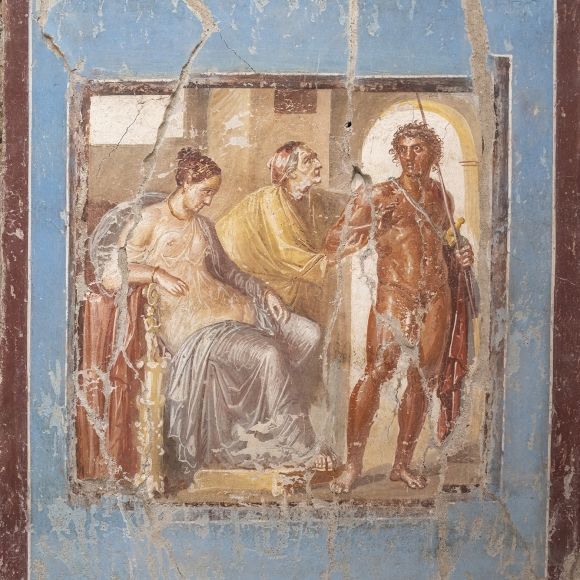
Another fresco features the mythological figures Phaedra and her stepson Hippolytus. It shows Hippolytus standing naked and muscular, while Phaedra sits wearing only thin clothing. Phaedra was a princess of Crete who became the second wife of the Athenian hero Theseus through a marriage alliance. However, Phaedra fell in love at first sight with Hippolytus, the son of Theseus's first wife, Hippolyta. This fresco evokes an erotic atmosphere, seemingly depicting their relationship.
The park explained, "Unlike other houses in Pompeii destroyed by the eruption of Mount Vesuvius in AD 79, the newly excavated house is characterized by not being built around an atrium, which was typical of Roman architecture before Christ." An atrium refers to an open space with a pool for collecting rainwater in the central courtyard.
The Guardian reported that the 'sensual' frescoes engraved inside the house are not a surprising discovery. Numerous erotic frescoes have been found in previously excavated Pompeii sites. In a house known to have been owned by two freedmen, a gigantic phallus painting was discovered. It depicts Priapus, the god of fertility and abundance, placing a large phallus on a scale to compare its weight with a bag full of money.
Located in southern Italy, Pompeii was a thriving city but was buried under ash and destroyed by the eruption of Mount Vesuvius in AD 79.
© The Asia Business Daily(www.asiae.co.kr). All rights reserved.


















