Ministry of Land, Infrastructure and Transport Aviation Statistics
18.32 Million Passengers from January to September
From the first to the third quarter of this year, flights departing from and arriving in Japan recorded the 'highest ever' numbers. As demand for travel to Japan surged due to the weak yen phenomenon, airlines accelerated increasing flight frequencies and launching new routes to keep up with the demand.
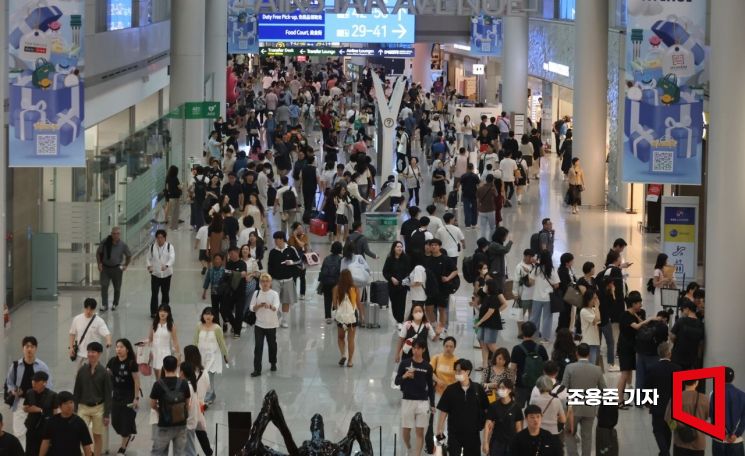
According to aviation statistics from the Ministry of Land, Infrastructure and Transport, the number of flights departing from and arriving in Japan from January to September this year reached 100,614, surpassing the previous record of 96,726 flights in 2019. This is also the first time the number exceeded 100,000. The number of passengers traveling to and from Japan was 18,320,557, about 17.4% higher than the previous record of 15,606,187 in 2019.
The aviation industry attributed this to the increase in tourists visiting Japan due to the ongoing weak yen effect since last year. Domestic airlines appear to have significantly increased the number of flights on Japan routes to meet the explosive travel demand, accelerating the pace. In particular, as repeat travelers to Japan increased, travelers have been visiting not only famous cities such as Tokyo, Osaka, and Kyoto but also lesser-known small towns. According to an analysis of domestic traveler reservation data by travel platform Trip.com for July and August, reservation rates for Japanese small towns such as Saga, Yonago, and Miyakojima surged by at least 800%. This is due to airlines competing to increase routes to small towns in Japan.
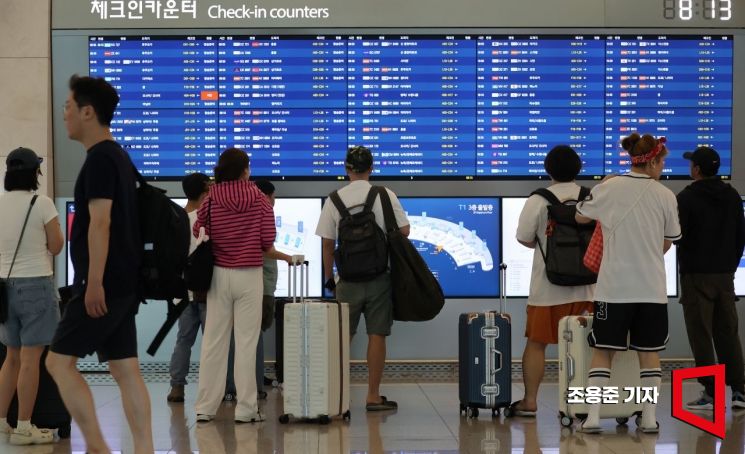 The departure hall of Incheon International Airport Terminal 1 is bustling with crowds heading overseas. Photo by Jo Yongjun jun21@
Korean Air increased the Incheon-Kagoshima route, which operated three times a week, to five times a week from the 2nd of last month and will expand it to seven times a week starting from the 28th. This is more than double the previous frequency. Asiana Airlines also increased flights for the summer peak season starting in July: Incheon-Osaka from 21 to 23 times a week, Incheon-Okinawa from 7 to 13 times a week, Incheon-Sapporo from 7 to 9 times a week, and scheduled two weekly flights on the Incheon-Asahikawa route.
Domestic low-cost carriers (LCCs) are also focusing on launching new routes and increasing flight frequencies. Jeju Air resumed the Incheon-Kagoshima route three times a week starting in August. Jin Air launched a new route to Takamatsu, Japan, in July.
Air Seoul’s Mint Pass for Japan, introduced in August, sold out in three minutes. This product is a kind of 'unlimited pass' allowing three rides to Air Seoul destinations, released with a limit of 600 people at 399,000 KRW, and tickets worth 2.4 billion KRW sold out in three minutes.
Japan also ranks first as the preferred overseas destination for Korean travelers seeking autumn foliage, and this trend is expected to continue for some time. The autumn foliage season in Japan this year is forecasted to be from early September to mid-November in northern regions such as Hokkaido and the Alpine Route, and from early November to mid-December in warmer southern regions such as Osaka and Kyushu.
© The Asia Business Daily(www.asiae.co.kr). All rights reserved.


















