Construction of 'Safety Training Center' for Experiencing Various Industrial Accidents in Virtual Reality
170 Billion KRW Investment in Eco-Friendly Facilities, 54% Reduction in Greenhouse Gas Emissions by 2050
Sampyo Cement is focusing its entire capabilities on spreading a safety culture and pursuing low-carbon eco-friendly management.
Recently, Sampyo Cement has been promoting the construction of a global-level 'Safety Training Center.' The Safety Training Center is a space where various industrial accidents can be experienced using virtual reality (VR). It operates as an experience-oriented program where workers can directly see and feel unexpected accidents such as falls or entrapments, which frequently occur in manufacturing and construction sites. The center is scheduled to open next year in the first half, covering an area of about 600 pyeong.
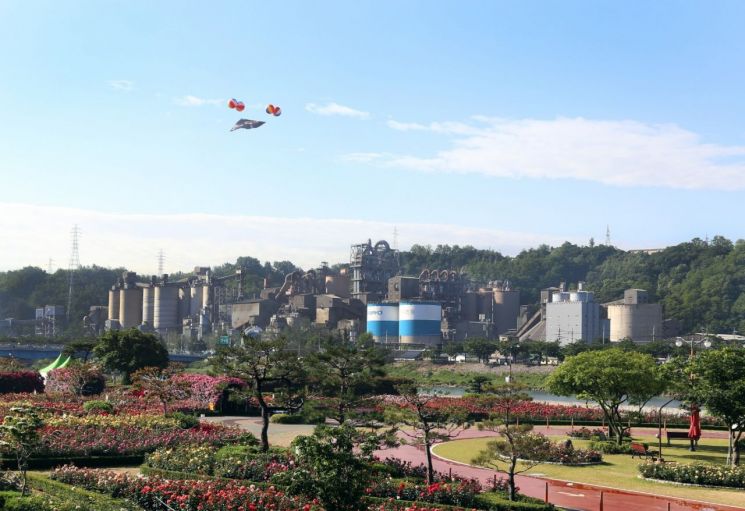
Efforts to spread a safety culture are also remarkable. Last year, Sampyo Cement actively participated as an institution in the Samcheok and Taebaek regions in the Safety Culture Practice Promotion Group, a public-private joint consultative and execution body organized by the Ministry of Employment and Labor. Following the government's roadmap to reduce major accidents, the company is focusing on spreading safety culture by providing safety learning experience education centers to small-scale workplaces in the area, attaching safety slogans on cement packaging and company-owned vehicles such as commuting buses and cleaning trucks.
Focusing on Spreading Safety Culture, Improving Even Potential Risk Factors
They also put effort into discovering latent risks, conducting 1,106 risk assessments last year, establishing 643 reduction measures, and improving 544 of them. This includes improvements to potential risk factors such as 'near-miss accidents.'
Efforts are also underway to reduce carbon dioxide emissions by expanding and applying low-carbon eco-friendly blended cement. Sampyo Cement is reducing CO2 emissions by expanding blended cement that replaces limestone, the main raw material of cement, with fly ash, slag, etc., developing technologies for low-temperature calcination and improved thermal efficiency through optimization of concrete mix structures, and substituting 34% of bituminous coal with recycled resources such as waste synthetic resin and waste tires.
The result of these efforts is the branding of 'Bluement.' Bluement, developed in-house by Sampyo Cement's Technology Research Institute, shows excellent early strength compared to the existing Type 1 Portland Cement (OPC) and outstanding effects in reducing carbon emissions. Recognizing this, it won the grand prize in the eco-friendly cement category at the '2024 Korea Consumer Awards' last July.
Sampyo Cement is also investing about 170 billion KRW in eco-friendly facilities to shift towards environment-centered management. To improve air quality, they are achieving equipment efficiency by remodeling low nitrogen oxide (NOx) preheaters and replacing low NOx burners, and plan to minimize environmental impact by replacing bag filters and installing dust reduction facilities.
170 Billion KRW Investment in Eco-Friendly Facilities, 54% Reduction in Greenhouse Gas Emissions by 2050
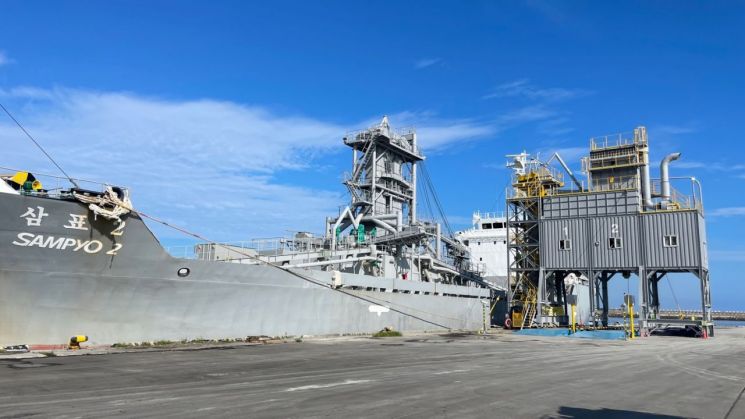
For the first time in the industry, they invested 6 billion KRW to deploy a dedicated cement ship at Jeju Port and built the industry's first enclosed unloading facility to prevent cement dust scattering. This enables stable supply and unloading regardless of weather conditions such as rain, greatly improving work efficiency, safety, and the environment.
They have also realized production advancement and automation through artificial intelligence (AI). Selected for the Ministry of Trade, Industry and Energy's AI Autonomous Manufacturing Leading Project, they will invest a total of 4.92 billion KRW by 2027 to convert existing cement processes from manual to AI autonomous manufacturing. This is expected to improve process automation rates and autonomous control prediction accuracy to about 95%.
Sampyo Cement is establishing and promoting phased strategies to achieve carbon neutrality by 2050. They have already achieved an 8% reduction in greenhouse gas emissions compared to 2018 last year and aim to reduce emissions by 21% by 2030 and 54% by 2050 compared to 2018.
They are also coexisting with local communities. In 2019, Sampyo Cement invested 2 billion KRW to build a combustible municipal waste fuel pre-treatment facility and donated it to Samcheok City, Gangwon Province. About 70 tons of daily and approximately 20,000 tons annually of municipal waste generated in this area are recycled as fuel replacing bituminous coal. This facility has become a model case for local companies and a benchmarking target for local governments nationwide.
Adoption of 'Companion Beach,' Achieved 'Integrated A Grade' in ESG Evaluation
To enhance biodiversity, Sampyo Cement has restored the habitat of the endangered Class 2 species, the Korean flying squirrel, allowing the flying squirrel, birds, martens, and others to use nests created near Samcheok.
In June last year, they adopted Deoksan Beach in Samcheok as a companion beach and have been conducting continuous marine cleanup activities. The companion beach program, led by the Ministry of Oceans and Fisheries and the Korea Marine Environment Management Corporation, involves companies or organizations adopting beaches and caring for them like pets.
In 2022, Sampyo Cement became the first in the cement industry to establish an ESG (Environment, Social, Governance) Committee within its board of directors, officially starting ESG management. Last year, they expanded eco-friendly product production and strengthened eco-friendly business efforts by reducing the proportion of bituminous coal use. Recognizing these achievements, they received an 'Integrated A Grade' in the ESG evaluation by the Korea Corporate Governance Service (KCGS) last year. They also achieved the distinction of being the first in the cement industry to be selected as an 'Excellent Governance (G) Company' by KCGS in 2023.
Baek Dong-hwan, CEO of Sampyo Cement, said, "The government's goal is to reduce carbon emissions by 10.9% compared to 2018 by 2030, but our target is a 21% reduction." He added, "Fundamentally, the way to reduce greenhouse gases is to increase blended cement. The challenge is to reach results through consultation so that construction, ready-mix concrete, and cement industries can share consensus and diversify products."
© The Asia Business Daily(www.asiae.co.kr). All rights reserved.


















