Real Estate R114 Weekly Apartment Market Report in the Seoul Metropolitan Area
Seoul Apartment Sale Prices Up 0.01%
Signs of Slight Slowdown for 2 Consecutive Weeks
Policy Mortgage Didimdol Loan Fluctuations Cause Confusion Among Majority of Actual Buyers
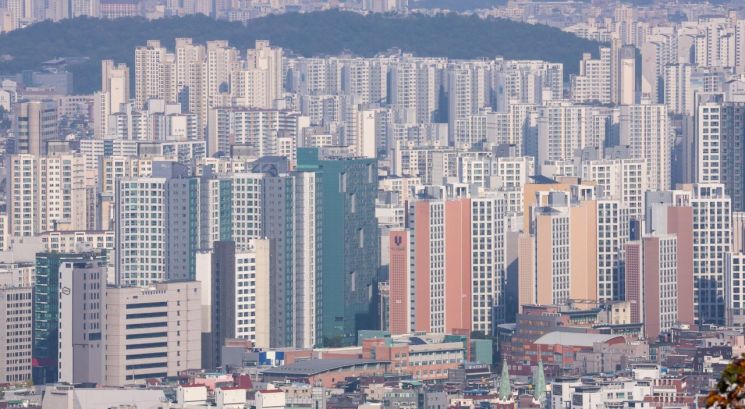
Real Estate R114 announced the 'Weekly Apartment Market Status in the Seoul Metropolitan Area for the Fourth Week of October' on the 26th, stating, "The government's fluctuating loan policies have significantly influenced apartment price movements."
As the government's loan regulation policies, including policy mortgages, were criticized during the National Assembly's audit, measures such as the temporary suspension of the 'room deduction' for Didimdol loans were implemented. The 'room deduction' is a mandatory deduction of a small tenant deposit amount (55 million KRW in Seoul) corresponding to the highest priority repayment amount under the Housing Lease Protection Act from mortgage loans. For borrowers, this results in a sudden reduction of several tens of millions of won in their loan limits.
This has caused increased confusion among actual demanders who had already paid deposits and were preparing the remaining balance. In response, the Ministry of Land, Infrastructure and Transport plans to establish improvement measures with grace periods excluding those who have already contracted to minimize market confusion and disorder. They also announced plans to differentiate between the metropolitan area and non-metropolitan areas. Apartment prices are also in an unpredictable situation, mirroring the government's inconsistent policies.
Seoul apartment sale prices rose by 0.01% this week, with the rate of increase slowing for two consecutive weeks by 0.01 percentage points. Reconstruction prices fell to flat (0.00%), while general apartments increased by 0.01%. New towns recorded flat (0.00%) for four consecutive weeks but rose by 0.01% this week, led by the second-generation new towns. Gyeonggi and Incheon showed flat (0.00%) for two consecutive weeks.
In Seoul, 5 out of 25 districts saw increases, while the remaining 20 districts remained flat (0.00%), indicating a significant decline in upward momentum over recent weeks. Individual areas rose in the order of Gangdong (0.08%), Mapo (0.03%), Dongjak (0.02%), Yeongdeungpo (0.01%), and Seongbuk (0.01%).
In new towns, Gwanggyo saw a 0.14% increase in market prices, with a 10 million KRW rise in large complexes such as Gwanggyo Natural & Hillstate in Iui-dong. Bundang rose by 0.01%, while other new towns remained flat (0.00%).
In Gyeonggi and Incheon, prices rose in Hwaseong (0.02%), Uiwang (0.01%), and Suwon (0.01%), while Icheon fell by 0.03%.
The jeonse (long-term lease) market in Seoul rose by 0.01%, shrinking by 0.02 percentage points compared to the previous week. This is the smallest increase in the past five weeks.
New towns (0.00%) and Gyeonggi-Incheon (0.01%) recorded the same rate of change as last week. Due to the government's liquidity reduction measures, tenants are minimizing residential moves by renewing contracts for their existing homes.
In Seoul, individual areas rose in the order of Geumcheon (0.05%), Yeongdeungpo (0.03%), Seongbuk (0.03%), Mapo (0.03%), and Jungnang (0.02%). In new towns, Pangyo (0.01%) and Gimpo Hangang (0.01%) increased, while other areas remained flat (0.00%). In Gyeonggi and Incheon, Osan (0.06%), Suwon (0.04%), Uijeongbu (0.03%), and Incheon (0.03%) rose.
A Real Estate R114 official stated, "With loan regulations continuing since the end of August due to the surge in household debt in July and August, the government's inconsistent policies have increased anxiety even among actual demanders."
He added, "Generally, actual demanders refer to the homeless, one-homeowners (including those switching homes with two homes), or tenants with lease contracts for residence purposes. Despite these actual demanders being imminent, the government has placed more emphasis on managing household debt, causing significant uncertainty and difficulties not only for investors but also for the majority of actual demanders."
He also emphasized, "Especially with rampant rumors that loan regulations such as DSR (Debt Service Ratio) might be applied not only to future policy mortgages but also to jeonse loan products, it is time for the government to clearly present standards and prepare in advance for side effects such as balloon effects in the jeonse and monthly rent markets due to regulations."
© The Asia Business Daily(www.asiae.co.kr). All rights reserved.
![Clutching a Stolen Dior Bag, Saying "I Hate Being Poor but Real"... The Grotesque Con of a "Human Knockoff" [Slate]](https://cwcontent.asiae.co.kr/asiaresize/183/2026021902243444107_1771435474.jpg)
















