- Korean Consumer Society Announces Results of Online Secondary Ticket Trading Consumer Survey
- 7 out of 10 People Aware of Ticket Resale... Ensuring Transaction Safety Key to Market Activation
The Korean Consumer Society (co-chairs: Professor Ok Kyung-young of Sookmyung Women's University and Professor Lee Sung-soo of Sunmoon University) announced the results of a consumer survey on online secondary ticket transactions.
This consumer survey was conducted with 1,000 men and women nationwide aged 16 to under 69 (quota by gender, age, and ticket purchase experience) to investigate △the status of secondary ticket transactions △consumer attitudes and needs regarding the online secondary ticket market △concerns about secondary ticket transactions and the necessity of policies and systems, aiming to explore improvement measures for creating a healthy secondary ticket market environment. The study was jointly conducted by Professor Nam Young-woon of the Department of Consumer Studies at Seoul National University and Professor Lee Hong-joo of the Department of Consumer Economics at Sookmyung Women's University. The main results were introduced at the ‘2024 Korean Consumer Society Special Seminar’ held on the 11th.
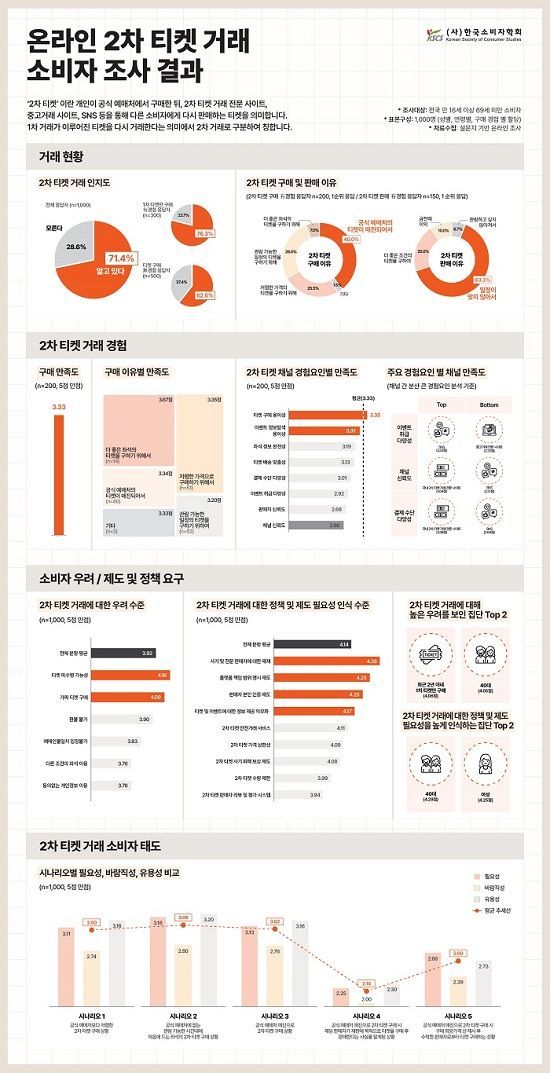
According to the survey results, 71.4% of respondents said they were ‘well aware’ of secondary transactions of performance and sports event tickets, with the highest awareness group being those aged 16-29 (86.5%). The main transaction channels for secondary ticket buyers (200 people) were specialized secondhand trading sites (16.7%), domestic secondary ticket trading specialized sites (11.4%), and SNS (9.4%), in that order.
Additionally, consumers who have experience selling or purchasing secondary tickets were mainly identified as highly involved consumers who frequently attend performances or sports games or spend a significant amount on ticket purchases. Among 150 respondents with experience selling secondary tickets online, the reasons for ‘selling’ secondary tickets were scheduling conflicts (63.3%), obtaining tickets with better conditions (20%), and making a monetary profit (10%), in that order. The main reasons for ‘purchasing’ secondary tickets online were sold-out tickets at official booking sites (40%), purchasing tickets for available dates (26%), and buying tickets at lower prices (25.5%).
Consumers generally evaluated positively the ease of purchasing secondary tickets online and the ability to find necessary event information, but showed low trust in secondary ticket sellers or transaction channels.
Examining satisfaction by eight channel experience factors such as ticket purchase convenience, event information search convenience, payment method diversity, seller trustworthiness, and channel trustworthiness, only two experience factors?ticket purchase convenience (3.35 points) and event information search convenience (3.31 points)?showed satisfaction above the overall average satisfaction (3.33 points out of 5). Seller trustworthiness (2.68 points) and channel trustworthiness (2.66 points) showed the lowest satisfaction.
In particular, from the perspective of event handling diversity, SNS (3.33 points) received higher evaluations compared to other transaction channels, and domestic secondary ticket trading specialized sites received positive evaluations for channel trustworthiness and payment method diversity (3.04 points and 3.38 points, respectively).
The level of concern about online secondary ticket transactions (3.92 points) was higher than satisfaction with purchase experience (3.33 points), indicating relatively high concerns. Consumers were most worried about damages caused by illegal acts of sellers, such as the possibility of not receiving tickets after purchase (4.16 points) and purchasing counterfeit tickets (4.09 points). It was confirmed that consumers who are well aware of secondary ticket transactions are more concerned about damages caused by illegal acts of sellers. Especially, consumers using SNS (3.73 points) and global secondary ticket trading specialized sites (3.71 points) showed generally higher levels of concern than those using domestic secondary ticket trading specialized sites (3.61 points) and specialized secondhand trading sites (3.55 points).
The necessity of systems and policies related to online secondary ticket transactions (4.14 points) was generally highly agreed upon. Groups well aware of secondary ticket transactions (4.19 points) felt a greater need for systems and policies than those unaware (4.01 points). Specifically, there was high interest in sanctions against fraud and professional sellers (4.38 points), systems specifying platform responsibility scope (4.25 points), and seller identity verification systems (4.20 points).
Meanwhile, although consumers recognize the usefulness and necessity of secondary ticket transactions, there was also a general tendency not to view secondary ticket transactions favorably. Particularly, the usefulness (3.2 points) and necessity (3.18 points) of secondary ticket transactions, which show functional utility in situations where tickets are traded to match one’s viewing conditions, were at a good level. However, in cases where sellers purchase tickets from the start for resale purposes, so-called scalping, usefulness (2.3 points), necessity (2.25 points) decreased, and desirability (2 points) was rated the lowest, showing that consumers’ attitudes vary depending on the situation.
Professor Lee Hong-joo of the Department of Consumer Economics at Sookmyung Women's University stated, “The entry of online platforms into the secondary ticket market is evaluated as having improved convenience of transactions and information provision. However, although there are differences by individual platforms, consumer damage such as seller fraud continues, resulting in low trust in sellers and transaction channels,” adding, “The fact that concerns about secondary ticket transactions are higher than satisfaction indicates that consumer trust in the market has not been sufficiently established.”
He also said, “The recent issue of scalping involves selling tickets above face value for profit, but secondary ticket transactions need to be distinguished as transactions involving transferring or selling tickets at face value or reasonable prices.” He emphasized, “It is time to consider ways to reasonably grow the market by reducing consumer damage in the secondary ticket market and increasing consumer satisfaction.”
Professor Nam Young-woon of the Department of Consumer Studies at Seoul National University said, “Consumer demand is high for the introduction of systems and policies related to the secondary ticket market, such as sanctions against fraudulent transactions and professional sellers, and seller identity verification,” adding, “To activate the resource redistribution function of the secondary ticket market, government and industry regulations must be established first. In other words, institutional measures that can create a safe and fair market should be introduced, and platforms also need to clarify their responsibilities in this regard.”
© The Asia Business Daily(www.asiae.co.kr). All rights reserved.
![Clutching a Stolen Dior Bag, Saying "I Hate Being Poor but Real"... The Grotesque Con of a "Human Knockoff" [Slate]](https://cwcontent.asiae.co.kr/asiaresize/183/2026021902243444107_1771435474.jpg)
















