The Evolution of Office Workers' Lunch Breaks
Lunch Sales Share Peaks at 12:10 PM
More Office Workers Leaving Early for Lunch
"Already full? Let's go somewhere else."
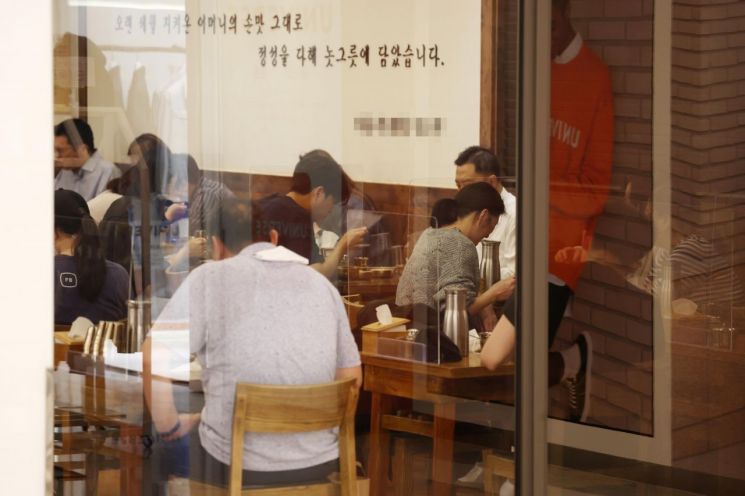
Recently, office workers' lunch hours have noticeably shifted earlier. Typically, lunch hours for office workers are from 12 PM to 1 PM. However, by 11:30 AM, many restaurants are already full, causing people to head to more remote locations. Kim Mihyun, an office worker in Euljiro, Jung-gu, Seoul, said, "Whether it's a pork cutlet place, a soup restaurant, or a Chinese restaurant, by 11:30 AM, restaurants near the office are packed," adding, "You have to walk a bit further to find a place or leave the office a few minutes earlier to eat lunch without waiting."
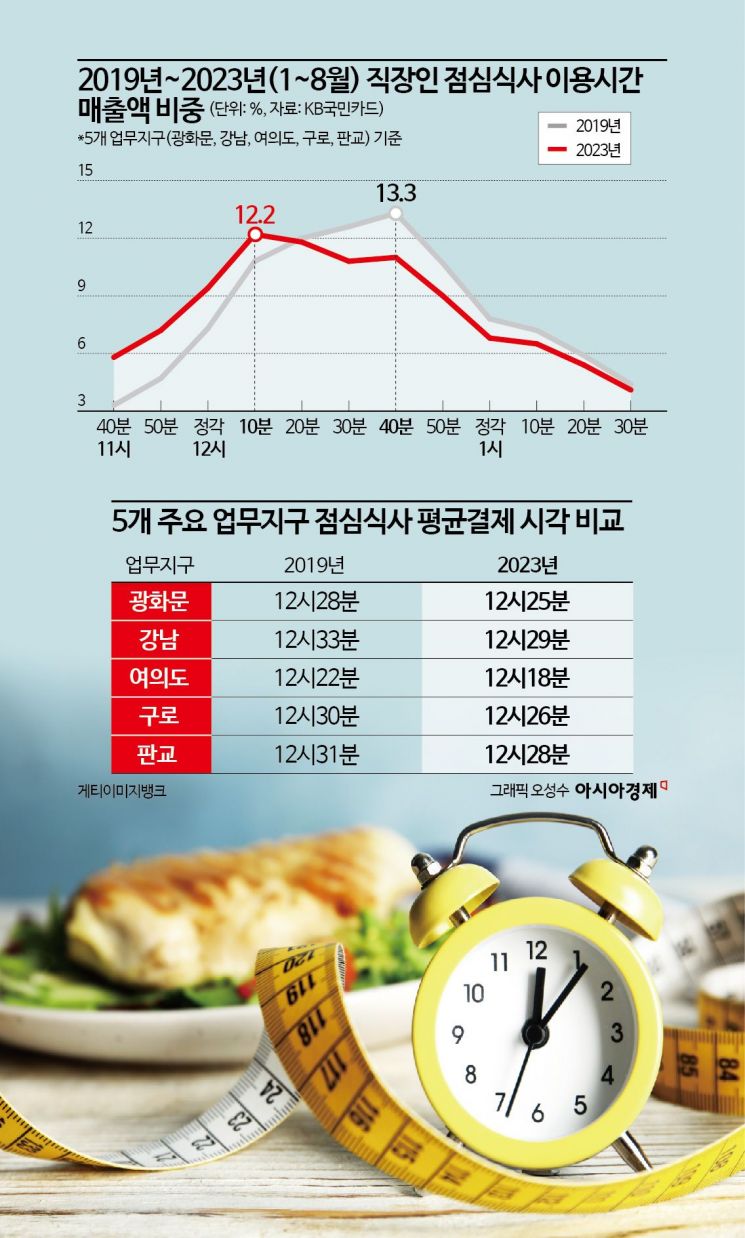
Statistics also show that office workers' lunch hours have moved earlier by more than 30 minutes. KB Kookmin Card analyzed the sales proportion of lunch usage times from 2019 to 2023 (January to November) for office workers in five Seoul business districts (Gwanghwamun, Gangnam, Yeouido, Guro, Pangyo). The result showed that 12:10 PM accounted for the highest proportion at 12.2%. In 2019, the peak was at 12:40 PM with 13.3%, indicating a 30-minute shift earlier over five years.
In particular, the average payment time for lunch has been gradually moving earlier. Comparing the average lunch payment times by business district year by year, all five districts have shifted earlier compared to 2019. Gwanghwamun moved from 12:28 PM to 12:25 PM, Gangnam from 12:33 PM to 12:29 PM, Yeouido from 12:22 PM to 12:18 PM, Guro from 12:30 PM to 12:26 PM, and Pangyo from 12:31 PM to 12:28 PM.
By age group, all age groups except those over 60 most frequently made payments at 12:10 PM. For those over 60, 12:40 PM accounted for the largest sales proportion at 10.5%.
Since payment times have moved earlier, it is expected that the actual start time of lunch for office workers has also become earlier. Usually, payment happens after eating, and additional time is needed to travel from the office to the restaurant, choose a menu, and wait for the order to be served.
Assuming an average meal time of 30 minutes, finishing lunch and making payment at 12:10 PM means arriving at the restaurant by at least 11:40 AM. Considering the time to order after entering the restaurant, the actual lunch start time is before 11:30 AM.
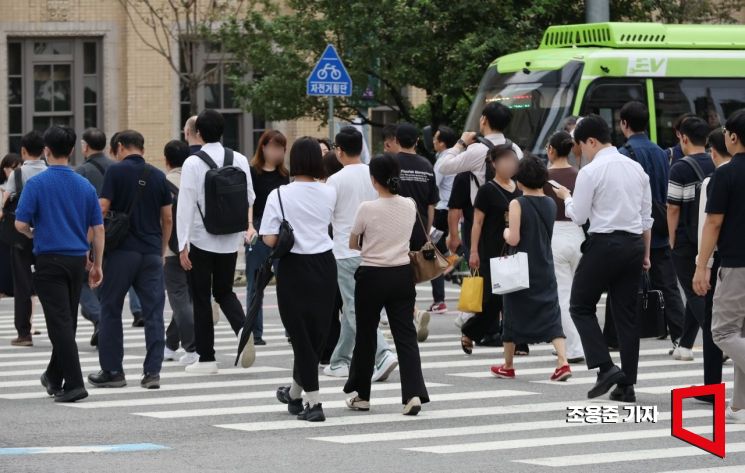 At the Gwanghwamun intersection in Jongno-gu, Seoul, citizens are hurrying on their way to work. Photo by Jo Yongjun jun21@
The change in office workers' lunch hours is believed to be influenced by more companies implementing staggered lunch hours after COVID-19. During the COVID-19 period, the government recommended workplaces to stagger lunch hours. Additionally, in the IT industry, flexible work hours have replaced the 9-to-6 schedule, allowing employees to freely set their commuting and lunch times. This culture of autonomy seems to have changed lunch hours as well.
Changed Work Culture, Leaving Work 19 Minutes Earlier
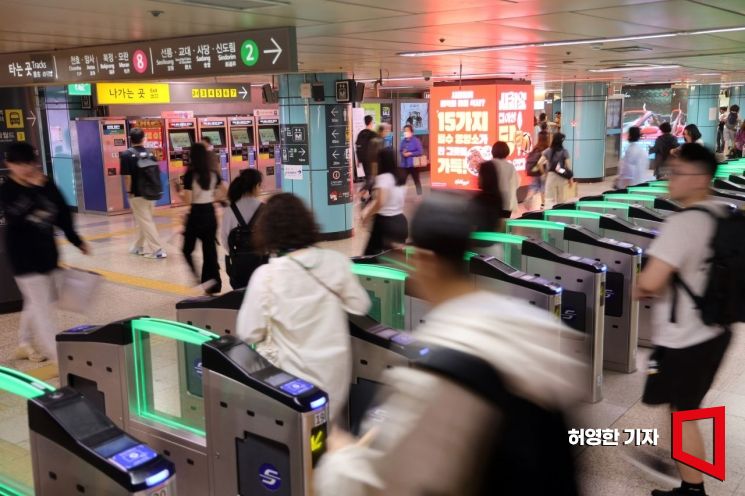 Passengers who got off at Jamsil Station in Seoul are exiting the ticket gate. Photo by Younghan Heo younghan@
As evening company dinners have disappeared and more workers prioritize work-life balance (WLB), leaving work has also become earlier. Looking at subway boarding counts by time, the proportion of rides between 5 PM and 6 PM in the five business districts increased from 13% in 2019 to 23% this year, a 10 percentage point increase.
Comparing 2019 and this year (January to August), the average subway boarding time during leaving work hours in the five districts moved 19 minutes earlier. In 2019, it was 6:47 PM; this year, it is 6:28 PM. By district, during the same period, Guro moved 21 minutes earlier, Gwanghwamun and Gangnam 20 minutes earlier, Pangyo 17 minutes earlier, and Yeouido 14 minutes earlier.
Office workers' lifestyle patterns after work have also changed. Comparing sales after leaving work, consumption in food-related sectors decreased, while spending on leisure activities increased. The number of sales transactions in food sectors during evening hours dropped by about 8% compared to five years ago, totaling 4.7 transactions. Spending on leisure activities increased from an average monthly amount of 72,000 KRW in 2019 to 86,000 KRW this year, and the number of transactions per person also rose from 2.1 to 2.3.
© The Asia Business Daily(www.asiae.co.kr). All rights reserved.



















