Choi Sang-mok Attends G20 Finance Ministers and Central Bank Governors Meeting
Bilateral Talks with Finance Ministers of Japan, Australia, and Finland
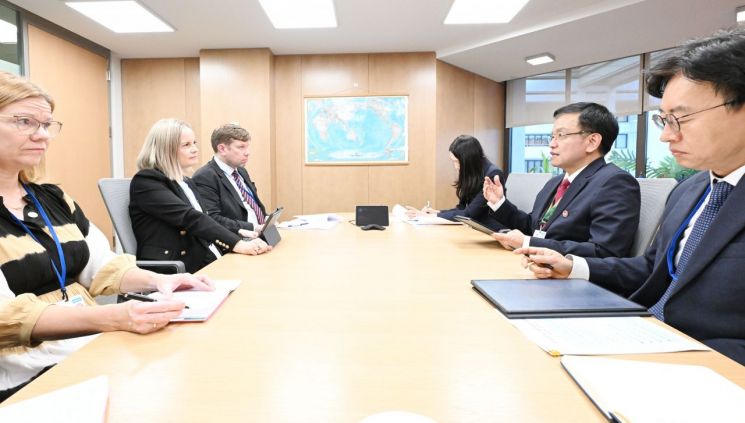 Choi Sang-mok, Deputy Prime Minister for Economic Affairs and Minister of Economy and Finance, who is visiting Washington DC, USA to attend the G20 Finance Ministers' Meeting, is meeting with Riikka Purra, Finland's Minister of Finance, at the International Monetary Fund (IMF) on the afternoon of the 23rd (local time).
Finance leaders of the Group of Twenty (G20) assessed that while the global economy remains resilient, downside risks are increasing amid high uncertainty.
They identified escalating wars and conflicts, economic fragmentation, surging commodity prices, delayed inflation, frequent extreme abnormal weather, severe volatility in financial markets, and excessive public and private debt as negative factors amplifying downside risks.
Choi Sang-mok, Deputy Prime Minister and Minister of Economy and Finance, attended the 4th G20 Finance Ministers and Central Bank Governors Meeting for 2024 held in Washington D.C., USA, on the 23rd and 24th (local time), in conjunction with the International Monetary Fund (IMF) and World Bank (WB) Annual Meetings.
The meeting was conducted in three sessions covering multilateral development bank (MDB) reform, financial issues and financial inclusion, and G20 finance track priorities and global economic cooperation measures.
Member countries agreed that over the past 25 years, remarkable achievements have been made in establishing a global financial regulatory system centered on the Financial Stability Board (FSB) and setting up a global health support system to counter the global financial crisis and the pandemic. However, they emphasized that the global economy still faces various challenges.
In particular, many member countries pointed out key challenges including the widening inequality and climate change prioritized by Brazil this year, global economic fragmentation, historically low growth rates, increasing debt vulnerabilities and reduced fiscal space, rising uncertainties due to technological changes, and demographic shifts.
Member countries shared the recognition that the G20 meetings should serve as a crucial platform for global cooperation to address these diverse challenges. They stressed the need to expand discussions on reducing inequality, proactive climate transition efforts, restoring the multilateral trading system, improving governance of international financial institutions, economic structural reforms, and resolving global debt issues.
Deputy Prime Minister Choi welcomed the establishment of the MDB reform roadmap, stating, "This roadmap expands the role of MDBs beyond supporting development in low-income countries to addressing global challenges such as climate change, and lays the foundation for providing long-term and stable funding to support these efforts." He added, "Through cooperation among MDBs, it will be possible to enhance financial accessibility and development effectiveness, enabling tailored responses that meet the needs of recipient countries and more systematic support."
Finally, Deputy Prime Minister Choi proposed a leading role for the G20 in restoring the global order and norms in response to the fragmentation and growing uncertainty of the world economy. He said, "To this end, we must restore the multilateral trading order centered on the World Trade Organization (WTO) and seek comprehensive solutions to global debt vulnerabilities, including debt restructuring for low-income countries."
He also urged, "Reflecting changes in the global economic structure, we will improve the diversity and equity of senior positions in international organizations and enhance governance of international financial institutions to expand policy participation of recipient countries."
During the two-day meeting, Deputy Prime Minister Choi also held talks with finance ministers from key countries including Finland, Australia, and Ukraine.
On the 23rd, he met with Finland’s Finance Minister Riikka Purra to exchange views on solutions to population aging and discussed expanding cooperation on advanced fields such as artificial intelligence (AI) and supply chains for critical minerals including nickel sulfate and cobalt sulfate. Regarding Ukraine, they agreed to fulfill promised support this year, including in the health sector, and to closely cooperate with the international community on assistance to Ukraine.
Deputy Prime Minister Choi also met for the first time with Japan’s Finance Minister Kat? Katsunobu, who took office on the 1st. Marking the 60th anniversary of the normalization of diplomatic relations between Korea and Japan next year, they agreed to deepen their cooperative relationship through continuous communication and joint efforts.
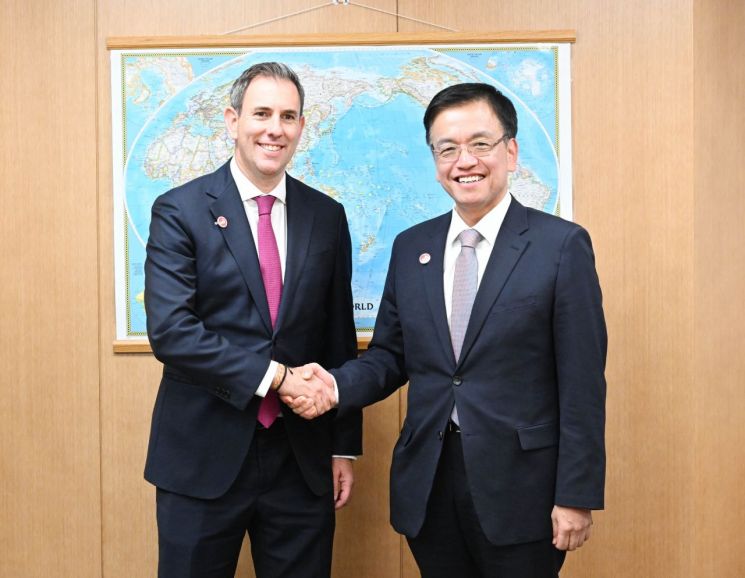 Choi Sang-mok, Deputy Prime Minister for Economic Affairs and Minister of Strategy and Finance, who is visiting Washington DC, USA to attend the G20 Finance Ministers' Meeting, is shaking hands and taking a commemorative photo with Jim Chalmers, Australian Treasurer, on the 24th (local time) before their meeting at the International Monetary Fund (IMF).
He pledged to strengthen cooperation with Australian Finance Minister Jim Chalmers on common interests such as supply chains and climate change response. With Ukrainian Finance Minister Serhiy Marchenko, he agreed to enhance cooperation including the participation of Korean companies in various Ukrainian support projects such as the Economic Development Cooperation Fund (EDCF) and the Ukraine Donor Platform (UDP).
© The Asia Business Daily(www.asiae.co.kr). All rights reserved.
![Clutching a Stolen Dior Bag, Saying "I Hate Being Poor but Real"... The Grotesque Con of a "Human Knockoff" [Slate]](https://cwcontent.asiae.co.kr/asiaresize/183/2026021902243444107_1771435474.jpg)

















