Discussion on 'OTT Industry Outlook' Held on the Afternoon of the 23rd
"Not Survival of the Fittest but Coexistence, Netflix as an Ally"
Predictions have emerged that the strategy of domestic online video service (OTT) platforms next year will shift from expanding subscriber numbers to prioritizing profitability. Experts suggested that governance changes and policy support must accompany the growth of domestic OTT operators.
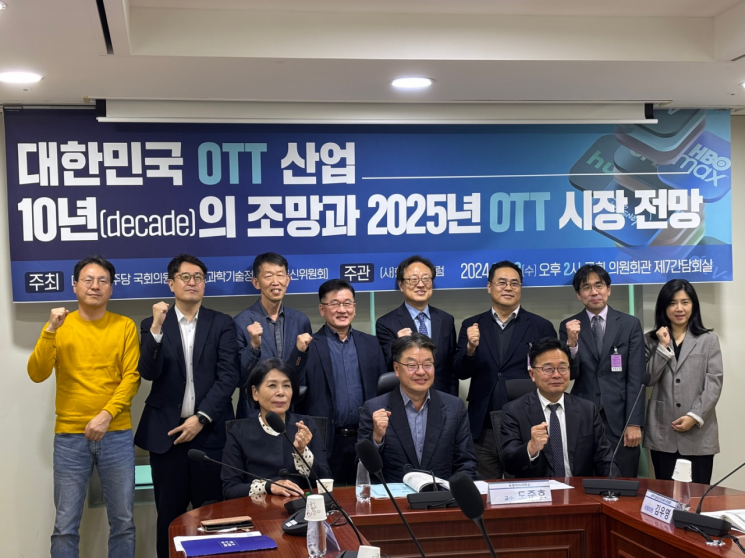 On the afternoon of the 23rd at 2 PM, participants of the discussion titled "A Decade Review of the Korean OTT Industry and the 2025 OTT Market Outlook," held at the National Assembly Members' Office Building in Yeouido, are taking a commemorative photo. Photo by Hwang Seoyul chestnut@
At the discussion titled "A Review of 10 Years of the Korean OTT Industry and the 2025 OTT Market Outlook," held at the National Assembly Members' Office Building in Yeouido at 2 p.m. on the 23rd, Yoo Geon-sik, former head of the KBS Public Media Research Institute and visiting professor at Sungkyunkwan University, stated, "All OTT services have been focusing on expanding profitability since last year, and to achieve this, price increases, expanded advertising, restructuring, and mergers and acquisitions (M&A) will continue."
Yoo also predicted that OTT companies will transform from independent survival to coexistence. He cited global cases such as Paramount+ selling the animation 'South Park' and the drama 'Yellowstone' to other companies, and HBO Max reselling some content to Roku and Fox's ad-supported free streaming services (FAST). Yoo said, "Next year, cooperation among media companies and various collaborations utilizing OTT's interactivity will be activated."
He also anticipated that media companies will accept Netflix not as an adversary but as an ally. Yoo said, "Warner Bros., Discovery, and Disney have started supplying content to Netflix, and domestically, as the exclusive content rights of terrestrial broadcasters and Wavve come to an end, Netflix is reportedly actively courting content." He added, "In situations where content production costs cannot be recovered through advertising or overseas sales, cooperation cases with Netflix will increase."
Additionally, he predicted ▲ the introduction of AI in OTT ▲ a shift from subscription to advertising-centered models ▲ a shift of interest from dramas to entertainment and sports content ▲ and the leadership of OTT moving from broadcasters to telecommunications companies.
Experts emphasized the need for governance changes by the government for the development of the domestic OTT industry. Ahn Jeong-sang, adjunct professor at Chung-Ang University, pointed out, "Currently, content and media-related matters are handled by three ministries: the Ministry of Culture, Sports and Tourism, the Ministry of Science and ICT, and the Korea Communications Commission. When related discussions occur, only parts without disagreement among the three ministries are issued as joint policies," criticizing the current situation.
He added, "A ministry integrating the entire media sector, such as a Ministry of Media or a Media Communication Center, should be established. Accordingly, standing committees could be reorganized, affiliated agencies integrated, and naturally, integrated media legislation could be created."
There was also an opinion that domestic OTT operators should pay attention to differentiation strategies. Lee Sang-won, professor of media studies at Kyung Hee University, said, "They could pursue differentiation by focusing on entertainment-oriented OTT or devise methods such as joint investment followed by profit sharing." He continued, "Strengthening strategic alliances through FAST could also be a method. Global distribution is important, and while direct entry has limitations, indirect entry through FAST could be attempted."
Policy support was also deemed necessary. Professor Lee said, "If indirect entry is made through FAST, we need to consider how to support distribution and research and development (R&D). The fund creation policy by the Media Content Convergence Development Committee is good, but private investment must be activated, and there are concerns about whether this can be achieved in a short time."
Choi Se-kyung from the Korea Institute of Startup & Entrepreneurship Development said, "A method is needed to ensure that the profits of global operators return to Korea, similar to the Broadcasting Development Fund (hereafter, Bangbal Fund)." She added, "We need to consider ways to attract investment rather than just collecting taxes, and policy is important in this regard."
However, voices called for a multifaceted approach. Kim Yong-hee, a specialist at Open Route, said, "There is discussion about imposing the Bangbal Fund, but in Europe, the fund means recovering additional profits when an operator's profits exceed their investment in that country." He added, "In Europe, Netflix can get refunds if it invests heavily in a country, but in Korea, there is a regulatory mindset that the higher the market share, the more fund or taxes must be paid."
Kim also said, "Instead of OTT platforms expanding overseas or exporting completed Korean content, Korean capital going abroad to produce content and distributing it through global OTTs is another method." He concluded, "If the goal is solely to maximize profits for Korean content operators, globalization will never be achieved, nor will fair competition."
© The Asia Business Daily(www.asiae.co.kr). All rights reserved.
![Clutching a Stolen Dior Bag, Saying "I Hate Being Poor but Real"... The Grotesque Con of a "Human Knockoff" [Slate]](https://cwcontent.asiae.co.kr/asiaresize/183/2026021902243444107_1771435474.jpg)











