KEPCO Announces Increase Only in Industrial Electricity Rates
KCCI and KBEA Comment "Business Activity Contraction"
Semiconductor, Steel, and Other Companies Express Concerns
"Companies with Large-Scale Production Facilities Face Difficulties"
The government and Korea Electric Power Corporation (KEPCO) announced on the 23rd that they will raise industrial electricity rates by 16.1 won per kilowatt-hour (kWh) starting from the 24th, prompting a series of concerns from the business community and industrial sectors. They particularly worried that the increase in electricity rates would raise industrial costs and dampen business activities.
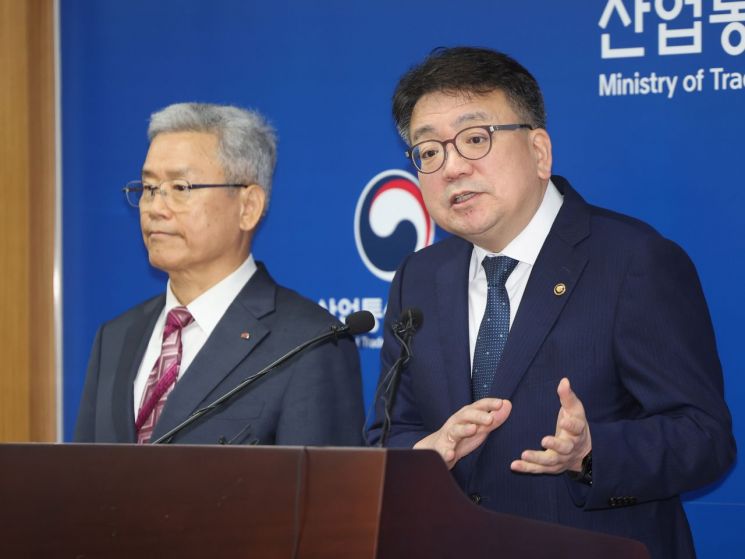 On the morning of the 23rd, Choi Nam-ho, the 2nd Vice Minister of the Ministry of Trade, Industry and Energy, and Kim Dong-chul, President of Korea Electric Power Corporation, are holding a briefing on electricity rate increases at the Ministry of Trade, Industry and Energy press room in the Government Complex Sejong.
 [Image source=Yonhap News]
Immediately after KEPCO announced the 'Electricity Rate Adjustment Plan' that day, business organizations issued consecutive statements expressing discomfort. The Korea Chamber of Commerce and Industry stated, "We are concerned about the impact on corporate competitiveness as industrial electricity rates are raised amid a challenging business environment due to the expansion of global economic uncertainties," adding, "While we understand that the electricity rate increase is inevitable, continuously raising only the industrial electricity rates, which directly affect manufacturing costs, places a burden on business activities?the source of growth?and could damage industrial competitiveness." They further emphasized, "While reflecting the factors behind the electricity rate increase, it is necessary to consider a plan where not only the industrial sector but all electricity consumers in our society share the costs and actively participate in energy efficiency improvements."
They also said, "We hope that clear future directions for electricity rate adjustments will be provided so that companies can establish future plans and management strategies realistically, and that follow-up measures such as expanding differentiated tax credits for energy-saving facility investments by company, promoting zero-carbon energy investments, and strengthening technology development will be prepared." They added, "Considering the national economic importance of energy supply stability, we also expect the National Assembly to expedite the passage of pending bills such as the National Power Grid Expansion Act, Offshore Wind Power Development Act, and Special Act on Radioactive Waste Disposal Facilities."
The Federation of Korean Industries also expressed concern, stating, "We worry that the differential increase for large corporations may accelerate the contraction of domestic industrial business activities, which are already at their limits due to high inflation, high exchange rates, and high interest rates." They added, "In the mid to long term, a cost-based electricity rate determination system should be established," and "It is necessary to consider a positive approach that rewards electricity savings rather than a negative approach of raising rates as a means of energy conservation."
Companies also appear burdened by the electricity rate hike. This is especially true for the semiconductor industry, which requires a large amount of electricity in the production process. A representative from Company A said, "The electricity rate increase is expected to cause cost increases and significant management difficulties, so we are very concerned," adding, "We believe that difficulties will be offset if subsidies, tax benefits, and other tangible support for companies are concretized in the National Assembly." Company B said, "While we partially agree with the necessity of the electricity rate increase, selective increases only for industrial electricity will be a significant burden for companies with large-scale production facilities." Company C said, "Electricity costs do not constitute a large portion of the overall cost structure, so the impact is expected to be limited," but added, "Companies need to make their own efforts such as improving energy efficiency and reducing usage."
The automobile industry is expected to be less directly affected because electricity costs have a relatively small impact on production costs compared to other industries. However, the industry believes that if prices of steel, parts, and other materials used in automobile production rise due to the electricity rate increase, production costs could also rise accordingly. According to data from Statistics Korea and the Bank of Korea Economic Statistics System, electricity costs account for 0.71% of the manufacturing costs in the automobile industry. Assuming a 5.32 percentage point increase in electricity rates, the impact on automobile production costs would be about 0.037 percentage points, which is very minimal. On the other hand, electronic components, video, audio, and communication equipment used as automobile parts have an electricity cost ratio of 1.35%, so the electricity rate increase could indirectly affect automobiles.
Steelmakers such as Hyundai Steel and Dongkuk Steel, which mainly use electric furnaces, responded with a "bad situation getting worse." Officials explained that the crisis has deepened as electricity costs, which account for a significant portion of production costs, have surged amid a sluggish trend caused by decreased steel demand and low-priced Chinese competition since the second half of last year. Hyundai Steel has been reducing production while conducting maintenance on electric furnaces over the past six months, and Dongkuk Steel has been operating only during nighttime hours when electricity rates are relatively cheaper since June. A steel industry official said, "The sharp rise in electricity costs amid production cuts due to demand stagnation is a severe blow," adding, "Performance remained poor even in the third quarter, the peak construction season, and there are no factors for a rebound in the fourth quarter, so difficulties are expected to continue."
Meanwhile, KEPCO froze rates for residential and general-use customers considering the burden on low-income households and raised electricity rates only for industrial customers. Industrial customers account for 1.7% of all customers (about 440,000 households) but consume 53.2% of total electricity. KEPCO decided to raise industrial electricity rates for large-volume customers such as large corporations (industrial category B) by 10.2%, and for small and medium-sized enterprises (industrial category A), which are facing difficulties due to the economic downturn, by 5.2%. As of last year, industrial category B customers numbered about 41,000 households, accounting for 0.1% of the total (25,129,000 households). Their electricity consumption was 263 TWh, representing 48.1% of total electricity consumption (546 TWh).
A KEPCO official explained, "The electricity rate increase is inevitable to expand the power grid for future advanced industries such as semiconductors and artificial intelligence (AI) and to maintain and repair essential power facilities to prevent blackouts and failures," adding, "However, this electricity rate adjustment reflects accumulated cost increases while comprehensively considering inflation and the burden on low-income households."
© The Asia Business Daily(www.asiae.co.kr). All rights reserved.

















