'Partial Amendment to the Literary Promotion Act' and Others
Including the Establishment of a Graduate School of Translation
“I felt a connection with Deborah Smith. For me, the standard of a faithful translation to the original work lies in ‘whether it properly conveys the emotions and tone.’” This is what novelist Han Kang said at the 2016 Man Booker International Prize award press conference. Following Han Kang’s Nobel Prize in Literature win, the importance of translation has been highlighted, prompting the National Assembly and the government to begin supporting literature and translation, which had been neglected until now.

The New York Times (NYT) in the United States praised the English version of The Vegetarian when it was selected as the winner of the 2016 Man Booker International Prize, a prestigious British literary award, stating that “the elegant translation transformed the Korean original into sharp and vivid English, preserving Han Kang’s keen exploration of whether true innocence is possible in a cruel world.” Alongside Han Kang, Deborah Smith, a British translator in her twenties who translated The Vegetarian, was recognized as a key contributor.
After Han Kang’s Nobel Prize win, bills to strengthen support for literary translation have also been proposed in the National Assembly. According to the National Assembly’s legislative information system, on the 14th, Kim Yoon-deok, a member of the Democratic Party of Korea, introduced the “Partial Amendment to the Literary Promotion Act” aimed at the international expansion of Korean literature and the training of professional translators. The amendment focuses on establishing a legal foundation for the Korean Literature Translation Institute to set up graduate schools of translation based on the Higher Education Act. Regarding the purpose of the amendment, Representative Kim stated, “This bill will play a decisive role in the future development of Korean literature and contribute to discovering the second Han Kang.”
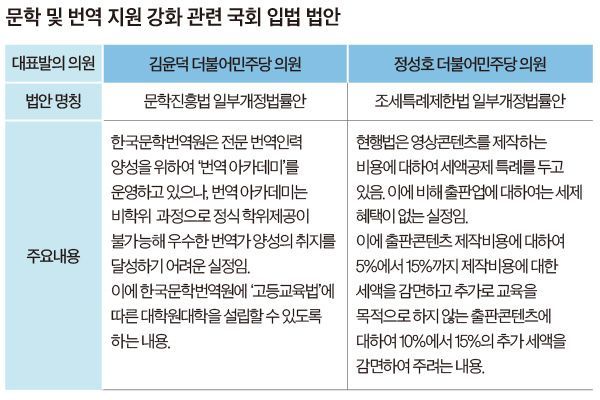
The National Assembly is also pushing a bill to provide tax benefits for the production of publications to revitalize Korean reading culture. The “Partial Amendment to the Restriction of Special Taxation Act,” introduced by Jung Sung-ho of the Democratic Party on the 11th, includes provisions allowing small and medium-sized enterprises to receive a basic tax credit of 15%, medium-sized enterprises 10%, and large enterprises 5% when producing publications, with an additional tax credit of up to 15% for publishing literary and humanities books. The amendment takes into account that while various tax benefits are provided to production companies in the video content sector to promote K-culture, there are no tax benefits for publication production.
The government also plans to secure additional budgets related to the expanded overseas opportunities for domestic novels. On the 16th, the Ministry of Culture, Sports and Tourism held a meeting with related organizations at the Korean Literature Translation Institute in Gangnam-gu, Seoul, to explore ways to expand the domestic and international base and overseas advancement of Korean literature. At the meeting, Lee Jeong-geun, head of the Korean Literature Translation Institute, emphasized, “We will establish a foundation where the second and third Han Kang can emerge.”
According to the Ministry of Culture, Sports and Tourism, the 2025 budget includes 3.12 billion KRW allocated to the Korean Literature Translation Institute’s support project for Korean literature translation and publication. This is an increase of about 800 million KRW, or 34.5%, compared to the previous year.
The Ministry stated, “The demand for translation and publication support projects has increased by more than 30% annually, and with Han Kang’s Nobel Prize win, the demand for translation from domestic and international publishers is expected to rise, leading to opinions that the translation and publication budget is still insufficient. We plan to make efforts to secure additional budgets for translation and overseas expansion support.”
Kim Ji-hyun, Legal Times Reporter
※This article is based on content supplied by Law Times.
© The Asia Business Daily(www.asiae.co.kr). All rights reserved.


















