Permanent and Special Exhibitions Open, Gaonnarae Operation and Outdoor Exhibitions
One-Year Full Renovation and Remodeling, Free Admission on 1st and 2nd Floors
First Public Display of Busan Tangible Cultural Heritage Amitanaeyeongdo and More
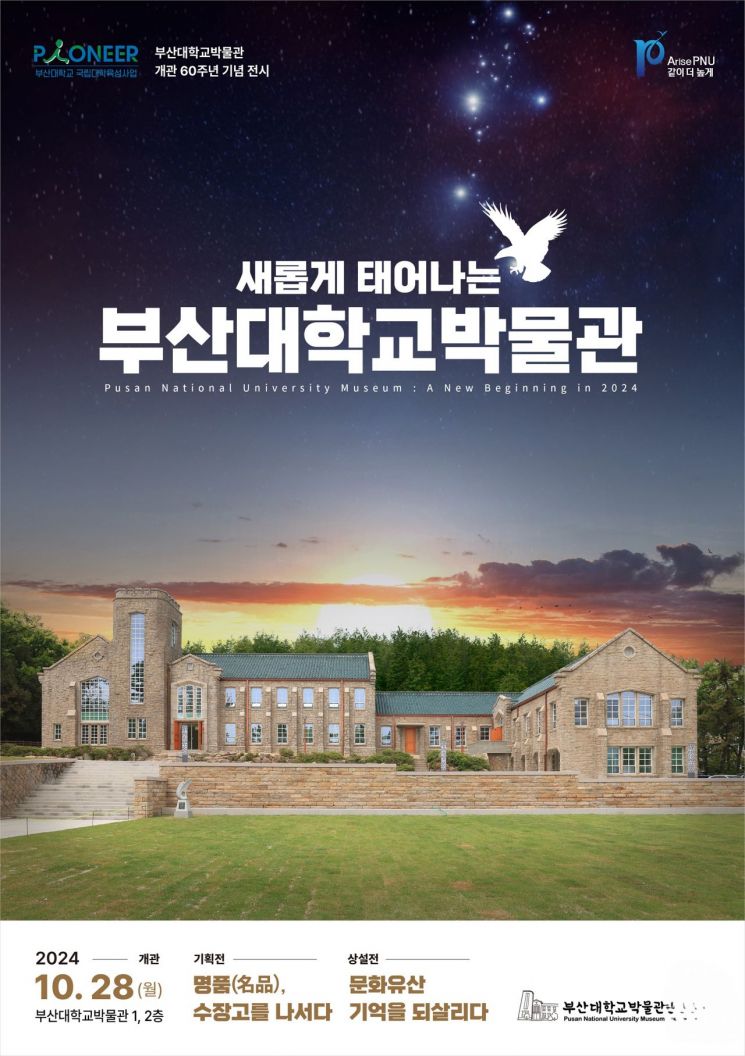
Pusan National University (President Choi Jae-won) announced on the 23rd that it will grandly reopen its on-campus museum, which preserves the founding spirit and history of the university from its early establishment, after extensive renovation and remodeling on the 28th.
In addition, the Pusan National University Museum (Director Lim Sang-taek, Professor of Archaeology) has prepared exhibition events to commemorate the reopening, including the special exhibition for the museum’s 60th anniversary, “Masterpieces (名品), Leaving the Storage,” and the permanent exhibition “Cultural Heritage, Reviving Memories,” which features a complete overhaul of the exhibition halls.
This exhibition is planned and implemented as part of the 2024 National University Development Project, and the opening ceremony will be held at 2 p.m. on the 28th at Saebyeoktteul in front of the Pusan National University Museum. The ceremony will be attended by many internal and external guests, including PNU President Choi Jae-won, and will include a presentation of appreciation plaques to supporters and donors such as Professor Emeritus Jeong Jing-won of the Archaeology Department. Performances by students from PNU’s College of Arts will follow to celebrate the opening.
The Pusan National University Museum was established in 1955 shortly after the Korean War and played a crucial role as a national treasure refuge for 18,833 important cultural heritage items from the National Museum of Korea, which had been stored in the Busan Regional Tax Office warehouse. It was officially opened in May 1964 and is celebrating its 60th anniversary this year.
This reopening event, following a year of seismic reinforcement and remodeling work, will be the first to reveal the museum’s antique appearance, which restored the ceiling structure (rafters) of modern wooden architecture from 70 years ago, along with the fully revamped exhibition halls and various internal facilities.
The newly revamped exhibitions and cultural spaces are designed not only to change the exterior but also to share the historical significance and professional capabilities of the Pusan National University Museum with the public.
The first part of the permanent exhibition, titled “Cultural Heritage, Reviving Memories,” reconstructs history through various relics and artifacts excavated by the Pusan National University Museum.
Permanent Exhibition Hall 1 (Prehistoric and Protohistoric Hall) features an exhibition on “Restoring Daily Life through Artifacts,” showcasing major excavation and burial cultural heritage from the prehistoric to the Samhan period, including the Ulsan Geomdan-ri site and Sacheon Neukdo site. Permanent Exhibition Hall 2 (Ancient Hall) focuses on the rediscovery of the forgotten kingdom of Gaya, centered on the Pusan Bokcheon-dong Tumuli and Gimhae Yean-ri Tumuli, demonstrating long-accumulated academic achievements for historical restoration.
The second part, the special exhibition titled “Masterpieces (名品), Leaving the Storage,” displays Pusan City’s tangible cultural heritage and major collected relics that had been kept in storage and not publicly exhibited due to conservation treatment and academic research. Notably, “Chilseongdo,” “Amitanaeyeongdo,” “Wooden Seated Amitabha Buddha Statue and Associated Artifacts,” and the registered cultural heritage “Nosangik Sim-ui” will be publicly unveiled for the first time through this special exhibition.
The third part, the open space “Gaonnarae: Soaring Toward Truth,” refers to the complex cultural space that was first opened on May 28. “Gaonarae” operates as “Gaon” (a pure Korean word meaning “center”), a space where anyone can easily access over 5,000 specialized books on history, archaeology, folklore, art, and Buddhism, and “Narae” (wing), a multipurpose cultural space for rest, study, lectures, exhibitions, and performances. Since its initial opening, it has quickly become a representative landmark of Pusan National University, attracting many campus members and citizens.
The fourth part, the outdoor exhibition “Saebyeoktteul and Stone Cultural Heritage,” can be experienced in the lawn plaza “Saebyeoktteul,” created after the removal of buildings and trees that blocked the museum’s front, and the outdoor exhibition space displaying stone cultural heritage owned by the Pusan National University Museum. These stone cultural heritages were originally located behind the museum annex but have been relocated and restored to Saebyeoktteul in front of the museum through this renovation. This allows visitors to comfortably view various stone heritages, including Pusan City’s tangible cultural heritage “Daegoksa Five-story Stone Pagoda,” “Bangogsa Stone Buddha Seated Statue,” and various Muninseok (scholar statues) and Beoksu (guardian figures).
Lim Sang-taek, Director of the Pusan National University Museum, stated, “Over the years, the Pusan National University Museum has been a core facility for collecting, preserving, and researching cultural heritage through numerous excavations. Now, the newly reopened museum will evolve into a vibrant complex cultural facility that engages with campus members and the local community through active exhibitions, education, and cultural events, beyond just preservation and academic research.” He added, “We ask for your continued support for the Pusan National University Museum, which will always be open and inclusive to everyone.”
© The Asia Business Daily(www.asiae.co.kr). All rights reserved.
![Clutching a Stolen Dior Bag, Saying "I Hate Being Poor but Real"... The Grotesque Con of a "Human Knockoff" [Slate]](https://cwcontent.asiae.co.kr/asiaresize/183/2026021902243444107_1771435474.jpg)
















