Medical AI company Lunit announced on the 23rd that two European studies proving the early detection of breast cancer and the reduction of medical staff workload using its AI mammography image analysis solution, 'Lunit Insight MMG,' have been published in world-renowned medical journals. These studies were published in the American Medical Association's 'JAMA Network Open' (IF 10.5) and the North American Society of Radiology's 'Radiology: Artificial Intelligence' (IF 8.1), respectively.
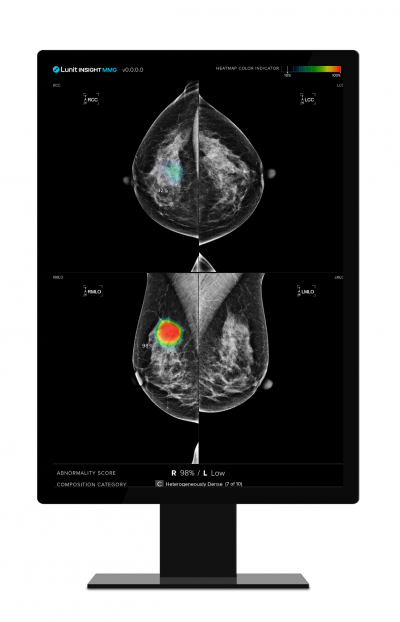
Among them, the study published in JAMA Network Open was led by Dr. Solveig Hofvind's research team at the Norwegian Institute of Public Health. It retrospectively analyzed data from 116,495 women aged 50 to 69 who participated in Norway's national breast cancer screening program, 'BreastScreen Norway.' The mammography screening images, conducted three times at two-year intervals, were analyzed using Lunit Insight MMG, confirming the possibility that AI can predict breast cancer occurrence up to six years in advance.
The AI assigns a score from 0 to 100 to each breast, with higher scores indicating a higher likelihood of breast cancer. The study found that the average AI score difference between breasts where cancer was later detected and the opposite breast increased over time. This difference gradually increased from an average of 21.3 points at the first screening, 30.7 points at the second, to 79.0 points at the third. In contrast, women without breast cancer maintained a score difference of less than 10 points between both breasts across all screenings.
Additionally, the research team classified the top 1% with AI scores of 91.3 or higher as the 'high-risk group.' Among patients where cancer was actually detected, 66% had already shown AI scores of 10 or higher, indicating a positive likelihood, at least two years prior. Notably, 4.5% of patients had scores of 10 or higher observed as early as 4 to 6 years before diagnosis.
Lunit explained, "These study results suggest that quantifying breast cancer risk through AI enables early identification of high-risk groups, allowing for tailored prevention and treatment strategies such as focused monitoring or additional testing."
The study published in Radiology: Artificial Intelligence was conducted by Dr. Mohammad Talal Elhakim's research team at Odense University Hospital in Denmark. They analyzed 249,402 mammography screening images. This study verified the effectiveness of introducing Lunit Insight MMG into the currently recommended 'double reading' system by two radiologists in Europe through three different scenarios.
As a result, when AI replaced the first radiologist's reading, the workload of doctors was reduced by 48.8% while maintaining cancer detection accuracy. When AI replaced the second radiologist, the reading workload decreased by 48.7%, and the recall rate for re-examination dropped by 2.2%, although sensitivity?the probability of correctly diagnosing actual positive cases?slightly decreased by 1.5%.
Among the three scenarios, the most effective method was AI pre-classifying patients into high-risk and low-risk groups. In this case, the reading workload was reduced by 49.7%, while showing positive results in sensitivity, positive predictive value (PPV), and negative predictive value (NPV).
Lunit stated, "This study empirically demonstrates that clinical application of AI can significantly improve the efficiency of healthcare systems. In particular, introducing AI into breast cancer screening greatly reduces the workload of medical staff while maintaining or improving diagnostic accuracy. This is expected to provide important evidence for the effectiveness of AI-based medical services in countries facing medical workforce shortages."
Seobum Seok, CEO of Lunit, said, "This European study once again proves that AI can play a crucial role in early breast cancer diagnosis and healthcare system efficiency. Based on these research results, Lunit will accelerate the clinical application of AI technology and strive to ensure that more patients benefit from accurate and rapid diagnosis."
© The Asia Business Daily(www.asiae.co.kr). All rights reserved.
![Clutching a Stolen Dior Bag, Saying "I Hate Being Poor but Real"... The Grotesque Con of a "Human Knockoff" [Slate]](https://cwcontent.asiae.co.kr/asiaresize/183/2026021902243444107_1771435474.jpg)
















