'Considering Burden on Ordinary Citizens' Residential and Small Business Rates Frozen
Industrial Rates Up 9.7%...Large Enterprises 10.2%↑, SMEs 5.2%↑
Industry Voices "Concerns Over Business Activity Contraction"
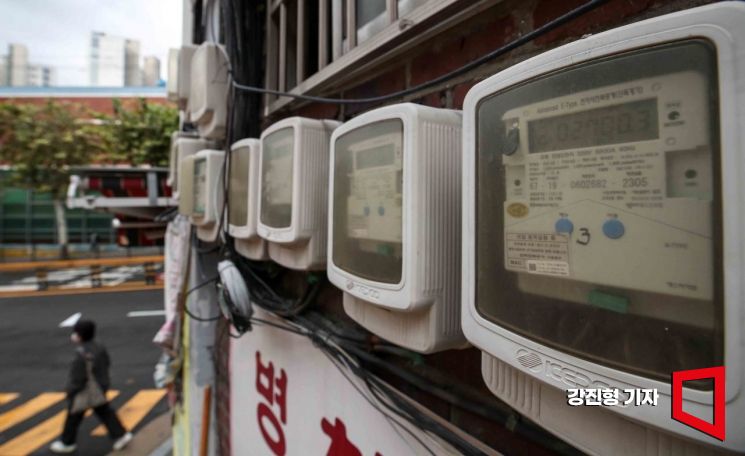
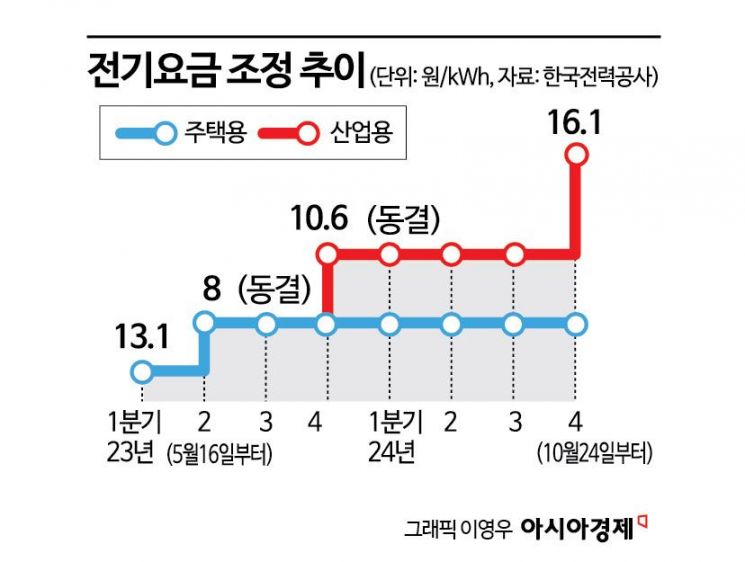
The government and Korea Electric Power Corporation (KEPCO) will raise industrial electricity rates by 16.1 KRW per kWh starting from the 24th. To minimize the burden on the low-income economy, electricity rates for residential and general use (small business use) will not be increased.
KEPCO announced the 'Electricity Rate Adjustment Plan' outlining these details on the 23rd.
A KEPCO official explained, "The electricity rate increase is inevitable to expand the power grid for future advanced industries such as semiconductors and artificial intelligence (AI), and to maintain and repair essential power facilities to prevent blackouts and faults. However, this electricity rate adjustment reflects the accumulated cost increases so far while comprehensively considering inflation and the burden on the low-income economy."
First, considering the burden on the low-income economy, rates for residential and general use will be frozen. However, for industrial customers only, the energy charge will be increased by a single-digit rate of 9.7% on average. This means electricity rates will rise by 16.1 KRW per kWh.
Industrial customers account for 1.7% of all customers (about 440,000 households) but consume 53.2% of total electricity usage. KEPCO decided to raise industrial use (Type B) rates, used by large corporations and other large-volume customers, by 10.2%, while increasing industrial use (Type A) rates, mainly used by small and medium-sized enterprises (SMEs), by 5.2%, considering the difficulties faced by SMEs due to the economic downturn. As of last year, industrial use (Type B) customers numbered about 41,000 households, representing 0.1% of the total (25,129,000 households). Their electricity consumption was 263 TWh (terawatt-hours), accounting for 48.1% of total electricity consumption (546 TWh).
KEPCO expects that due to this industrial electricity rate increase, the annual burden for small-scale industrial use (Type A), such as SMEs, will increase by less than 1 million KRW per household. For large corporations using industrial use (Type B), the annual burden is estimated to increase by 1.1 trillion KRW per household.
Since only industrial electricity rates are being raised again this time, following the increase in November last year, it is expected to take more time to resolve KEPCO's massive debt. This is because residential and general use rates have been frozen since the increase in May last year.
Despite six rate hikes and self-help efforts since 2022 due to soaring international fuel prices, KEPCO's cumulative deficit from 2021 through the first half of this year reached about 41 trillion KRW (consolidated basis). As a result, debt reached approximately 203 trillion KRW in the first half of this year, increasing financial burdens. Even though KEPCO recorded profits for four consecutive quarters recently, interest payments on the massive debt continue to accumulate more debt. KEPCO spent 2.28 trillion KRW on interest expenses in the first half of this year alone.
A KEPCO official said, "KEPCO is gradually normalizing electricity rates to eliminate accumulated deficits and secure investment funds for the power grid. Based on this rate adjustment, we will thoroughly implement the self-help efforts promised to the public to accelerate management normalization and focus on power grid construction to contribute to strengthening national competitiveness."
Immediately after the announcement of the industrial electricity rate increase, concerns were raised in the business community.
The Korea Economic Association stated, "We are concerned that the differential increase for large corporations may accelerate the contraction of domestic industrial activities, which are already at their limits due to high inflation, high exchange rates, and high interest rates." The association added, "In the mid to long term, a cost-based electricity rate determination system should be established. It is also necessary to consider a positive approach that rewards electricity savings rather than a negative approach of rate increases as a means of energy conservation."
Companies also expressed concerns about the electricity rate increase. A representative from Company A said, "The electricity rate increase is expected to cause cost increases and significant management difficulties, so we are very worried. We believe that concrete benefits such as subsidies and tax incentives from the National Assembly are necessary to offset these difficulties."
Company B commented, "While we partially agree with the necessity of the electricity rate increase, the selective increase only for industrial electricity will impose a heavy burden on companies with large-scale production facilities." Company C said, "Electricity costs do not constitute a large portion of the overall cost structure, so the impact is expected to be limited. However, companies need to make efforts such as improving energy efficiency and reducing usage."
© The Asia Business Daily(www.asiae.co.kr). All rights reserved.


















