Minister Sang-min Lee Reviews 'Comprehensive Plan for National Safety System Reform'
Focus on Crowd Management Support System... Providing Technical Support
Enhancing Functions by Adding Collected Information and Linking with Local Government CCTV
The government has decided to utilize information such as transportation card usage and Wi-Fi usage in the crowd management system. This is to detect risk factors of crowd congestion in advance and to respond quickly according to the situation.
On the 23rd, Lee Sang-min, Minister of the Ministry of the Interior and Safety, received a report on the "Comprehensive Plan for National Safety System Reform" containing these details and began reviewing the sector-specific response measures already established. Earlier, the government initiated a diagnosis and reform of the overall disaster safety management system following the Itaewon tragedy in 2022. In January last year, it announced a plan to implement this over five years (2023?2027) and decided to promote a special measure focused on "Measures to Prevent Recurrence of Crowd Accidents."
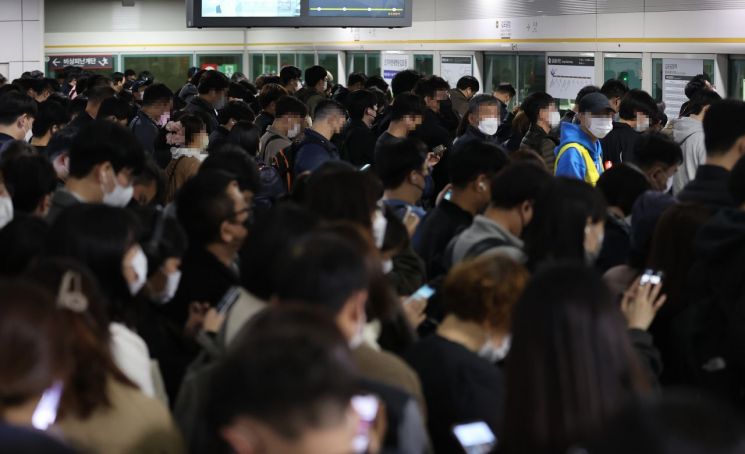
During this year's inspection, Minister Lee focused on the currently operating crowd management support system. The government has built and is utilizing a crowd management support system that manages crowd density risk levels by using telecommunications base station information. During previous events such as the Seoul World Fireworks Festival and other local festivals, the Ministry of the Interior and Safety dispatched staff to provide on-site technical support to ensure proper use of the crowd management support system.
Efforts were also concentrated on eliminating blind spots in crowd accident safety management. The government included "mass gathering crowd accidents" as a type of social disaster to establish a legal basis for safety management and designated disaster management agencies for each multi-use facility starting from July. For festivals without organizers, local governments were given safety management obligations, and the safety management manual for local festival sites was revised and distributed last month.
A joint response system among emergency reporting agencies was also established. It is now mandatory for emergency agencies such as fire and police to conduct on-site verification during joint responses, and information about dispatches from other agencies is provided via text messages to on-site personnel. Additionally, liaison officers have been dispatched between fire and police situation rooms to strengthen cooperation, with plans to expand dispatches to city/provincial fire headquarters and local police agencies.
From next year, existing measures will be further supplemented and developed. The crowd management system will be advanced by adding collected information such as transportation card and Wi-Fi usage and enhancing linkage functions with local government CCTV. To establish the "Integrated Support Center for Disaster Victims," local governments are currently pursuing ordinance revisions. Furthermore, the number of trainees for fire scene commander competency enhancement education will be significantly increased, and virtual disaster scene simulation videos will be developed and distributed. Discussions have also begun on continuously expanding the ICT platform where artificial intelligence monitors forest fires 24/7.
Minister Lee also conducted a review of the "Climate Crisis Innovation Plan" on the same day. A representative example is the "Flood Prevention Measures for Underground Roads to Prevent Casualties," which established a management system including ▲new control standards to strengthen underground road safety management ▲designation of four on-site responsible persons ▲expansion of targets for installation of entry blocking facilities. Additionally, the number of trainees for fire scene commander competency enhancement education will be significantly increased, and virtual disaster scene simulation videos will be developed and distributed. The plan to continuously expand the ICT platform where artificial intelligence monitors forest fires 24/7 is also under consideration. Minister Lee emphasized, "We will continue to check the progress of key tasks with related agencies and experts, disseminate best practices, and actively collect field opinions. Since disasters occur in unpredictable situations, we all must maintain constant vigilance and effort."
© The Asia Business Daily(www.asiae.co.kr). All rights reserved.