Price Crisis at 'Severe' Stage Left Unaddressed for Over 20 Days
"Lukewarm Response to Climate Change... Reserve Supplies Depleted"
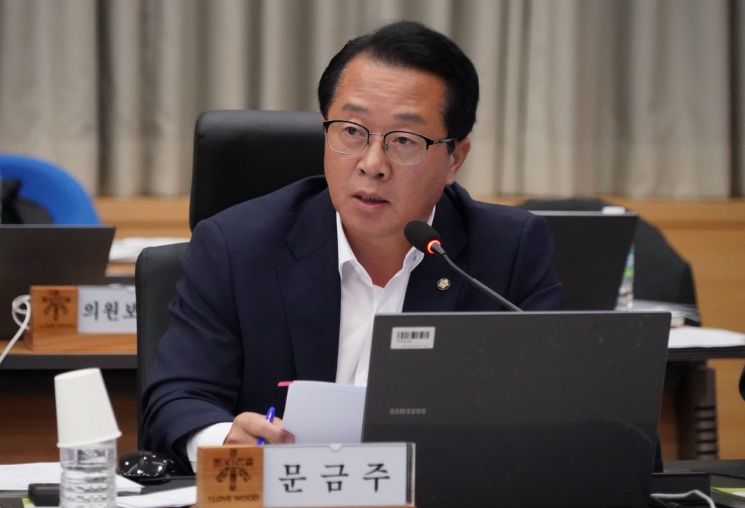 Democratic Party lawmaker Moon Geum-ju is questioning during the audit of the Korea Agro-Fisheries & Food Trade Corporation (aT) held at the National Assembly on the 22nd.
 [Photo by Moon Geum-ju's office]
Criticism arose during the National Assembly audit that the cabbage price surge was caused by the delayed response of the government and the Korea Agro-Fisheries & Food Trade Corporation (aT).
On the morning of the 22nd, Moon Geum-ju, a member of the Democratic Party of Korea (representing Goheung, Boseong, Jangheung, and Gangjin), criticized at the National Assembly audit of the Korea Agro-Fisheries & Food Trade Corporation, stating, “The cabbage price surge this summer is a man-made disaster caused by the delayed response of the government and aT and their lukewarm approach to climate change.”
As of the 21st, the retail price per head of cabbage (premium grade) reached 9,162 won, a sharp increase of 79.54% compared to the same period last year (5,103 won). Signs of this upward trend in cabbage prices had appeared several months earlier. However, aT only prepared the ‘2024 Summer Cabbage Emergency Supply Stabilization Government Purchase Detailed Implementation Plan’ on the 25th of last month, after cabbage prices had already risen.
aT’s ‘Item-specific Crisis Stage Guidelines’ manage prices by categorizing responses into ‘Severe,’ ‘Warning,’ and ‘Caution’ stages during price increases. At the highest ‘Severe’ stage, measures such as discounted supply of stockpiled quantities, direct supply, import tariff reductions, and government direct imports are implemented, as seen in the supply stabilization measures prepared on September 25.
However, despite the cabbage price crisis entering the ‘Severe’ stage on September 4, aT neglected to prepare any detailed plans for about 20 days. Moreover, since the ‘Warning’ stage, which precedes ‘Severe,’ had been ongoing since August 14, preparations should have been made from mid-August, and immediate measures should have been taken once the ‘Severe’ stage began.
The criteria for the ‘Item-specific Crisis Stage Management Guidelines’ are also problematic. The fluctuation rate standard for the ‘Severe’ stage of summer cabbage prices is as high as 79%. Because the ‘Severe’ stage threshold is set excessively high, measures were only implemented after cabbage prices had already surged.
Despite increasing crop damage due to recent climate change and higher-than-average temperatures expected since early August, aT released all government stockpiles on September 6 based on average temperatures, failing to adequately respond to the cabbage price surge in September.
aT assumed that by September, the weather in semi-cold regions such as Gangneung and Pyeongchang would return to temperatures suitable for cabbage growth. However, the persistent high temperatures, 3.1 to 3.4 degrees Celsius above the average maximum temperature, caused poor crop conditions and disrupted smooth supply.
Representative Moon stated, “This cabbage price surge is a representative case that clearly shows the reality of Korea’s agricultural climate change response due to the complacent handling by the government and aT,” and urged, “Institutional improvements such as revising the crisis stage guidelines, developing climate change indicators for crops, and storage technology development must be established as countermeasures.”
© The Asia Business Daily(www.asiae.co.kr). All rights reserved.

















