Incheon Chamber of Commerce Survey of 170 Companies
Financial Risks and Raw Material Supply Disruptions
62% of companies in the Incheon area recognize that geopolitical risks affect corporate management, and 50% have no countermeasures to prepare for these risks.
According to the Incheon Chamber of Commerce and Industry on the 22nd, a recent survey of 170 companies in Incheon on the 'Impact of Prolonged Geopolitical Risks on Incheon Companies' found that 61.8% of respondent companies perceived ongoing geopolitical risks such as the US-China conflict, the Russia-Ukraine war, and Middle East conflicts as 'risk' factors.
Specifically, they mainly experienced 'temporary performance decline (28.8%)' and 'competitiveness decline (27.1%)', and 5.9% felt a 'threat to business continuity.' On the other hand, 1.8% of companies reported that geopolitical risks acted as a 'positive factor.'
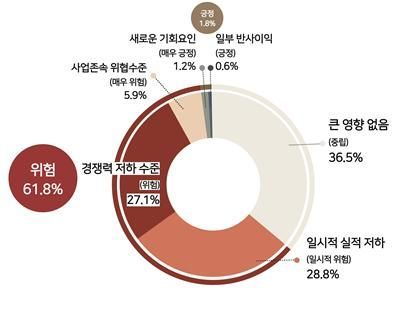 The Impact of Geopolitical Risks on Management [Provided by Incheon Chamber of Commerce and Industry]
The damages experienced by companies were identified as 'financial risks such as exchange rate fluctuations and payment delays (22.4%)', 'production disruptions due to raw material supply issues (19.0%)', and 'increased costs for energy and raw material procurement (19.0%)'. This was followed by 'inventory management disruptions and increased logistics costs (17.6%)', 'restricted access to overseas markets and decreased sales (12.7%)', and 'local business suspension and reduced investment (7.8%)'.
As geopolitical risks prolong, 42.4% of respondent companies have discovered new alternative markets in addition to existing export markets, and 28.9% have switched from overseas procurement of parts and materials to domestic procurement. However, only 4.4% of companies established organizations to respond to external geopolitical risks.
Also, 50.0% recognize the need to prepare for problems arising from geopolitical risks but have not established specific countermeasures. Companies reviewing countermeasures account for 31.8%, those that have already prepared countermeasures are 4.1%, while 14.1% responded that 'there is no need to prepare.'
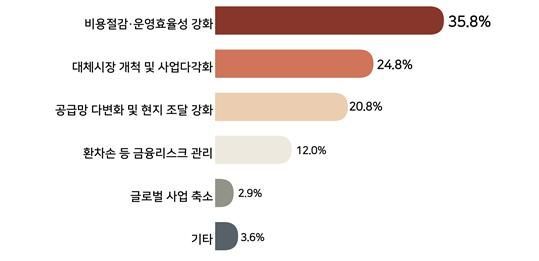
Companies cited their response strategies to geopolitical risks in the following order: 'cost reduction and strengthening operational efficiency (35.8%)', 'pioneering alternative markets and business diversification (24.8%)', 'diversifying supply chains and strengthening local procurement (20.8%)', 'managing financial risks such as exchange losses (12.0%)', and 'scaling down global operations (2.9%)'.
An official from the Incheon Chamber of Commerce and Industry stated, "If supply chain instability intensifies and restrictions on access to overseas markets prolong due to geopolitical risks, the damage to companies is likely to increase."
He added, "Companies are making efforts such as cost reduction to strengthen operational efficiency and pioneering alternative markets, but it is difficult for companies to respond on their own. The government must promptly identify the damage to our companies caused by geopolitical risks, prepare support measures, and also support supply chain diversification," he emphasized.
© The Asia Business Daily(www.asiae.co.kr). All rights reserved.
![Clutching a Stolen Dior Bag, Saying "I Hate Being Poor but Real"... The Grotesque Con of a "Human Knockoff" [Slate]](https://cwcontent.asiae.co.kr/asiaresize/183/2026021902243444107_1771435474.jpg)

















