Statistics Korea Announces Supplementary Survey on Economically Active Population
Regular Employment Decreases While Non-Regular Employment Increases
Female Proportion at 57.3%... Highest Ever Recorded
The number of regular wage workers decreased for the first time in three years, causing the proportion of non-regular workers to jump to the second-highest level ever at 38%. Although the wages of non-regular workers exceeded 2 million won, the wage gap with regular workers reached about 1.75 million won, marking the largest gap on record.
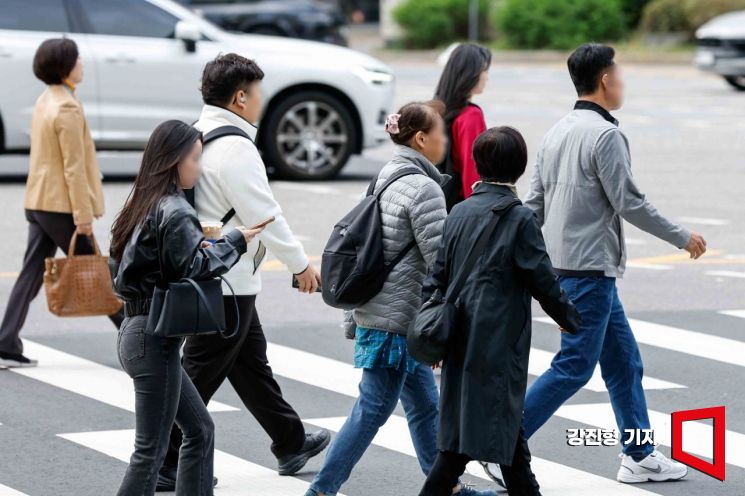 On the 21st, as the morning temperature in Seoul dropped to 9.7 degrees, marking the lowest temperature this fall, citizens near Gongdeok Five-way Intersection in Mapo-gu, Seoul, are wearing coats on their way to work. Photo by Kang Jin-hyung
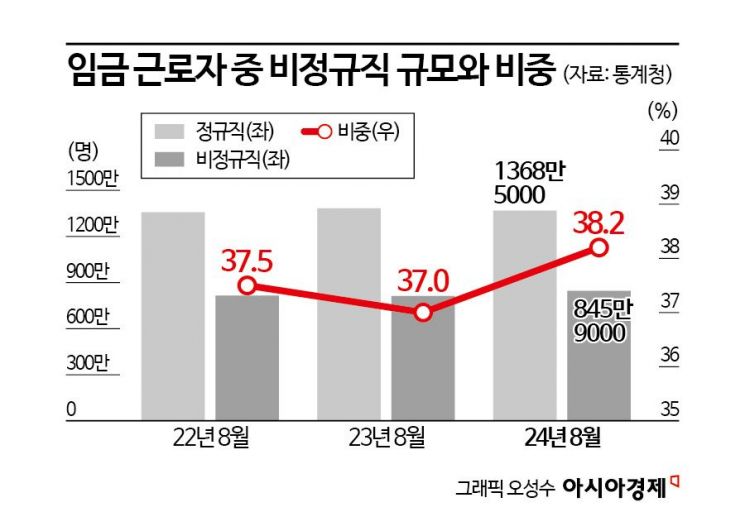
According to the "2024 August Economic Activity Population Supplementary Survey by Employment Type" released by Statistics Korea on the 22nd, the number of non-regular workers as of last August was 8,459,000, an increase of 337,000 compared to the same month last year. Meanwhile, the number of regular workers was 13,685,000, a decrease of 147,000 compared to the same month last year. This is the first decline in three years since August 2021 (-94,000).
Accordingly, the proportion of non-regular workers among wage workers rose by 1.2 percentage points to 38.2%. This is the second-highest figure since related statistics began in 2003. The highest figure was 38.4% in August 2021, with only a 0.2 percentage point difference between the two.
Among non-regular workers, temporary workers numbered 5,628,000, an increase of 369,000 compared to the same period last year. Part-time workers also increased by 383,000 to 4,256,000. On the other hand, atypical workers decreased by 54,000 to 1,903,000. The proportion of part-time workers among non-regular workers reached 50.3%, surpassing 50% for the first time since related statistics began.
Im Kyung-eun, head of the Employment Statistics Division at Statistics Korea, explained, "There is a trend among young and elderly groups, as shown in supplementary surveys, to prefer working the desired hours at the desired times," adding, "The supply and demand for (part-time) jobs are also increasing."
Both male and female non-regular workers increased. The number of males was 3,615,000, an increase of 58,000 compared to the same month last year. Females numbered 4,844,000, an increase of 279,000. While males showed an increasing trend in August 2021 and August 2022 but decreased last August before recovering this time, females showed a continuous increase during the same period. The proportion of females among non-regular workers reached a record high of 57.3%.
By age group, non-regular workers were most numerous among those aged 60 and over (2,812,000; 33.2%), followed by those in their 50s (1,661,000; 19.6%) and those aged 29 and under (1,604,000; 19.0%). Compared to the same month last year, the 60 and over group increased by 193,000, the 30s by 84,000, the 50s by 34,000, and those 29 and under by 27,000. Notably, the number of non-regular workers aged 60 and over has increased every August since 2021.
By industry, non-regular workers were most numerous in health and social welfare services (1,546,000), accommodation and food services (871,000), business facility management (864,000), wholesale and retail trade (745,000), and construction (736,000). Compared to the same month last year, increases were seen in health and social welfare services (54,000), accommodation and food services (82,000), and wholesale and retail trade (39,000), while decreases occurred in business facility management (6,000) and construction (12,000).
By occupation, non-regular workers were most numerous among simple labor workers (2,758,000), service workers (1,446,000), and professionals and related workers (1,383,000). Compared to the same month last year, simple labor workers increased by 194,000 and service workers by 77,000. Conversely, craft and related trades workers decreased by 27,000.
The average tenure of non-regular workers was 2 years and 10 months, the longest ever recorded. The average weekly working hours were 27.6 hours, the shortest ever recorded. The average monthly wage over the recent three months (June to August) was 2,048,000 won, an increase of 91,000 won. This is the first time the average monthly wage of non-regular workers has exceeded 2 million won. However, the wage gap with regular workers (3,796,000 won) was 1,748,000 won, the largest gap ever recorded.
Regarding social insurance enrollment rates among non-regular workers, the national pension (37.5%) and health insurance (52.2%) rates decreased by 0.9 and 0.4 percentage points respectively compared to the same month last year. In contrast, employment insurance (54.7%) increased by 0.5 percentage points. The proportion of non-regular workers eligible to join labor unions remained at 6.0%, the same as last year. Among them, the proportion who actually joined labor unions decreased by 0.9 percentage points to 49.3%.
© The Asia Business Daily(www.asiae.co.kr). All rights reserved.
![Clutching a Stolen Dior Bag, Saying "I Hate Being Poor but Real"... The Grotesque Con of a "Human Knockoff" [Slate]](https://cwcontent.asiae.co.kr/asiaresize/183/2026021902243444107_1771435474.jpg)

















