Sharp Increase in Mountain Rescue Requests During Fall Foliage Season
Many Cases of Unnecessary Rescue Calls Due to Exhaustion
"Carried Down, Then Walked Home on Two Feet"
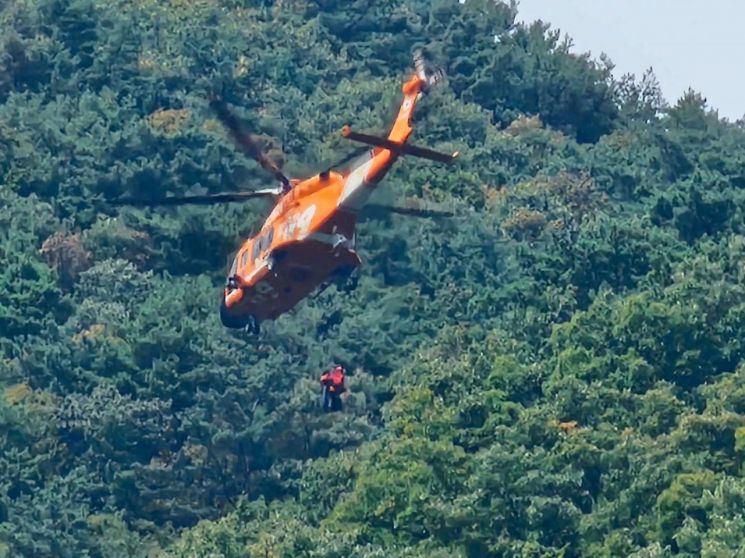 Amid a series of mountain accidents in the fall, it has been revealed that many rescue requests are made simply because physical strength has been exhausted. The photo is for illustrative purposes only and is unrelated to the content.
 [Photo by Gangwon Special Self-Governing Province Fire Headquarters/ Yonhap News]
As the autumn foliage season arrives and the number of hikers increases, mountain rescue requests are also on the rise. Among these, a significant number of reports have been made simply because hikers felt "too exhausted to continue walking."
On the 21st, YTN highlighted the rescue operations of the Seoraksan National Park Special Mountain Rescue Team. According to the report, on the 11th, a hiker who had set out alone on a trail in Seoraksan injured their ankle and head and requested rescue, prompting the deployment of 20 rescue team members. They walked for five hours along the pitch-dark mountain path to reach and rescue the hiker.
However, the problem is that many rescue requests are made without injuries, simply because hikers find it difficult to continue walking. According to rescue workers, hikers who were carried or transported on stretchers down the mountain often walk away from the parking lot on their own two feet. Son Kyung-wan, head of the Seoraksan National Park Special Mountain Rescue Team, lamented, “Rescue workers take turns carrying hikers down the mountain, but when they reach the parking lot, many walk away on their own. It’s quite disheartening in those moments.”
Experts warn that unnecessary rescue requests may delay truly urgent rescues
Experts point out that unnecessary rescue requests can delay genuinely urgent rescues and emphasize the importance of "choosing a course that matches one’s physical fitness and descending at least two hours before sunset." They also advise, "Do not enter unauthorized non-designated trails, as they pose high accident risks and are difficult to rescue from."
If you have an accident in the mountains, you should first inform 119 of your exact location. By checking the national point number signs installed along hiking trails, you can accurately report your location to 119. Before hiking, it is also important to check weather conditions and the exact hiking route in advance to prepare for accidents. Especially due to large temperature differences, it is important to bring outerwear to prevent hypothermia.
© The Asia Business Daily(www.asiae.co.kr). All rights reserved.
![Clutching a Stolen Dior Bag, Saying "I Hate Being Poor but Real"... The Grotesque Con of a "Human Knockoff" [Slate]](https://cwcontent.asiae.co.kr/asiaresize/183/2026021902243444107_1771435474.jpg)
















