18% Decrease in Teen Driver License Holders
Complex Effects of Population Decline and PM Development
Over the past five years, the number of teenagers and people in their twenties obtaining a driver's license for the first time in their lives has decreased by two to three times more than the population decline rate. As the number of license holders has sharply declined, especially among young people, driving schools are facing the risk of extinction.
According to the National Police Agency on the 22nd, the total number of drivers who obtained a license for the first time last year was 571,363. The number of license holders, which was 660,606 in 2019, decreased by 13.5% (89,243 people) in just five years.
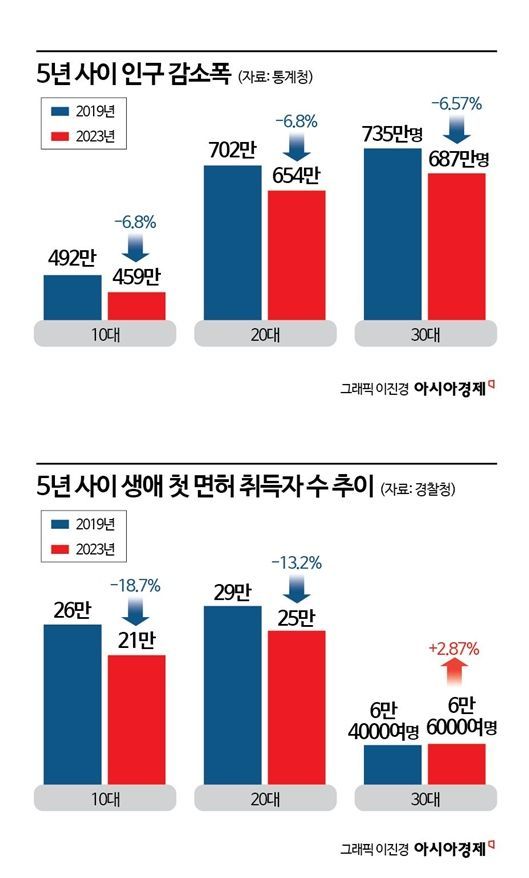
By age group, teenagers and people in their twenties accounted for most of the decline. The number of teenagers and people in their twenties who obtained a driver's license for the first time decreased by 87,551 compared to 2019. This accounts for 98.1% of the total decrease in license holders over the past five years.
The decline in the number of young license holders is significantly higher even when considering the population decline during the same period. Last year, the number of teenagers and people in their twenties obtaining a license for the first time decreased by 18.7% and 13.2%, respectively, compared to 2019. On the other hand, according to Statistics Korea's future population projections, the population of teenagers and people in their twenties last year decreased by 6.8% compared to 2019 (4.92 million and 7.02 million, respectively). Considering the population decline during the same period, the decrease in license holders is about two to three times greater. In the case of people in their thirties, the population decreased by 6.57% over five years, but the number of license holders increased by 2.87%.
Experts analyze that the population decline and the development of shared mobility, which can replace private cars, have had a complex impact on the decrease in license holders.
Professor Choi Jae-won of the Korea Road Traffic Authority said, "Population decline appears to be one of the main reasons for the decrease in license holders," but added, "The background behind the greater decrease in young license holders compared to the population decline may also be influenced by the so-called Maas (Mobility As A Service) policy implemented from the perspective of transportation demand management."
Professor Choi explained, "Maas is a concept that links various mobility services other than cars to enhance travel convenience," adding, "As part of national transportation policy, an environment has been created where young people can reach their destinations using personal mobility devices (PM), shared bicycles, and so on without using cars, which seems to have reduced their desire to obtain a driver's license."
As the reluctance of young people to obtain a driver's license becomes more pronounced, driving schools have been hit hard. Bucheon Automobile Driving Specialized Academy, located in Bucheon, Gyeonggi Province, saw its number of students drop from nearly 4,000 in 2016 to the 2,100 range last year, resulting in losses. Among the 32 instructors, five have taken unpaid leave as part of cost-cutting measures.
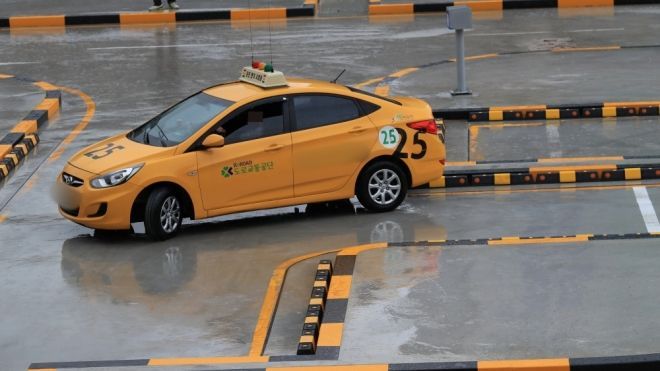
Song Jin-seok (57), the head of this academy, said, "Driving schools in rural areas have seen their student numbers halved due to population decline. Bucheon is in the metropolitan area, so the impact is relatively less," adding, "Places with more severe management difficulties than us are reducing the number of full-time instructors to the minimum and hiring part-time instructors only during vacation periods to survive."
Driving schools in Seoul, which are in a better situation compared to rural areas, are also sighing over the decrease in students. A representative of a driving specialized academy in Nowon-gu, Seoul, lamented, "Compared to 10 years ago, it feels like the number of teenage and twenties students has halved."
The driving school industry expects the decline in students to become more pronounced in the future. Ahn Joo-seok, Secretary General of the National Federation of Automobile Driving Specialized Academies, expressed concern, saying, "The number of driving schools registered with the police decreased from 383 in 2019 to 356 last year," adding, "The school-age population reaching the legal driving age of 16 (for motorized bicycles) and 18 (for Class 1 and 2 licenses) continues to decline, which is very worrisome."
© The Asia Business Daily(www.asiae.co.kr). All rights reserved.


















