KCCI Survey of 300 Domestic Manufacturers
Harris' 'Targeted Tariffs' and Trump's 'Universal Tariffs'
64.7% Say "Protectionism Will Intensify"
Our companies have shown great interest in the tariff-related aspects of the economic pledges made by each candidate running for the U.S. presidential election.
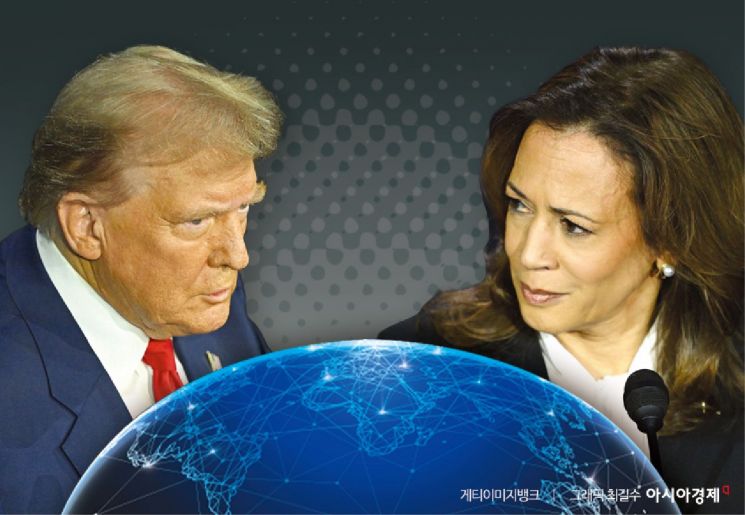
The Korea Chamber of Commerce and Industry (KCCI) announced on the 21st that this was revealed through a survey conducted from the 2nd to the 11th of this month targeting 300 manufacturing companies nationwide on 'U.S. Election-Related Policy Issues and Challenges for Our Companies.'
Among the pledges of Democratic candidate Vice President Kamala Harris, the most attention was given to 'Strategic Targeted Tariffs' (17.4%), 'Expansion of Multilateral Trade Centered on Allies' (17.3%), 'Corporate Tax Increase' (13.0%), 'De-risking Policy toward China' (11.9%), and 'Eco-friendly and Decarbonization Policies' (10.2%). In contrast, among the pledges of Republican candidate former President Donald Trump, interest was shown in 'Expansion of Universal and Reciprocal Tariffs' (25.6%), 'Trade Strategy to Resolve U.S. Trade Deficit' (18.5%), 'Reduction of Benefits for Foreign Companies Investing in the U.S.' (13.9%), 'Decoupling Policy from China' (12.7%), and 'Corporate Tax Cut' (8.2%).
Regarding the future trade environment, 64.7% of respondents believed that 'Protectionism such as tariff barriers will strengthen,' which was more than the 35.3% who answered that 'Global markets will expand through international cooperation.' In fact, global protectionism has been intensifying recently. According to KOTRA, in the first half of this year, there were 214 import regulation measures targeting South Korea worldwide, an increase of 13 compared to 201 cases in the same period last year.
Regarding global geopolitical risks such as the Russia-Ukraine war, Middle East conflicts, and North Korean nuclear issues, 58.0% of companies expected these risks to 'escalate,' which was higher than the 42.0% who expected them to 'decrease.' Additionally, concerning the global interest rate cut trend, 60.3% expressed concerns that it would 'affect the won-dollar exchange rate and worsen export competitiveness,' which was higher than the 39.7% who expected it to 'lead to an expansion of global liquidity.'
Regarding the global energy policy environment, more companies (60.7%) anticipated 'increased pressure to use decarbonized renewable energy' than those (39.3%) who foresaw 'improvements in energy efficiency and expanded use of nuclear power.' As for the future U.S. economy, responses were almost evenly split between 'the risk of a hard landing will decrease' (50.3%) and 'concerns about a U.S.-originated economic recession will intensify' (49.7%).
Companies responded about the possibility of changing their investment strategies or management policies depending on the U.S. election results as follows: 'Some restructuring is possible' (36.3%), 'No capacity to restructure' (33.7%), and 'Do not feel the need to restructure' (28.0%). Only 2.0% answered that 'complete restructuring is possible.'
Furthermore, regarding government support tasks to respond to changes in the international situation, the most common response was 'Mitigating geopolitical risks through strengthening economic security' (42.0%).
Kang Seok-gu, head of the KCCI Research Division, said, "The U.S. presidential election is a political event that greatly influences the global economy, and depending on the outcome, it can significantly impact global export and supply chain environments, individual industries, new industries, and energy policies. The government and companies must cooperate to prepare for various scenarios and establish strategies that maximize national interests."
© The Asia Business Daily(www.asiae.co.kr). All rights reserved.
![Clutching a Stolen Dior Bag, Saying "I Hate Being Poor but Real"... The Grotesque Con of a "Human Knockoff" [Slate]](https://cwcontent.asiae.co.kr/asiaresize/183/2026021902243444107_1771435474.jpg)

















