Promise of coexistence and essential budget 'cut off'... Setback in securing funds for KINTEX 3rd Exhibition Hall
Smart City contest project, which secured 20 billion KRW in national funds, also cut citing "lack of effectiveness"
Public museum budget omitted 5 times, urban master plan budget omitted 3 times
Mayor Lee: "If you remove the Goyang mayor's name tag, these are livelihood budgets with no reason for even a 1% cut"
Mayor Lee: "The chairman's call for coexistence should be with 'citizens,' not the mayor"
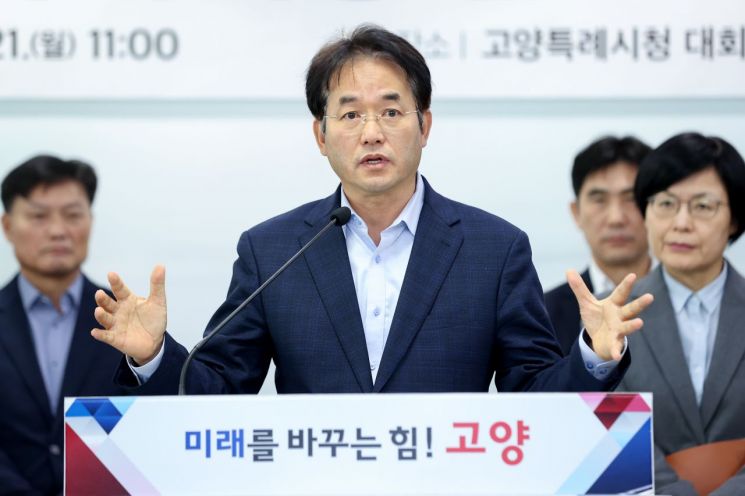 Lee Dong-hwan, Mayor of Goyang Special City, held an emergency press conference on the 21st, strongly urging the implementation of the "Win-Win Agreement" promised between Goyang City and the City Council last May.
 On the 21st, Lee Dong-hwan, Mayor of Goyang Special City, held an emergency press conference to strongly urge the fulfillment of the ‘win-win agreement’ promised between Goyang City and the City Council last May.
Mayor Lee explained the background of the press conference, saying, “Over the past 2 years and 4 months, repeated disruptions in the council for reasons unrelated to legislative matters have exceeded the limits of infringing on citizens’ interests. Although the city’s position has been expressed to the council more than ten times, nothing has changed.”
Mayor Lee pointed out, “Just as there is an unspoken rule in war not to attack civilian homes and medical personnel even when weapons are drawn, there is a sanctuary called ‘citizens’ in political competition. The current behavior of the council is an act of recklessly harming citizens to attack just one mayor.”
As an example, he mentioned that essential budgets of interest to the mayor have been repeatedly targeted and cut.
According to the city, the budget for the reestablishment of the basic urban plan was cut three times, and the budget for the feasibility study for the construction of a public museum was cut five times. The basic urban plan is the highest-level urban plan directly related to redevelopment and reconstruction of aging cities such as the Free Economic Zone and the first phase of new towns.
Additionally, citizen interest projects such as the establishment of a welfare foundation, creation of a Hanok village, installation of fine dust protection windows for vulnerable groups, and revision of the Goyang district unit plan have also faced repeated cuts for nearly a year.
Mayor Lee stated that such ‘slashings’ began with the second supplementary budget review in 2022, his first budget after taking office. At that time, the budget for establishing a metropolitan railway network expansion plan was cut after much difficulty. In the 2023 main budget, budgets related to attracting businesses such as the Free Economic Zone, bio-industry, and venture companies, as well as operational expenses essential for organizational functions, were cut by 90%.
He expressed strong regret, saying, “The budget submitted to the council is not the mayor’s budget but the ‘citizens’ budget.’ There is no reason for even a 1% cut if the budget is not labeled as a project desired by the current mayor or within the current mayor’s term.”
He also criticized, “Cutting budgets that must be established for citizens by themselves and then restoring them when beneficiaries are pushed to the brink is nothing but council authoritarianism under the pretext of review.”
Mayor Lee also pointed out that not only targeted cuts but also the council’s failure to fulfill its fundamental duties stipulated in the Local Autonomy Act, such as attendance and review, have caused social crises.
In the temporary session last September, the council was supposed to handle budgets for the welfare of 120,000 students’ meals, welfare benefits, road maintenance, and personnel expenses, but the session was disrupted due to a lack of quorum, and the budget was only dramatically approved in the following month’s temporary session. A similar pattern was repeated in the March temporary session, which was supposed to handle budgets such as Goyang Pay and operational expenses.
He said that during the disruption process, the budget was prepared later than other local governments, and the organization was only reorganized one year after his inauguration, causing a state of ‘powerlessness and confusion.’
The city included key policies in the economic, transportation, and urban sectors to create a ‘prosperous city’ as advocated by Mayor Lee in the 2023 main budget, and proposed an organizational reform plan to implement these policies. However, due to council disruptions until the start of the year, the budget was not even reviewed, and a quasi-budget system was operated, reflecting only 78.5% of the budget in principle. The first organizational reform was also not reviewed or was rejected four times.
Mayor Lee criticized, “The council did not even review the budget submitted after careful consideration by over 3,500 public officials. Which side is truly not communicating?”
He said, “I withdrew the request for reconsideration submitted in protest against the 2024 main budget approval in February this year, and in May, to completely end the conflict, I signed a win-win agreement with the council and kept the line of communication open while waiting. However, on the very day the agreement was signed, the council once again carried out targeted budget cuts before the ink was dry.” Fourteen essential feasibility study budgets were cut in the first supplementary budget held in May. This included legally mandated plans such as road construction management plans and landscape plans.
In the second supplementary budget held in October, the road construction management plan feasibility study was cut again, along with large cuts to resident-preferred budgets such as arboretums, smart farms, and air purification for daycare centers.
The base-type smart city project, a national public contest project won through the efforts of public officials, receives 20 billion won in national funding. However, the council rejected the budget, claiming it was ineffective. The same happened with the housing expo, which receives provincial funding.
Mayor Lee said, “In the temporary session last September, the council even opposed the sale of the site (S2 site) where a hotel for Kintex visitors is to be built.”
He argued, “In a situation where citizens feel a great loss due to the cancellation of the CJ Live City agreement, the MICE industry is the top driving force to revive Goyang City. The sale of the site is essential to fund the construction of the hotel and the third exhibition hall of Kintex. They blocked it, saying that Lee Dong-hwan should not carry out projects promoted by previous mayors. Where is the win-win, and where is the cooperative governance?”
He also expressed regret that the recent small-scale organizational reform, which only established four new departments, was rejected again following the previous organizational reform.
He said, “The newly established departments are essential organizations for safety structures, public architecture, and birth and childcare support, and are close to internal decisions reflecting the opinions of field workers. This is evidence that the council is indiscriminately slashing.”
Mayor Lee urged, “The win-win the council desires should not be ‘win-win between the mayor and the council chairman,’ or ‘win-win in words only,’ where they smile in front but indiscriminately cut livelihood budgets behind the scenes. It is time for the council to apologize to the citizens and keep the promise of win-win for the citizens themselves,” calling for strong determination and action.
© The Asia Business Daily(www.asiae.co.kr). All rights reserved.

















