Reflecting Residents' Desire to Re-Promote Balanced Development
Targeting 100,000 Signatures in One Month Starting from the 18th
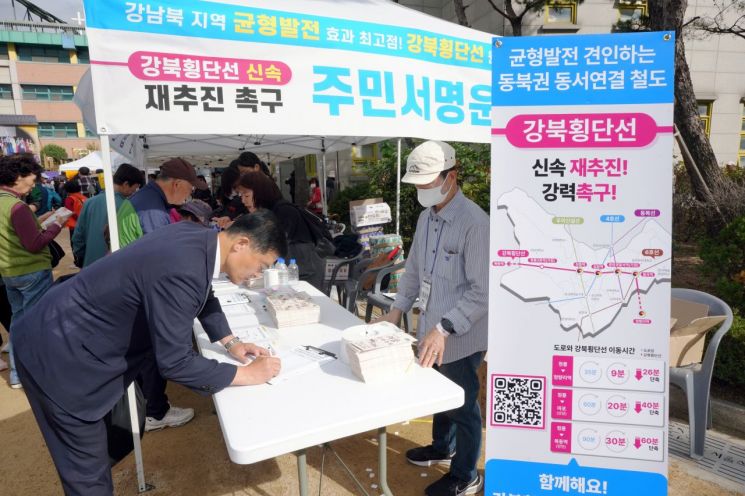 Seungro Lee, Mayor of Seongbuk-gu, visited the site of the "Seongbuk-gu Residents' Signature Campaign for the Rapid Re-promotion of the Gangbuk Transverse Line" set up at the Uireung Cultural Festival in Seokgwan-dong on the 19th and signed the petition. Provided by Seongbuk-gu.
Seongbuk-gu, Seoul (Mayor Lee Seung-ro) announced on the 20th that reflecting the local residents' strong desire for the swift resumption of the Gangbuk Transversal Line, it formed the ‘Gangbuk Transversal Line Seongbuk-gu Swift Resumption TF’ on the 15th and launched a district-wide signature campaign starting from the 18th.
The Gangbuk Transversal Line is a light rail line connecting Cheongnyangni Station to Jeongneung and Gireum in Seongbuk-gu, Hongje in Seodaemun-gu, Digital Media City in Mapo-gu, and finally Mokdong Station in Yangcheon-gu. It was highly anticipated as a route that would effectively alleviate the inconvenience citizens face by having to rely solely on roads for travel between the northeastern and southwestern parts of Seoul, while promoting balanced regional development.
In fact, the Inner Circular Road, a representative road network connecting the east and west of Seoul’s northeastern area, has an average vehicle speed of 14 km/h during rush hours (7:30 AM to 9:00 AM), which is only about 50% of Seoul’s average speed of 27.1 km/h. The section in Seongbuk-gu is particularly notorious for chronic congestion.
To improve this poor public transportation environment and promote balanced development, Seoul City finalized the 2nd Seoul Urban Railway Network Construction Plan in 2019 and announced plans to establish the Gangbuk Transversal Line with a budget of approximately 2 trillion KRW.
According to the plan, travel times will be reduced to one-third of the current duration: 9 minutes from Jeongneung to Cheongnyangni Station, 20 minutes to Sangam, and 30 minutes to Mokdong Station. Additionally, five stations?Jeongneung 3-dong Station (tentative name), Jeongneung Station, Gireum Station, Jongamsageori Station (tentative name), and Wolgok Station?will connect with four lines including the Ui-Sinseol Line, Line 4, Line 6, and the Dongbuk Line scheduled to open in 2026. This is expected to have a ripple effect throughout Seongbuk-gu. The line is also directly or indirectly adjacent to eight universities in the area, which is anticipated to improve commuting convenience and increase the settlement rate of young people near university districts, raising the expectations of Seongbuk residents for regional vitality.
However, due to the route’s characteristics passing through mountainous areas, the project requires relatively high costs while demand is predicted to be low, resulting in low economic feasibility. Consequently, it was rejected in the preliminary feasibility study review by the Ministry of Economy and Finance in June.
The district office is fully committed to providing administrative support to swiftly resume the Gangbuk Transversal Line project in accordance with Seoul City’s original intent and plan to improve the poor public transportation environment in underserved urban railway service areas and promote balanced development, thereby resolving the long-standing wishes of Seongbuk residents.
As part of this effort, on the 15th, the district officially launched the ‘Gangbuk Transversal Line Swift Resumption TF,’ which involves cooperation among 10 major departments, 20 community service centers, local residents, universities, and religious organizations. The goal is to unite the will of the public, academia, and government to effectively communicate with related agencies and collaborate closely for the swift resumption of the Gangbuk Transversal Line.

The district-wide signature campaign has also begun. Starting from the 18th, the campaign aims to collect 100,000 signatures over one month. Offline participation is available at Seongbuk-gu Office, community service centers, and apartment building lobbies. Online participation is also possible using QR codes.
Mayor Lee Seung-ro stated, “The Gangbuk Transversal Line is not only an effective solution to the severe transportation issues in Seongbuk-gu, which lacks a direct rail connection between its east and west, but it will also serve as a practical driving force leading the Gangbuk area’s grand transformation and prosperous era that Seoul City is ambitiously pursuing. Bold financial investment in transportation-disadvantaged areas is a public responsibility, and since the Gangbuk Transversal Line received the highest evaluation for its effect on regional balanced development, I hope Seoul City and the government will accept the voices of Seongbuk residents demanding its swift resumption with a strong sense of public duty.”
© The Asia Business Daily(www.asiae.co.kr). All rights reserved.
!["The Woman Who Threw Herself into the Water Clutching a Stolen Dior Bag"...A Grotesque Success Story That Shakes the Korean Psyche [Slate]](https://cwcontent.asiae.co.kr/asiaresize/183/2026021902243444107_1771435474.jpg)

















