Over 12,000 Including About 1,500 in the First Phase
Deployment to Kursk, Russian Mainland on the 1st of Next Month
North Korea has decided to deploy a large-scale special forces unit to the Ukraine war to assist Russia. It is expected that a force of about 12,000 troops, including the initial 1,500 deployed in the first phase, will be sent. This is the first large-scale deployment of North Korean ground forces, raising concerns that it will cause significant repercussions not only on the Korean Peninsula and Northeast Asia but also on the global security landscape.
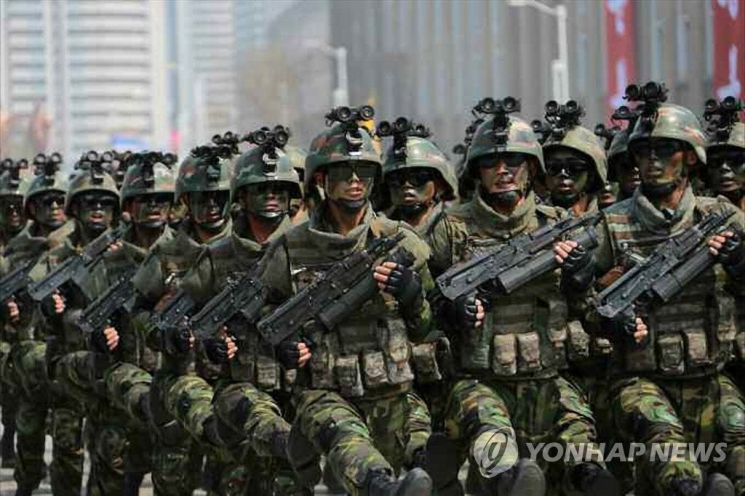 In 2017, North Korea revealed the existence of its Special Operations Force for the first time during the military parade commemorating the 105th birthday of Kim Il-sung. The photo shows members of the Special Operations Force parade unit, as published by Rodong Sinmun.
On the 18th, the National Intelligence Service (NIS) stated, "We detected North Korean special forces being transported to Russian territory via Russian naval transport ships from the 8th to the 13th," confirming "the commencement of North Korean military participation."
The first group of deployed personnel has already moved to Russia
According to the NIS, 1,500 personnel have already been transported from areas near Chongjin, Hamhung, and Musudan to Vladivostok, Russia, using four landing ships and three escort ships belonging to the Russian Pacific Fleet. The NIS anticipates a second transport operation will take place soon.
Intelligence sources said, "North Korea is expected to deploy approximately 12,000 troops from four brigades of the elite 11th Corps, also known as the Storm Corps, to the Ukraine war."
Deployment possibly chosen as a means to earn foreign currency amid blocked income sources
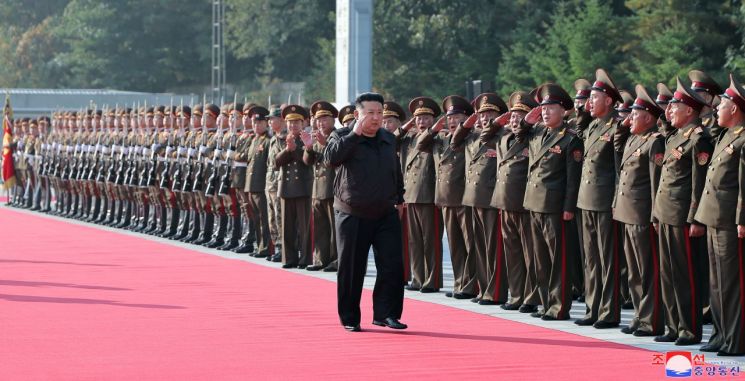
North Korea gains significant benefits by sending combat troops. Primarily, it is a source of foreign currency. North Korea has earned foreign currency by sending workers overseas. According to a March report by the UN Security Council’s North Korea Sanctions Committee, North Korea has earned between $750 million and $1.1 billion annually (approximately 1.0382 trillion to 1.5227 trillion KRW) through this method until recently. This deployment could be another opportunity to earn foreign currency. Additionally, North Korea can gain real combat experience with short-range ballistic missiles like the ‘KN-23’ (North Korean version of the Iskander) and drone operations exported to Russia.
Yang Wook, a research fellow at the Asan Institute for Policy Studies, analyzed, "North Korea will likely receive weapons or money in exchange for the deployment," adding, "They also do not want to miss the opportunity to gain war experience."
The North Korean troops deployed to Russia are currently stationed at Russian military bases dispersed across the Far East regions of Vladivostok, Ussuriysk, Khabarovsk, and Blagoveshchensk. They are expected to be deployed to the front lines once they complete adaptation training. They have been issued Russian military uniforms and Russian-made weapons, and the NIS reported that they were also given fake identification cards disguising them as residents of Siberian Yakutia and Buryatia, whose appearance is similar to North Koreans. This appears to be an effort to conceal their participation by disguising them as Russian soldiers.
Ukraine’s intelligence authorities also predict that thousands of North Korean troops dispatched to Russia will be deployed to Kursk on the Russian mainland next month. On the 17th (local time), Kyrylo Budanov, head of Ukraine’s Defense Ministry Intelligence Directorate, told a U.S. military media outlet, "They will be ready by November 1," adding, "An advance group of 2,600 will go to Kursk next month." Earlier, Ukrainian and Western media speculated that the North Korean troops would be stationed in the Kursk region in relation to the deployment rumors.
Budanov further stated that 11,000 North Korean infantry troops are currently training in Russia’s Far East region. He added, "It is uncertain where the remaining troops will be deployed."
Deployment decision based on military intervention clause between the two countries
The NIS revealed that in early August, after detecting multiple visits by Kim Jong-sik, First Deputy Director of the Military Industry Department and a key figure in North Korea’s missile development, to North Korean ‘KN-23 missile’ launch sites near the Ukraine and Russia front lines, they monitored subsequent movements and confirmed the transfer of North Korean troops via Russian warships. The NIS assessed that since August last year, North Korea has supported Russia with more than 13,000 containers worth of lethal weapons, including shells, missiles, and anti-tank rockets, in over 70 shipments.
This deployment appears to be based on the military intervention clause contained in the "Comprehensive Strategic Partnership Treaty" signed by North Korea and Russia in June. Article 4 of this treaty stipulates that if either country is in a state of war, the other will provide military and other assistance using all means at its disposal in accordance with the UN Charter and domestic laws of both countries.
North Korea’s participation in the war is expected to deepen military cooperation between the two countries. In particular, in exchange for the large-scale deployment, the possibility of North Korea receiving advanced military technologies it has long sought, such as intercontinental ballistic missile (ICBM) technology and nuclear-powered submarine technology, has significantly increased. There is also a growing concern that Russia might militarily intervene in the event of an emergency on the Korean Peninsula.
Possibility of North Korean soldiers deserting after exposure to external information
However, North Korea must also bear losses. Even if soldiers are selected through background and ideological verification in North Korea, once abroad, they inevitably come into contact with external information. The main force of the North Korean military consists of generations born in the 1990s and 2000s, who are market-friendly. If the foreign currency they earn flows into the North Korean regime, the likelihood of desertion is high. In fact, local Ukrainian media reported that 18 North Korean soldiers deserted their units near the border between Kursk and Bryansk regions. The problem continues afterward. If the young soldiers deployed abroad return and spread external culture, it could increase the risk of cracks in the North Korean regime. In the long term, this could shake the Kim Jong-un regime.
© The Asia Business Daily(www.asiae.co.kr). All rights reserved.
![Clutching a Stolen Dior Bag, Saying "I Hate Being Poor but Real"... The Grotesque Con of a "Human Knockoff" [Slate]](https://cwcontent.asiae.co.kr/asiaresize/183/2026021902243444107_1771435474.jpg)

















