Recent Surge in 'Fake Rescue Videos'
Deliberately Putting Animals in Danger
Animal protection organizations rescuing animals in crisis. They might actually be 'fake.' A recent investigation revealed that a significant portion of animal rescue videos spreading on social networking services (SNS) are staged content aimed at gaining views and donations.
On the 16th, the 'Social Media Animal Cruelty Coalition (SMACC),' a union of 29 Asian animal organizations, issued a warning that so-called 'fake animal rescue content' is rapidly spreading online.
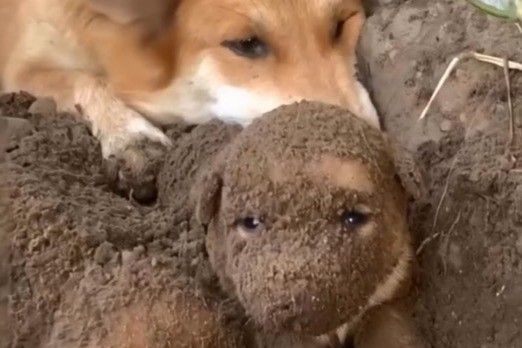 A video capturing the scene of an animal buried underground being rescued. [Image source= SNS capture]
Fake animal rescue content involves videos where animals are deliberately put in danger, such as through abuse, and then rescued. These videos garner millions of views on SNS. To make matters worse, those who post fake animal rescue content reportedly gain financial benefits through advertising revenue and donations. According to SMACC's investigation, 21% of fake rescue video posters shared bank account numbers under the pretext of 'helping animals,' encouraging viewers to donate.
After a six-week investigation, they found that 1,022 fake animal rescue videos were shared mainly on Facebook, Instagram, YouTube, TikTok, and X. The primary sharing platforms were Facebook and Instagram, while TikTok recorded the highest number of views.
Since fake animal rescuers are suspected of deliberately putting animals in danger, concerns about animal abuse arise. There were even cases where different species were forced to confront each other to stage 'prey and predator' scenarios.
The abused animals in the videos were mostly abandoned in piles of trash, garbage bins, or on the roadside. Some animals were trapped in narrow spaces or stuck in objects. Content showing the 'rescue' of such animals accounted for one-fifth of the total content.
The most frequently appearing animals were cats, making up 42% of all videos. They were followed by primates, dogs (puppies), snakes, and turtles. Endangered species such as long-tailed macaques and stump-tailed macaques were also sometimes used.
Jill Robinson, founder of Animals Asia and lead author of the report, said, "Cases imitating legitimate animal rescue accounts are increasing and becoming more sophisticated," urging, "SNS platforms must implement effective monitoring systems to quickly detect and remove such fake videos and take firm action against all forms of animal abuse."
© The Asia Business Daily(www.asiae.co.kr). All rights reserved.
![Clutching a Stolen Dior Bag, Saying "I Hate Being Poor but Real"... The Grotesque Con of a "Human Knockoff" [Slate]](https://cwcontent.asiae.co.kr/asiaresize/183/2026021902243444107_1771435474.jpg)
















