Celltrion has revealed plans to establish a contract development and manufacturing organization (CDMO) subsidiary within the year, marking a full-scale entry into the CDMO business.
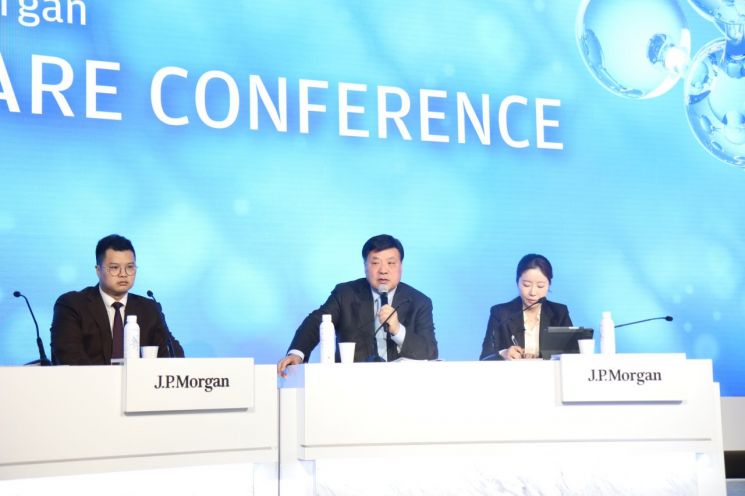 Seo Jin-seok, CEO of Celltrion, and Seo Jung-jin, Chairman of Celltrion Group (from left), are conducting a Q&A session at the JP Morgan Healthcare Conference (JPMHC) held last January in San Francisco, California, USA.
 [Photo by Celltrion]
On the 18th, Celltrion announced on its website, "The key point in advancing the CDMO business is to secure competitiveness that surpasses existing CDMO companies by fully leveraging Celltrion's antibody development and production expertise, while maintaining low expansion costs and high productivity." The company added, "We plan to establish a corporation as a 100% subsidiary of Celltrion within this year and will begin full-scale facility expansion and sales activities starting next year."
Last month on the 7th, at the Morgan Stanley Global Healthcare Conference, Celltrion outlined its business status and mid-to-long-term strategy, emphasizing the "full-scale launch of the CDMO business." The company stated, "We will strengthen and expand the existing CDMO business capabilities and scale, and consider securing new factories through the establishment of subsidiaries dedicated to new product manufacturing and CDMO business purposes."
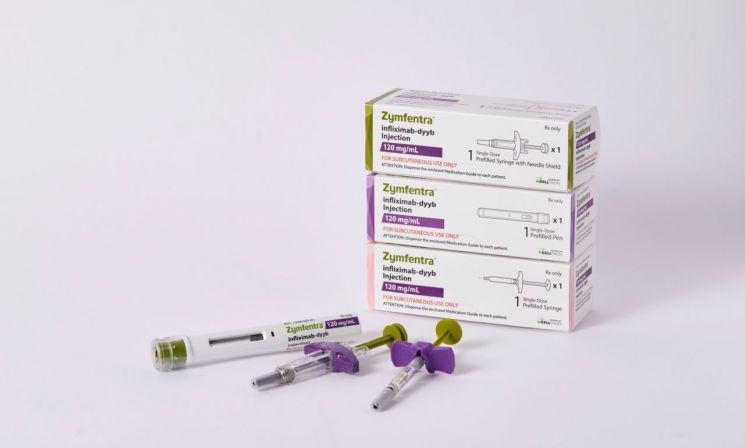
In the announcement, Celltrion also explained the prescription status of its flagship product, the autoimmune disease treatment new drug Jimpendra, in the U.S., as well as the company's profitability following the absorption merger with Celltrion Healthcare earlier this year.
Since its introduction to the U.S. market in the first quarter of this year, Jimpendra has achieved significant progress in expanding coverage by prescription benefit managers (PBMs), which are gatekeepers to market entry. Currently, the PBM market is dominated by three major PBMs holding about 80% market share, and Jimpendra is listed on the prescription formularies of all three. The company stated, "Considering that it is a newly launched drug, coverage has been secured at a relatively fast pace," but added, "For actual prescriptions, listing by insurance companies under the PBMs must also occur, which causes an additional delay of about 2 to 3 months." It emphasized, "Despite this, Jimpendra's prescription volume in the U.S. is rising sharply, and shipments to wholesalers, which directly reflect our sales, are increasing even faster."
Currently, Celltrion is intensifying promotional efforts by airing Jimpendra advertisements on YouTube and other online platforms as well as on TV since the beginning of this month. The sales target for Jimpendra this year is 250 billion KRW. The company expressed confidence, saying, "Considering the overall situation, we expect to achieve annual sales of 1 trillion KRW for Jimpendra next year without difficulty," and added, "The company's total sales target for next year is 5 trillion KRW, and we are steadily executing plans by country and product." Previously, Seo Jung-jin, Chairman of the Celltrion Group, also declared about Jimpendra, "It can generate annual sales of up to 3 trillion KRW within three years," and "Even conservatively, it is a product that can reach up to 5 trillion KRW."

Regarding the company's profitability following the absorption merger with Celltrion Healthcare, Celltrion emphasized that concerns in the market about the improvement of the cost of goods sold (COGS) ratio are being addressed. The company stated, "Due to the merger, we acquired high-cost inventory assets held by the former Celltrion Healthcare, which temporarily increased Celltrion's COGS ratio this year," and added, "The COGS ratio is improving as originally planned by the company." As the existing high-cost inventory is depleted, newly produced pharmaceuticals with consistently lower costs are driving the COGS ratio down continuously.
In particular, the company explained, "This improvement in the cost ratio is naturally occurring through stable business operations and is unrelated to yield improvements," and added, "We are continuously reducing manufacturing costs through yield improvements and production internalization, and these efforts will further accelerate the improvement of the COGS ratio in the future."
© The Asia Business Daily(www.asiae.co.kr). All rights reserved.
![Clutching a Stolen Dior Bag, Saying "I Hate Being Poor but Real"... The Grotesque Con of a "Human Knockoff" [Slate]](https://cwcontent.asiae.co.kr/asiaresize/183/2026021902243444107_1771435474.jpg)


















