Mainichi Shimbun in Japan Mentions Tokyo Governor Candidate Controversy
Shirt Removed During Policy Broadcast to Promote YouTube Channel
"Discussion on Public Official Election Law Revision... Regulation Practically Difficult"
In the Tokyo gubernatorial election held last June, a female candidate caused a stir by removing her clothes during her campaign speech broadcast, prompting Japanese media to point out limitations in the Public Offices Election Act. On the 17th, Mainichi Shimbun reported that "it is difficult to stop candidates from 'doing whatever they want.'"
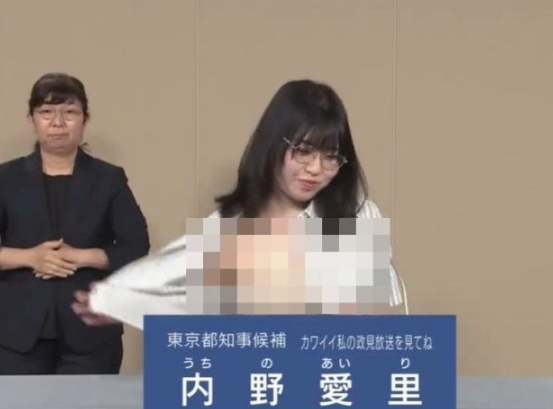 Uchino Airi, a candidate in the Tokyo gubernatorial election, is taking off her shirt during a policy broadcast. [Image source=NHK broadcast screen capture]
In Japan, campaign speeches are defined as part of election campaigning and are broadcast on TV or radio during elections for the House of Representatives, House of Councillors, and prefectural governor elections. Under the Public Offices Election Act, candidates and political parties can deliver their campaign speeches free of charge on public broadcasting, and broadcasters must air the recordings exactly as submitted by the candidates or parties. Although there is a regulation stating that "candidates or parties must not engage in conduct or speech that damages dignity," it is reported that most broadcasts air the original footage without edits.
There have been past cases where broadcasters partially edited campaign speeches. During the 1983 House of Councillors election, public broadcaster NHK deleted audio containing discriminatory language used by a candidate before airing it. The candidate later filed a lawsuit that reached the Supreme Court, but NHK won the case. At that time, the Supreme Court ruled that "the use of discriminatory language violates the Public Offices Election Act's prohibition against conduct or speech that damages dignity."
Around midnight on June 27, NHK aired the campaign speech of Airi Uchino, the representative of the party "Please Watch My Cute Campaign Speech," who was running for Tokyo governor. Wearing glasses and a shirt, she said, "Finally, I have met you all. I am the cute and famous Airi Uchino." Instead of announcing policy pledges during the approximately six-minute broadcast, she repeatedly said things like "I am not only cute but also sexy," "My favorite foods are meat and fish," and "My name is Airi Uchino. Please remember it."
In the middle of the broadcast, she suddenly took off her shirt and glasses and promoted her YouTube channel, saying, "Aren't I sexy?" This led to a flood of viewer criticism, with reactions that the Tokyo gubernatorial election was descending into chaos.
Mainichi stated, "Although candidates' performances during campaign speeches have been a topic of discussion in the past, the level was different in this gubernatorial election with 56 candidates. Where has the dignity of candidates gone?" It added, "The ruling and opposition parties are discussing revisions to the Public Offices Election Act regarding reckless campaign speeches, but considering the constitutional guarantees of freedom of political activity and freedom of expression, regulation does not seem easy."
© The Asia Business Daily(www.asiae.co.kr). All rights reserved.

















