"Next Year's Quota Change Is Like Changing Rules Mid-Game"
"Actually Need to Increase by 4,000... 2,000 Is the Minimum"
"Winter Emergency Medical Measures to Be Prepared... Announcement Soon"
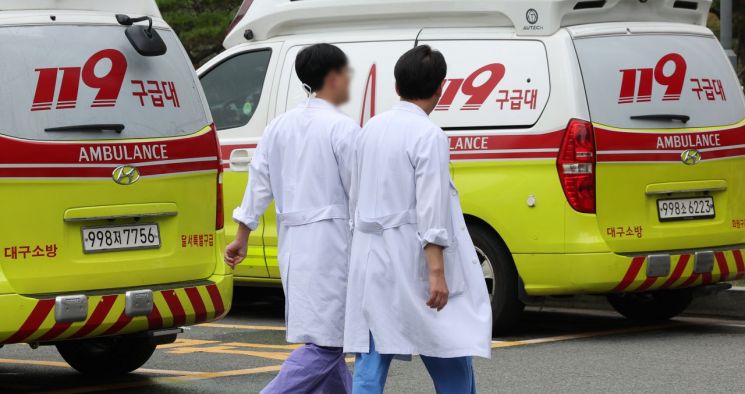 In front of the emergency room of a top-tier general hospital in Daegu, a 119 ambulance is waiting while medical personnel are moving around.
 [Image source=Yonhap News]
The Presidential Office stated on the 17th that realistically calculated, the number of doctors will be nearly 20,000 short by 2035, and although an increase of 4,000 medical students is actually needed, the number for next year's increase was set at 2,000, which is a feasible figure without a heavy burden.
It also reiterated that adjusting the medical school admission quota for next year is impossible, but discussions on the quota for the 2026 academic year are possible.
A Presidential Office official said in the afternoon at the Yongsan Presidential Office, "Even if we increase by 2,000, we will inevitably face a severe shortage of doctors starting five years from now."
The Presidential Office explained that reflecting realistic assumptions, the shortage of doctors in 2035 will approach 20,000, not the initially announced 10,000.
According to surveys by the Korea Institute for Health and Social Affairs, the Korea Development Institute (KDI), Seoul National University, and others, about 10,000 doctors will be lacking in 10 years, but this conclusion is based on unrealistic assumptions such as all doctors working with the same productivity until age 90 or working 265 days a year excluding Saturdays and Sundays.
The official emphasized, "Currently, there is already a shortage of 5,000 doctors. Reflecting the field situation, the shortage in 10 years will be close to 20,000."
He continued, "Although analysis showed that an increase of 4,000 is actually needed to somewhat prepare for the doctor shortage in 2035, the number was set at 2,000 to avoid immediate burdens on faculty quotas and facilities while still being able to provide education."
In other words, while voices from the medical community say that increasing medical school admissions by 2,000 next year is excessive, the Presidential Office explains that this is the minimum increase.
Regarding the Korean Medical Association's claim that the number of doctors will increase by 7,630 by 2047, a Presidential Office official pointed out, "This result comes from fixing the 2010 doctor growth rate of 2.84% forever," calling it "a significant overestimation."
Unlike in the past, the recent expansion of the dermatology and cosmetic medical market has increased the proportion of doctors leaving general practice, and the 'work-life balance (WLB)' trend has strengthened in the medical community, leading to a reduction in working hours by more than 10% in just three years, causing changes that could worsen the shortage of essential medical doctors.
The Presidential Office also mentioned that although there is an option to gradually increase the number of doctors by 500 to 1,000 annually over a longer period, this would inevitably cause social conflicts every year during the increase, and more importantly, delay the time to reach the final shortage of 10,000 doctors.
"By 2035, doctors themselves will be aging, the retired population will increase, and working hours will decrease, so the actual number of active doctors will decline," the explanation continued.
The official emphasized, "Last November, when we asked each university about the possible scale of medical school expansion, we received answers that at least 2,151 additional students could be admitted," stressing that increasing the quota by 2,000 would not impose a significant educational burden.
Moreover, with faculty increases and facility expansions, the number of students that can be educated will further increase. The government also announced plans to support medical education modernization with a total of 6 trillion won over six years, including 2 trillion won from the Ministry of Education, 3 trillion won from the Ministry of Health and Welfare, and 1 trillion won in loans to universities.
The Presidential Office clearly stated that the plan to increase medical school admissions next year cannot be withdrawn.
A Presidential Office official said, "To change the 2025 academic year college entrance examination system, it must be done by the end of May this year, so it is illogical to argue for changes now."
According to the Enforcement Decree of the Higher Education Act, changes to university entrance examination implementation plans can be made by the end of May of the year before the entrance exam in cases of legislative amendments, natural disasters, or unavoidable reasons such as departmental restructuring. Some in the medical community have cited this clause to argue for re-discussion of the medical school quota issue.
However, the official said, "We are already in the middle of the college entrance procedures of early and regular admissions, and changing the final recruitment number now is like changing the rules during a sports game," adding, "We are not at a stage where the quota can be changed based on that clause."
He added, "However, discussing changing the quota for the 2026 academic year based on this clause is possible."
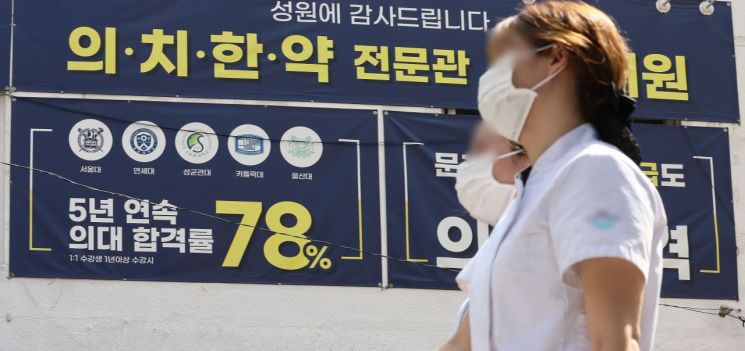 A medical school entrance exam promotional poster is displayed on a private academy building in Daechi-dong, Gangnam-gu, Seoul.
 [Image source=Yonhap News]
Regarding concerns that expanding medical school quotas and the number of students repeating a year will increase the first-year medical student population to 7,500 next year, making education difficult, the official said, "Students will be distributed across 40 medical schools, and given that first-year premedical education is lecture-focused rather than practical, education will not be impossible."
The official said, "We anticipate winter to be a particularly challenging period," and that separate emergency measures are being prepared to respond to respiratory patients, cardiovascular and cerebrovascular patients, and infectious diseases, which will be announced soon.
He added, "The emergency medical system is being strengthened first for high-difficulty, severe, and specialized treatments."
He also emphasized, "Recently, outpatient, inpatient, surgery, and intensive care unit treatment volumes have recovered to about 93-103% of normal levels. Although emergency medical care has decreased compared to usual, preparations are being made to ensure there are no gaps in severe emergency medical care."
© The Asia Business Daily(www.asiae.co.kr). All rights reserved.
![Clutching a Stolen Dior Bag, Saying "I Hate Being Poor but Real"... The Grotesque Con of a "Human Knockoff" [Slate]](https://cwcontent.asiae.co.kr/asiaresize/183/2026021902243444107_1771435474.jpg)


















