Recent Decline in Coincident Economic Index Raises Recession Concerns
Bank of Korea Analysis Indicates Recession Has Passed and Recovery Is Gradual
Recovery Trend Expected to Continue Next Year
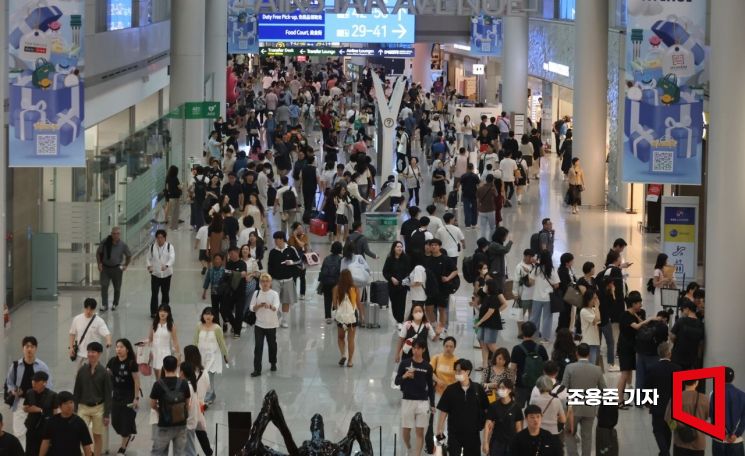
The Bank of Korea has asserted that the economy has already hit bottom and is in recovery, countering concerns from some quarters that our economy is still in decline. Consumption is improving more than expected, and the recovery trend is projected to continue into next year.
On the 17th, the Bank of Korea's Research Department posted an article titled "The Current State and Future Trends of Our Economy" on its website, explaining that the Korean economy has bottomed out and entered a gradual recovery phase.
Recently, the coincident index of economic activity (coincident index) has been showing a downward trend, leading to claims that our economy remains in a downturn phase. The Bank of Korea’s statement is interpreted as a rebuttal to these claims.
Coincident Index Negative for Six Consecutive Months
According to Statistics Korea, the coincident index, which reflects the current economic situation, has been negative for six consecutive months from March to August this year. The coincident index is considered an economic indicator that relatively accurately shows which phase the economy is currently in. In August, the coincident index dropped to 98.2, below the baseline of 100.
However, the Bank of Korea explained that the coincident index mainly reflects the domestic economy rather than the overall economic situation, which may lead to misunderstandings in interpretation. The coincident index is composed of seven sub-indicators, which directly reflect domestic conditions but only indirectly reflect export conditions, causing such misunderstandings. Accordingly, when exports are strong and driving growth, but this effect does not smoothly spread to other sectors, the coincident index may not accurately reflect the actual economic situation, the Bank of Korea added.
Regarding concerns about sluggish domestic demand, it analyzed that factors such as construction investment, facility investment, and intellectual property product investment, which also constitute domestic demand, have a greater impact than private consumption.
Ultimately, the Bank of Korea emphasized that it is appropriate to assess the recent economic situation through a more comprehensive measure, the Gross Domestic Product (GDP). The domestic GDP growth rate was only 1.0% year-on-year in the first half of last year but rebounded to 1.7% in the second half and rose significantly to 2.8% in the first half of this year. Based on the GDP cyclical component, our economy bottomed out in the second quarter of last year and is gradually recovering.
Our Economy Expected to Maintain Moderate Growth Going Forward
Looking ahead, the economy is expected to show moderate growth as exports maintain a favorable trend and private consumption and facility investment resume their recovery. In particular, private consumption, which accounts for the largest share of domestic demand, is expected to improve further due to easing living costs and rising wages.
Facility investment is anticipated to rebound, supported by a strong IT sector and improved corporate investment capacity. However, construction investment remains challenging due to a continued decline in building construction and sluggish social overhead capital (SOC) investment.
The Bank of Korea predicts that the recovery trend centered on domestic demand, including consumption, will continue next year. Although export growth rates may decline due to the base effect from the previously high growth, exports are expected to maintain a favorable trend through the first half of next year. However, uncertainties have increased compared to previous forecasts due to rising external risks.
Song Byung-seop, deputy director of the Bank of Korea’s Research Department, stated, "Exports going forward are expected to be significantly influenced by factors such as the outcome of the U.S. presidential election, developments in the Middle East situation, the effects of China’s economic stimulus, and the direction of the global IT industry," adding, "Our economy will show a growth trend with a more balanced contribution from exports and domestic demand."
© The Asia Business Daily(www.asiae.co.kr). All rights reserved.

















