Godongjin "Competitors run at 300km, we maintain constant speed"
Handonghun "Semiconductor company subsidies must be included in the bill"
Ministry of Economy and Finance says direct support to large corporations is against public sentiment and burdensome
The People Power Party declared over two months ago that it would propose the "Special Act for Supporting the Semiconductor Industry (Semiconductor Special Act)" as a party policy. However, progress has been slow. This is because the Ministry of Economy and Finance is reluctant to provide direct subsidies to large corporations. Coordination between the party and the government has yet to be finalized.
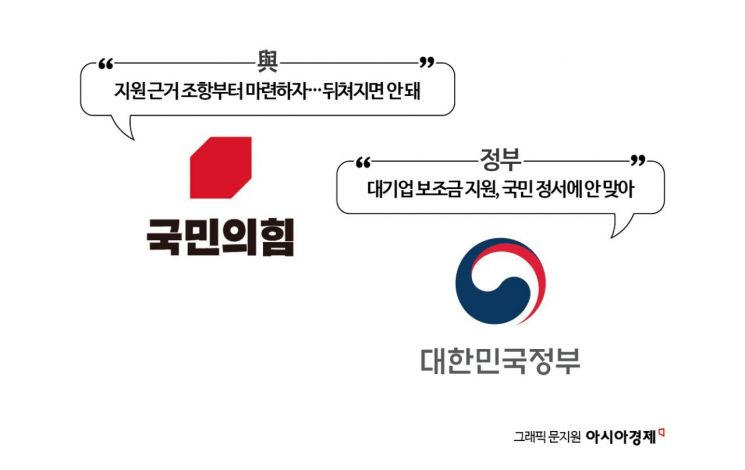
In a phone interview with Asia Economy, People Power Party lawmaker Go Dong-jin expressed frustration, saying, "Direct subsidies may seem like simply giving money to companies, but the government becomes an 'angel investor' for companies through tax revenue." He added, "We even provided the Ministry of Trade, Industry and Energy with ideas on the excess profit-sharing system implemented in the U.S., but the Ministry of Economy and Finance still hasn't taken action." The excess profit-sharing system refers to the government recouping excess profits gained by companies from direct subsidies and encouraging reinvestment.
The People Power Party leadership announced in August that they would jointly revise and review the Semiconductor Special Acts proposed separately by lawmakers Go Dong-jin, Park Soo-young, and Song Seok-jun, and push the special act as a party policy. Since then, some agreement has been reached with the government side, and the bill was close to being proposed, but difficulties remain over the issue of direct subsidy support.
According to ruling party sources, the Ministry of Economy and Finance was favorable toward direct subsidy support for small and medium-sized enterprises (SMEs) and mid-sized companies. However, the ministry is reportedly reluctant to explicitly include provisions for direct subsidies to large corporations in the Semiconductor Special Act, citing that providing the same benefits to large corporations is not in line with public sentiment.
On the 16th, the Ministry of Economy and Finance announced a comprehensive semiconductor ecosystem support plan worth 8.8 trillion won. However, the ruling party views the ministry’s plan as limited to financial and tax support, which they consider insufficient compared to competing countries that are fully committed to semiconductor support. They also point out that SMEs face difficulties in obtaining loans without collateral.
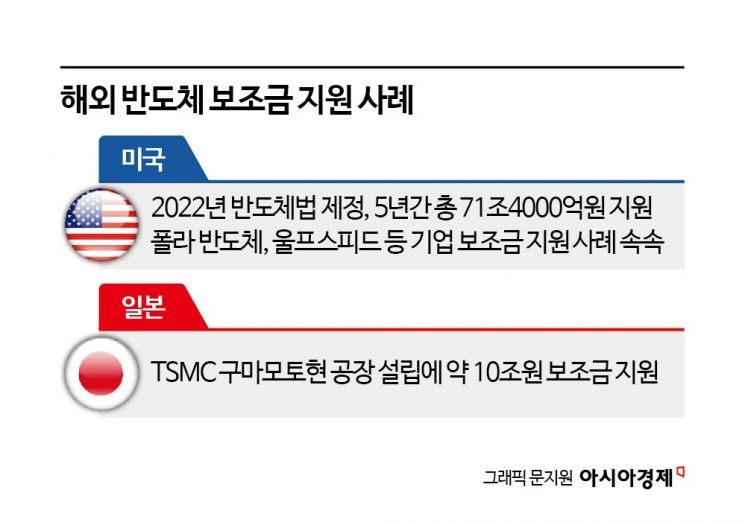
The United States enacted the CHIPS Act in 2022 to encourage semiconductor companies to invest in domestic facilities. Over five years, it provides a total of $52.7 billion (71.4 trillion won), including $39 billion in semiconductor production subsidies and $13.2 billion in research and development (R&D) support. Last month, the U.S. Department of Commerce approved a subsidy of $12.3 million (about 1.636 billion won) to "Polar Semiconductor" under the CHIPS Act, marking the first case of subsidy support. On the 15th (local time), a subsidy plan of $750 million (about 1 trillion won) was also finalized for U.S. semiconductor company Wolfspeed.
Japan also provided subsidies exceeding 10 trillion won to Taiwan’s TSMC, the world’s largest foundry semiconductor manufacturer, after TSMC decided to build two factories in Kumamoto Prefecture, Japan. Lawmaker Go criticized, "The U.S., Japan, and China are running at 200 to 300 km/h, but we are driving steadily in the city." Lawmaker Song also said in a phone call that "It seems the Ministry of Economy and Finance is worried about funding," adding, "Consultations will be necessary."
The People Power Party’s position is to proceed with the government’s support plan of 8.8 trillion won for now, but to at least include a legal basis for direct subsidy support in the special act. By including a basis for support, they can start supporting SMEs and mid-sized companies, which have fewer burdens once funding is secured. For large corporations, support could be prioritized later to avoid stirring public sentiment. However, despite this proposal, the Ministry of Economy and Finance and others are reportedly not showing active movement. Calls are growing for the People Power Party leadership to take a more proactive stance in persuading the government and to swiftly process the special act bill. It is known that People Power Party leader Han Dong-hoon has repeatedly emphasized the necessity of including direct subsidies to companies in the legislation.
© The Asia Business Daily(www.asiae.co.kr). All rights reserved.
![Clutching a Stolen Dior Bag, Saying "I Hate Being Poor but Real"... The Grotesque Con of a "Human Knockoff" [Slate]](https://cwcontent.asiae.co.kr/asiaresize/183/2026021902243444107_1771435474.jpg)

















