The cause of the ‘electrical short circuit’ in all-solid-state batteries has been identified.
On the 16th, the Korea Atomic Energy Research Institute announced that Dr. Kim Hyung-seop’s research team has, for the first time in the world, identified the cause of changes in the crystal structure of the electrolyte in all-solid-state batteries and proposed a method to control it.
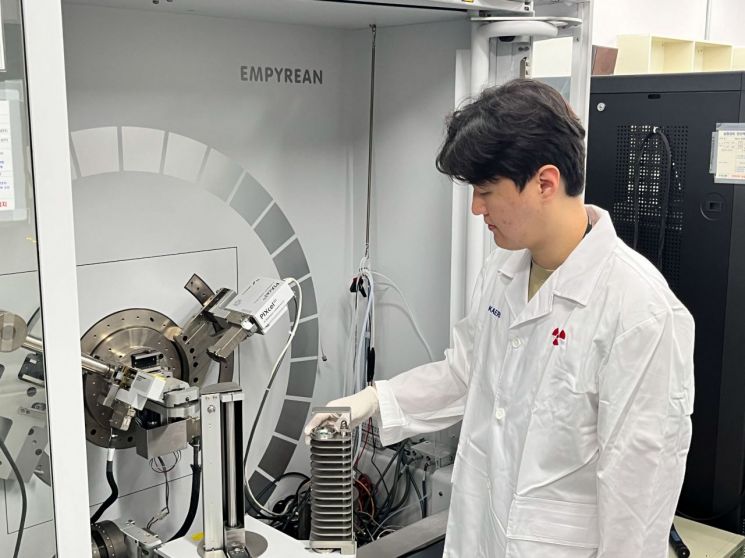 The research team is loading a sample into the X-ray diffraction device to analyze the surface structure of the solid electrolyte. Photo by Korea Atomic Energy Research Institute
All-solid-state batteries consist of a cathode, an anode, and a solid electrolyte through which lithium ions move. They are attracting attention as next-generation batteries because they use a solid electrolyte instead of a liquid, ensuring safety.
However, if the crystal structure on the surface of the solid electrolyte changes, uneven current flows at the interface between the cathode and the solid electrolyte, causing an electrical short circuit due to overcurrent, which remains a challenge to solve.
It has been presumed that the crystal structure of the solid electrolyte changes depending on the amount of lithium and the degree of polishing on the electrolyte surface, but the correlation between these two causes and methods for improvement have not been proposed until now.
Accordingly, to identify the exact cause of changes in the electrolyte’s crystal structure, the research team quantified the amount of lithium inside the solid electrolyte crystal structure using neutron beams and the degree of crystal structure change on the solid electrolyte surface due to polishing using X-rays.
As a result, the research team explained that they confirmed a phenomenon where part of the crystal structure on the surface of the solid electrolyte changes from a cubic (cubic system) to a rectangular parallelepiped (tetragonal system) structure depending on the amount of lithium used in synthesizing the solid electrolyte and the degree of polishing. This is the world’s first case of identifying comprehensive conditions that cause crystal structure changes through controlling complex variables.
In particular, the research team confirmed that in the case of solid electrolytes whose crystal structure changed to a rectangular parallelepiped, ion conductivity is low, increasing resistance with the anode and cathode, hindering the smooth movement of lithium ions, and causing electrical short circuits. They developed an improved process to prevent electrical short circuits during the solid electrolyte manufacturing stage.
This result was obtained by confirming that drastically lowering the rotation speed of the abrasive during the polishing process of the electrolyte surface stably controls the crystal structure, preventing abnormal changes.
Dr. Kim said, “The research team’s results are significant in that they identified the cause of short circuits in all-solid-state batteries and proposed technology to control it, thereby establishing a kind of guideline for preventing battery fires and explosions.”
Meanwhile, this research was conducted with support from the Ministry of Science and ICT’s Science and Technology Commercialization Promotion Agency’s pilot project for establishing an academic-industry cooperation platform. The research paper was published online last month in the materials science journal Advanced Energy Materials.
© The Asia Business Daily(www.asiae.co.kr). All rights reserved.
![Clutching a Stolen Dior Bag, Saying "I Hate Being Poor but Real"... The Grotesque Con of a "Human Knockoff" [Slate]](https://cwcontent.asiae.co.kr/asiaresize/183/2026021902243444107_1771435474.jpg)
















