An analysis has revealed that the distribution of disaster relief funds during the COVID-19 pandemic had a positive impact on revitalizing the local economy.
On the 16th, KAIST announced that a research team led by Professor Kim Ji-hee from the Department of Technology Management at the College of Business analyzed the effects of COVID-19 disaster relief fund distribution and found that the increase in sales of small business owners was greater than the amount of relief funds distributed.
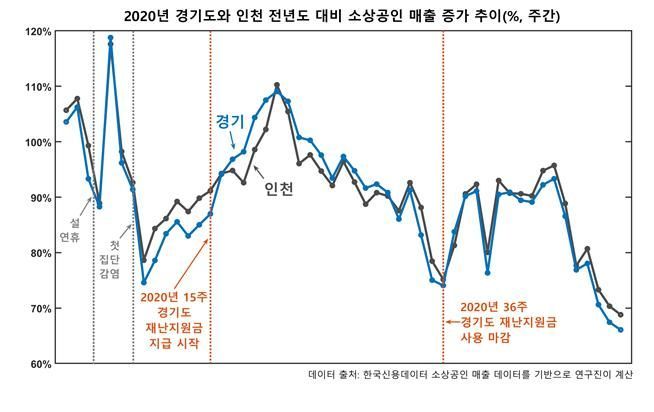 Analysis of Sales Changes of Small Business Owners in Gyeonggi-do and Incheon Regions in 2020 (Year-on-Year). Provided by KAIST
The research team conducted the study based on the fact that Gyeonggi Province and Incheon implemented different policies during the pandemic.
Starting from April 2020, early in the COVID-19 outbreak, Gyeonggi Province distributed disaster relief funds to all residents. However, the distributed funds were restricted to be used only at local small business stores. In contrast, Incheon did not distribute disaster relief funds during the same period.
Based on this, when analyzing the effects of the disaster relief fund distribution, small business sales in Gyeonggi Province increased by approximately 4.5% over five weeks following the distribution.
Notably, the total increase in sales by small business owners during this period was confirmed to be 1.09 times the budget allocated for the disaster relief funds. This means that the actual amount spent by local residents exceeded the amount provided as relief funds.
The research team also analyzed whether the disaster relief funds led to increased sales for small business owners in Gyeonggi Province by utilizing sales data from small businesses in both Gyeonggi Province and Incheon.
As a result, small business sales in Gyeonggi Province increased by 4.5% more than in Incheon during the five weeks after the relief funds were distributed, and the impact gradually decreased as the consumption deadline for the relief funds approached. This indicates that the disaster relief funds stimulated short-term consumer spending but that the effect did not persist.
However, at the end of the relief fund usage period, the total increase in small business sales in Gyeonggi Province was found to be 9% higher than the budget allocated for the disaster relief funds, leading the research team to evaluate that the disaster relief fund policy made a tangible contribution to revitalizing the local economy.
Above all, the effect of the disaster relief fund distribution on economic revitalization in Gyeonggi Province was analyzed to be consistent across regions regardless of differences in income levels and purchasing power within the province.
Professor Kim stated, “Unlike countries such as the United States and Singapore, which distributed disaster relief funds in cash, Korea restricted the use of relief funds to small business establishments, which is analyzed to have had a positive impact on both household finances and the local economy.”
© The Asia Business Daily(www.asiae.co.kr). All rights reserved.
![Clutching a Stolen Dior Bag, Saying "I Hate Being Poor but Real"... The Grotesque Con of a "Human Knockoff" [Slate]](https://cwcontent.asiae.co.kr/asiaresize/183/2026021902243444107_1771435474.jpg)











