As the COFIX rate turned upward after four months, mortgage loan interest rates at commercial banks also rose one after another. To control the increase in household loans, banks raised loan spread rates, and with the COFIX rate also turning upward, some banks saw mortgage loan interest rates approaching 7% per annum at the upper end.
The Korea Federation of Banks announced on the 15th that the COFIX rate based on new contracts in September was 3.40%, up 0.04 percentage points from the previous month (3.36%). The COFIX based on new contracts had fallen for three consecutive months since June but rebounded after four months.
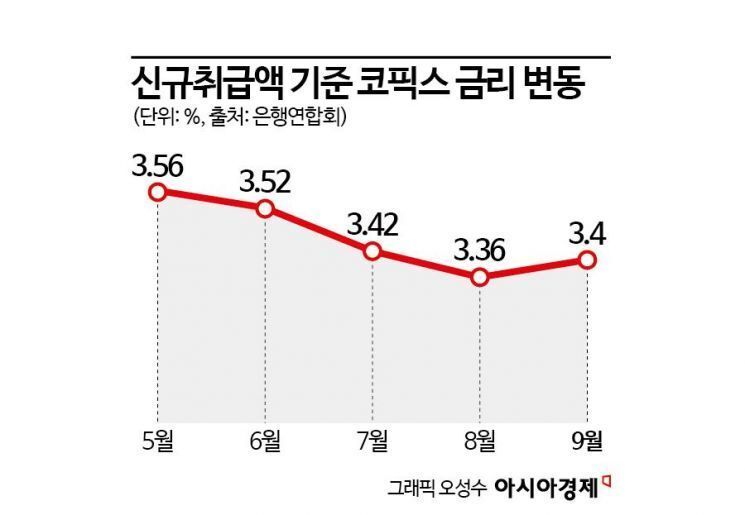
COFIX is the weighted average interest rate of funds raised by eight major banks (KB Kookmin, Shinhan, Hana, Woori, NH Nonghyup, SC First, Industrial Bank of Korea, and Citibank Korea). It reflects changes in interest rates of deposit products such as actual deposits, savings, and bank bonds handled by banks. When COFIX falls, it means banks can secure funds by paying less interest, and when COFIX rises, the opposite is true.
The reason for the COFIX rate turning upward after four months is interpreted as a slight increase in deposit interest rates in September. With the expectation that deposit interest rates are at their peak, funds flowed into deposits, increasing time deposits this year. Banks, which raised loan interest rates due to strengthened household loan regulations, also raised deposit interest rates considering the interest rate spread between deposits and loans, which seems to have influenced the COFIX rate's upward turn.
Accordingly, from the 16th, variable interest rates on mortgage loans at commercial banks will also rise one after another. Since COFIX based on new contracts is calculated on newly raised funds during the month, changes in market interest rates are immediately reflected.
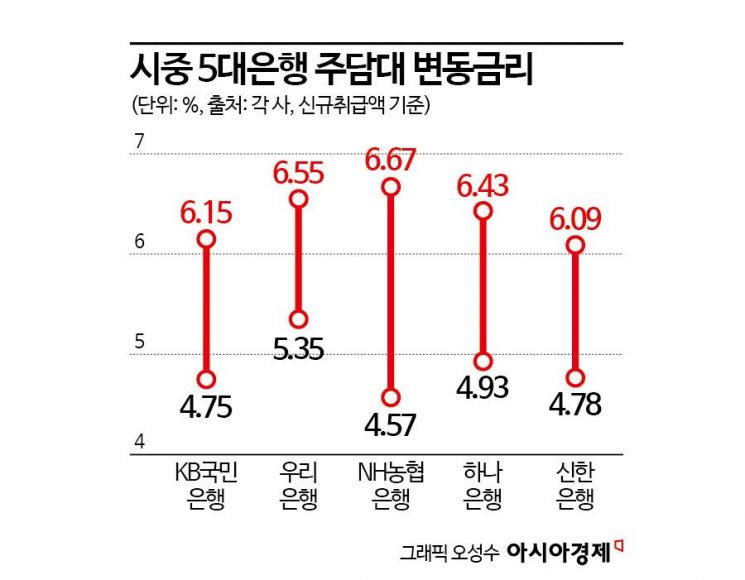
On that day, KB Kookmin Bank's variable mortgage loan interest rate linked to COFIX based on new contracts rose by 0.04 percentage points at both the upper and lower ends, from 4.71?6.11% to 4.75?6.15%. Woori Bank's rate is 5.35?6.55%, and NH Nonghyup Bank's is 4.57?6.67%. Shinhan Bank and Hana Bank, which calculate mortgage loan interest rates based on corporate bonds rather than COFIX, are expected to reflect the increase with a time lag.
A representative from a commercial bank said, "Although the Bank of Korea cut the base rate by 0.25 percentage points on the 11th, the expectation of a base rate cut had already been priced in, and it will take time for the actual market interest rates to be felt." He added, "The key is whether household debt is controlled, and since management is aligned with target levels, a decline in loan interest rates seems difficult."
Gong Dong-rak, a researcher at Daishin Securities, evaluated, "Expectations for a base rate cut were already reflected earlier, and there are no factors for market interest rates to fall further."
© The Asia Business Daily(www.asiae.co.kr). All rights reserved.
![Clutching a Stolen Dior Bag, Saying "I Hate Being Poor but Real"... The Grotesque Con of a "Human Knockoff" [Slate]](https://cwcontent.asiae.co.kr/asiaresize/183/2026021902243444107_1771435474.jpg)


















